— ideapeel Blog




Search is changing. More people now ask ChatGPT, Perplexity, Gemini, or Google's AI Overviews a question instead of typing keywords into a search box. If your website isn't easy for these AI systems to read, you become invisible in that conversation, even if your content is great.
This guide explains, in plain words, what makes a website "LLM-friendly," and gives you a clear, honest framework to follow. We'll also flag where common advice online overstates what actually helps, based on what Google and OpenAI have publicly confirmed.
If you want a hand implementing any of this, ideapeel's web development team builds sites with this exact architecture in mind.
What Is an LLM-Friendly Website?
An LLM-friendly website is one where crawlers and AI retrieval systems can easily reach, read, and understand your important content, and where that content is written clearly enough to be pulled into an AI-generated answer.
It's not one trick. It's a chain of small things working together: a crawler must be able to reach the page, get the real content (not a blank JavaScript shell), understand what each part means, and trust it enough to quote it.
How Do AI Search Systems Actually Read a Website?
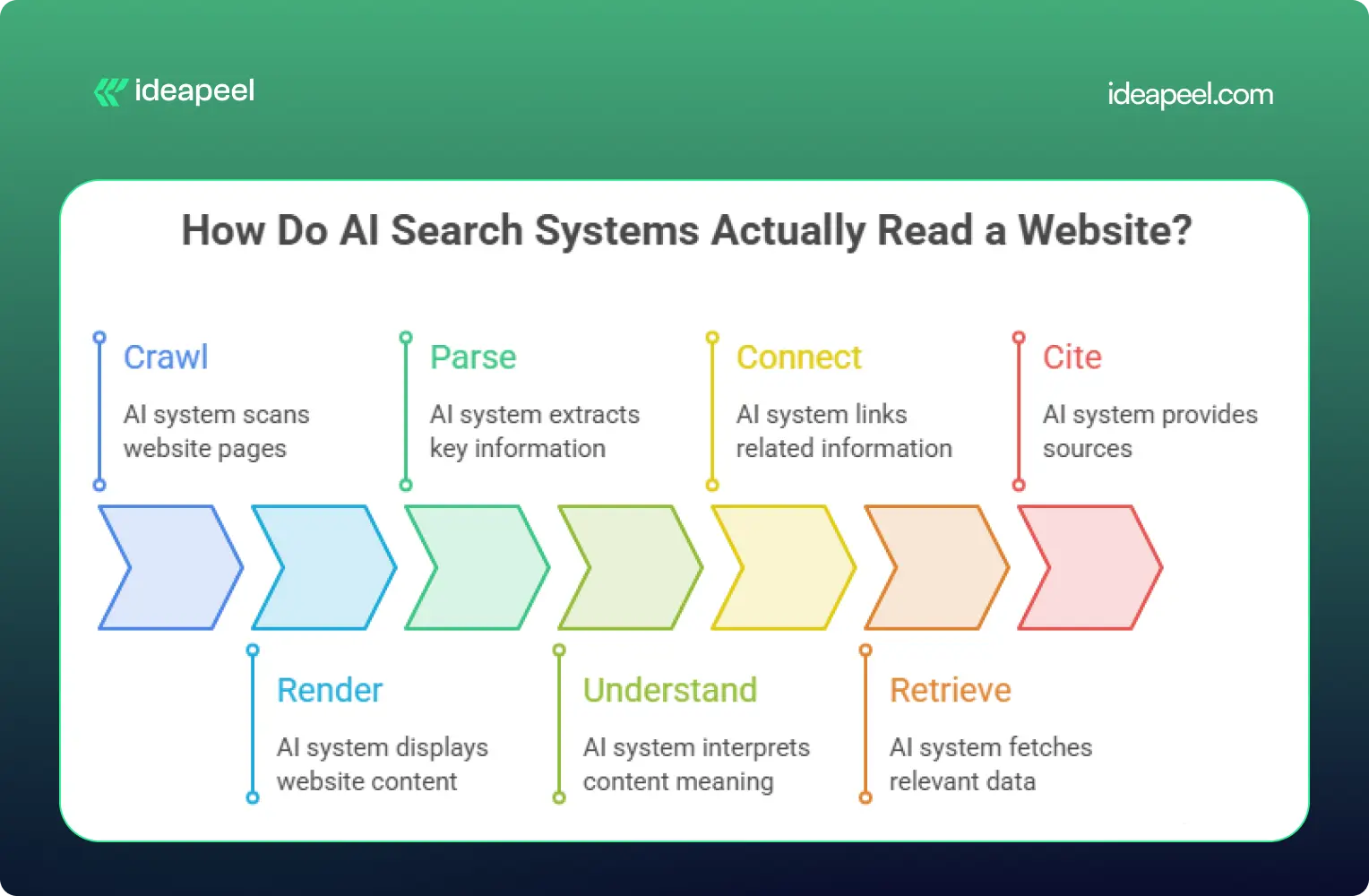
Most AI systems follow a simple path: crawl → render → parse → understand → connect → retrieve → cite.
- Crawl: the bot requests your page.
- Render: it tries to get the actual content (many AI bots skip JavaScript entirely).
- Parse: it reads the HTML structure to find headings, lists, and text.
- Understand: it works out what each section means.
- Connect: it links your content to entities and concepts it already knows.
- Retrieve: it pulls the relevant passage when someone asks a related question.
- Cite: it quotes or references your page in its answer.
Most articles online only talk about step 3 (structure). The real opportunity is making sure your site works at every step in this chain. That's the core idea behind ideapeel's GEO strategy work.
Does Semantic HTML Help AI Search?
Semantic HTML helps AI systems understand your content faster and more accurately, but it is not a confirmed ranking factor on its own.
Google has stated there are no special technical requirements beyond normal indexing and Search eligibility for a page to appear in AI Overviews or AI Mode. Semantic HTML is recommended mainly because it improves accessibility and human readability, and that clarity happens to help machines too.
So use semantic HTML because it's good practice, not because it's a magic switch.
A weak example:
<div class="title">What Is GEO?</div>
<div class="text">GEO means optimizing content for AI search...</div>
A strong example:
<article>
<header>
<h1>What Is Generative Engine Optimization?</h1>
</header>
<section>
<h2>What Is GEO?</h2>
<p>GEO is the practice of structuring content so AI search tools can find, understand, and cite it.</p>
</section>
</article>
The second version tells a crawler exactly what's a heading, what's an article, and what's a self-contained section.
Semantic HTML Elements Every Site Should Use
Keep headings in logical order (H1 → H2 → H3). Skipping levels or using headings purely for visual styling confuses both AI parsers and screen readers.
How Clean Code Improves AI Accessibility
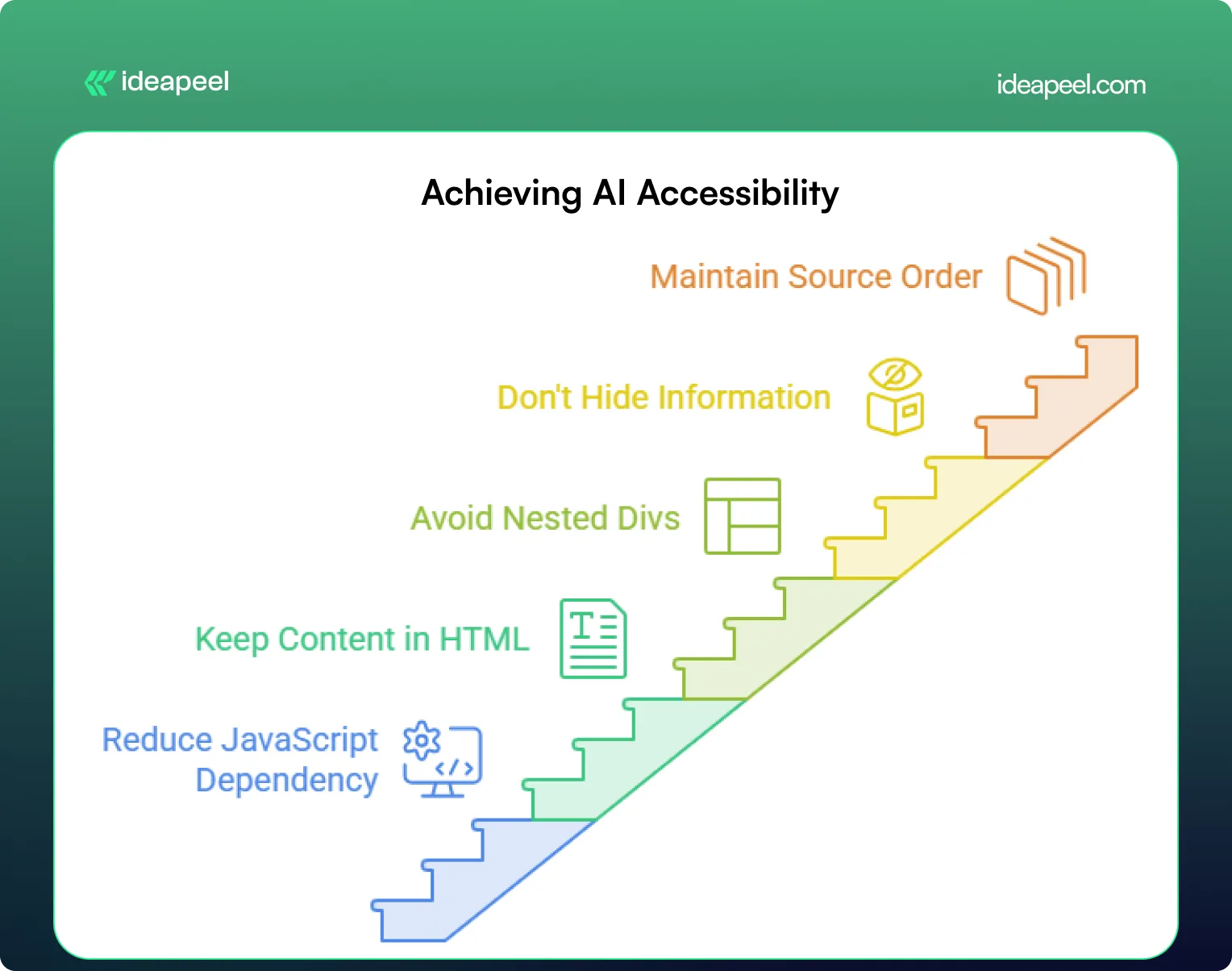
"Clean code helps AI" is vague advice. Here's what it actually means in practice:
- Reduce JavaScript dependency. Many AI crawlers don't execute JavaScript at all. If your key content only appears after a script runs, it may be invisible to them. Server-side rendering (SSR) or static generation puts real content directly in the HTML.
- Keep primary content in the HTML source. Your headline, intro, headings, and body text should be visible without any interaction.
- Avoid deeply nested <div> soup. Flat, logical markup is easier to parse and easier for your own team to maintain.
- Don't hide key information behind tabs or accordions unless there's a real usability reason; crawlers usually won't click.
- Maintain a sensible source order. The HTML should read logically top to bottom, even before CSS repositions anything visually. MDN's accessibility guidelines cover this well.
A simple test: turn off JavaScript in your browser and reload your most important page. Whatever's still visible is roughly what many AI crawlers see.
[[inner-cta]]
How to Structure Content for LLM Retrieval
AI systems tend to pull short, self-contained passages rather than reading an entire page in context. Structure your content so each section can stand on its own.
- Answer first. Put the direct answer to the heading's question in the first sentence or two, then explain further.
- One idea per paragraph. Keep paragraphs short, two to four sentences.
- Define terms as you use them. Don't assume the reader (or the AI) already knows what a term means.
- Use tables for comparisons. Tables are easy for AI systems to extract and quote cleanly.
- Add FAQs and summaries. These are naturally structured for extraction.
Build an Entity-First Content Architecture
Beyond individual pages, AI systems build an internal map of how topics and organizations relate to each other. Writing clearly about these relationships helps.
Weaker: "ideapeel builds websites. It also does Webflow work. The company works with SaaS brands."
Stronger: "ideapeel is a Webflow development agency that designs and builds websites for B2B SaaS companies."
The second sentence makes the relationships explicit:
- ideapeel → is a → Webflow agency
- ideapeel → serves → B2B SaaS companies
Apply the same idea to your whole site by grouping related content into a clear cluster, connected with internal links:
- Pillar page: What Is GEO?
- Supporting page: GEO vs SEO
- Supporting page: AI-Readable Website Checklist
- Commercial page: Webflow Development Services
Linking a pillar page to its subtopics, and back again, gives both readers and AI systems a clear map of how your content connects.
Technical SEO Requirements for AI Search
Does Google require special HTML for AI search? No. Google has confirmed there are no additional technical requirements for appearing in AI Overviews or AI Mode beyond meeting normal Search requirements and being eligible for a standard snippet.
That means the basics still matter most:
- Crawlability: nothing important is blocked in robots.txt
- Indexability: pages aren't accidentally set to noindex
- A clean XML sitemap: listing only real, indexable pages
- Canonical tags: one clear version per piece of content
- Fast load times: a slow, heavy page can fail before it's even read
Does Schema Markup Help AI Search?
Schema markup helps search engines and AI systems understand what your page is about and can make it eligible for rich results, but it doesn't guarantee an AI citation on its own.
Add schema where it genuinely matches your visible content:
- Article or BlogPosting for guides and posts
- Organization for your homepage
- FAQPage for pages with real Q&A content
- BreadcrumbList for site navigation
- Product or Service for commercial pages
Test your markup with Google's Rich Results Test before publishing.
Does llms.txt Improve AI Visibility?
This is one of the most debated points in AI search advice right now, and it deserves an honest answer instead of a confident one.
llms.txt is a proposed (not official) plain-text file placed at your site's root that summarizes your most important pages for AI systems, similar in spirit to a sitemap. Google has stated plainly that it does not require llms.txt and that Google Search ignores it for generative AI features. Independent log analysis from several agencies has also found little to no crawl activity from major AI bots on llms.txt files specifically.
The honest takeaway: llms.txt is low-effort and probably harmless to add, but it should never replace real technical SEO and content structure. Treat it as a small experiment, not a strategy.
How to Make Your Site Accessible to ChatGPT Search
OpenAI has said that sites that want their content discoverable and cited in ChatGPT Search should avoid blocking its search-related crawler in robots.txt. If you want visibility there, check that:
- OAI-SearchBot isn't blocked
- Your key pages return real HTML content on first load (not just after JavaScript runs)
- Internal links use standard <a href> tags, not JavaScript-only navigation
LLM-Friendly Website: Before and After
Before: Content loads via a JavaScript framework after the initial page request. Headings are styled <div> tags. Key answers are buried in paragraph eight. No internal links connect related topics.
After: Content is server-rendered and present in the raw HTML. Headings use proper <h1>–<h3> tags in order. Each section opens with a direct answer. Related pages link to each other with descriptive anchor text, not "click here."
The difference isn't a redesign; it's making sure the right things are already true in your source code.
[[question-block]]
Beyond the Basics: What Actually Builds Trust for AI Citation
Most guides stop at structure and code. But structure only gets you understood; it doesn't get you trusted. Two things matter more than most checklists admit:
- Third-party corroboration. AI systems tend to weigh independent sources (reviews, comparison articles, forum discussions, Wikipedia) more heavily than a company's own claims about itself. Being mentioned accurately elsewhere on the web matters as much as your own pages.
- Original data. A specific, original stat or finding is far more likely to be quoted than recycled general advice, simply because no one else has it.
If citation share matters to your business, these two levers are worth as much attention as the technical checklist.
LLM-Friendly Website Audit Checklist
- [ ] Key content is visible in raw HTML (test with JavaScript disabled)
- [ ] Headings follow a logical H1–H4 order
- [ ] Each section opens with a direct answer
- [ ] Important pages are within 3 clicks of the homepage
- [ ] Internal links use descriptive anchor text
- [ ] Robots.txt doesn't accidentally block useful AI bots
- [ ] XML sitemap is accurate and up to date
- [ ] Canonical tags are set correctly
- [ ] Relevant schema markup is added and validated
- [ ] Site loads quickly with minimal render-blocking scripts
Make Your Website Ready for AI Search With ideapeel
Building an LLM-friendly website is no longer just about making a page accessible to search engines. As AI changes how people discover businesses, your website needs a strong technical and content foundation that helps both traditional search and AI systems understand what you offer.
That starts with clean HTML, logical semantic HTML, and a clear content structure. Proper H1 and H2 headings, descriptive URLs, accurate metadata, accessible navigation, and relevant structured data markup help crawlers understand how your pages are organized. At the same time, important content should not depend entirely on JavaScript, CSS, or complex framework behavior that can make it harder for a crawler to access and parse.
But technical optimization is only one piece of the process.
Connect SEO, AEO, GEO, and LLM Optimization
An AI-ready website brings multiple disciplines together. SEO helps search engines discover and index your pages. Semantic HTML and accessibility make the information easier to interpret. Structured data gives additional context about your content. And LLM optimization focuses on making your information clear enough for AI systems to understand, retrieve, and potentially reference.
This requires a consistent workflow across your website:
Crawl → Parse → Understand → Connect → Retrieve → Answer
Your HTML structure, content architecture, internal links, metadata, APIs, and CMS should all support that workflow.
For businesses building on Webflow, this is where a technically strong development partner can make a difference.
How ideapeel Builds AI-Ready Websites
ideapeel combines web development, SEO, content architecture, and AI-search thinking to help SaaS and technology companies build websites that are designed for both people and machines.
Our approach can include:
- Semantic HTML and accessible website structures
- SEO-friendly headings, metadata, and URLs
- Clean Webflow development and CMS architecture
- LLM-friendly content and page structures
- Structured data and relevant schema markup
- Technical SEO and indexing best practices
- Internal linking and topic-cluster architecture
- Content structures designed for AI search and answer engines
- Performance-focused development with unnecessary JavaScript dependencies reduced where appropriate
If you're building a new website, redesigning an existing one, or trying to improve your AI search visibility, these elements should be considered from the beginning rather than added after development.
Explore ideapeel's Web Development Services to see how we approach modern website architecture, or learn more about GEO for AI search and Webflow development.
Your Website Should Be Easy for AI to Understand
The future of search is not only about ranking a URL. It is increasingly about whether your website can be found, understood, connected, and referenced when someone asks an AI system a question.
You do not need to rebuild everything around AI or add every new technology. Start with the fundamentals: clean HTML, semantic structure, accessible content, logical headings, strong SEO, reliable indexing, useful structured data, and a content architecture that clearly communicates what your business does.
Then build on that foundation with AEO and GEO.
If your website is difficult for a crawler to access, difficult for a search engine to index, or difficult for an LLM to parse and understand, great content may never reach the people searching for it.
ideapeel helps SaaS and technology brands turn their websites into clearer, faster, search-ready digital experiences built for the next generation of AI-powered search.
Ready to make your website AI-ready? Talk to the ideapeel team for an AI search, SEO, and website architecture assessment.
[[last-cta]]
%20for%20B2B%20SaaS_%20How%20to%20Get%20Cited%20in%20AI%20Search.webp)
More B2B buyers are starting their research in ChatGPT, Perplexity, and Google AI Overviews before they ever open a search results page. If your SaaS company isn't structured for those systems to find, understand, and cite it, you're invisible at the exact moment someone is deciding who to shortlist.
This guide breaks down what Generative Engine Optimization actually means for a B2B SaaS company, how it's different from (and connected to) SEO and AEO, and what to change on your website so AI systems can accurately represent your product - and hopefully recommend it.
Quick answer
Generative Engine Optimization (GEO) for B2B SaaS is the practice of structuring your website, content, and external presence so AI systems like ChatGPT, Perplexity, and Google AI Overviews can understand what your product does, who it's for, and why it's credible enough to cite. It builds on SEO fundamentals but adds a heavier emphasis on entity clarity, evidence, and machine-readable structure.
Key takeaways
- GEO isn't a replacement for SEO - it's what happens when SEO, entity clarity, and evidence-backed content work together for AI systems instead of just search rankings.
- AI search engines don't rank pages the way Google does. They gather evidence, compare it, and decide what's worth citing. That changes what "good content" looks like.
- Comparison pages, case studies, and author pages carry more weight in GEO than in traditional SEO, because they give AI systems something concrete to evaluate.
- No platform - not ChatGPT, not Perplexity, not Google - guarantees citations. The realistic goal is improving your eligibility and likelihood of being cited, not forcing a result.
- Webflow now ships native AEO tooling (Enterprise tier) and an MCP server (available on every plan, including the free tier) that both play into a GEO strategy in different ways.
What is Generative Engine Optimization for B2B SaaS?
.webp)
Traditional SEO helps your SaaS website compete for rankings on a results page. GEO helps make your company easier for AI systems to understand, evaluate, and potentially cite when someone asks for a recommendation.
The difference matters because the underlying task is different. A search engine matches a query to a set of pages and ranks them. A generative engine has to do more work: it interprets what the user actually needs, pulls together information from multiple sources, compares options, and produces an answer - with citations attached, if it's confident enough in what it found.
Take a query like "best Webflow development agencies for a B2B SaaS company." To answer that well, an AI system has to:
- Understand what the user actually needs (not just match keywords)
- Identify companies that plausibly fit
- Compare them against each other
- Evaluate the evidence available for each one
- Decide which sources are trustworthy enough to cite
- Generate a recommendation
- Attribute it to specific pages
Every one of those seven steps is a place where a well-structured SaaS website has an advantage over a vague one - and where GEO work actually pays off.
[[inner-cta]]
GEO vs. SEO vs. AEO vs. LLM optimization
These terms get used interchangeably a lot, which causes confusion. They're related, not identical, and none of them replaces the others.
A strong SEO foundation feeds AEO, which feeds GEO, which feeds how well LLMs represent your brand when someone asks about you in a completely different context. Treat them as layers on the same foundation, not four separate strategies competing for budget.
Why GEO matters for B2B SaaS specifically
B2B SaaS buying decisions involve research, comparison, and validation - which happens to be exactly the kind of query AI search engines are built to answer. Someone evaluating a new tool isn't typing one search and clicking the top result. They're asking follow-up questions, comparing named competitors, and asking an AI system to summarize the trade-offs.
If your product only exists as marketing copy with no comparison content, no evidence, and no clear entity definition, an AI system has very little to work with. It'll either skip you or, worse, describe you inaccurately based on scraps of information from third-party sites you don't control.
The 6E framework for GEO readiness
.webp)
Most GEO advice stops at "write good content." That's not specific enough to act on. Here's a framework built around what AI systems actually need to extract and trust information about a B2B SaaS company.
Entity - Clearly identify the company, the product, the people behind it, and the concepts it's associated with. An AI system needs to know what category you belong to before it can decide whether you're relevant to a query.
Explanation - State plainly what the company does. Not "we help companies grow," but a specific, checkable description of the product, who it serves, and the problem it solves.
Evidence - Back up claims with something concrete: numbers, named clients, measurable outcomes, third-party validation. Claims without evidence are easy for an AI system to ignore.
Experience - Show first-hand knowledge. Case studies, original research, documented projects. This is what separates a company that clearly does the work from one that's just describing a service category.
Ecosystem - Connect your company to the broader landscape: technologies, industries, partners, and related concepts. Isolated pages read as thin. Pages embedded in a network of related content read as authoritative.
Extraction - Structure content so a specific, useful answer can be pulled out cleanly. Clear headers, direct answers near the top, tables where comparison is the point.
Put together: GEO readiness = Entity + Explanation + Evidence + Experience + Ecosystem + Extraction.
How to structure a B2B SaaS website for GEO
.webp)
Generic advice to "create quality content" doesn't tell you what to build. Here's the actual architecture.
Homepage - Company description, core value proposition, primary services, target customers, industry expertise, differentiators, and proof (logos, numbers, testimonials).
Service or product pages - What it is, who it's for, the problem it solves, the process, deliverables, pricing context where it makes sense, FAQs, related case studies.
Case studies - Client, industry, the specific problem, the solution, how it was implemented, the results, the technology used, and a timeline. Vague case studies ("we improved their results") give an AI system nothing to cite.
Comparison pages - Product A vs. Product B, honest use cases, real limitations, pricing context, and who each option is actually best for.
Author pages - Name, role, expertise, experience, credentials, publications, and relevant work. This matters more than most companies realize - AI systems weigh author credibility as part of trust signals.
[[question-block]]
How to create content AI search engines can cite
.webp)
AI systems cite specific claims, not vague marketing language. Compare these three versions of the same statement:
Weak: "ideapeel builds high-converting Webflow websites."
Stronger: "ideapeel specializes in Webflow development for SaaS and technology companies, combining UI/UX design, Webflow development, CMS architecture, and SEO."
Evidence-rich: "ideapeel specializes in Webflow development for SaaS and technology companies. Its portfolio includes [named project], where the team handled [specific scope of work] and achieved [a verifiable, specific outcome]."
The third version is the only one an AI system can actually use as a citable claim, because it's specific enough to check.
Why comparison content matters more than you'd think
A large share of AI search queries are inherently comparative: "which is better," "what's the best tool for X," "alternatives to Y," "X vs. Y." That's the natural language version of how B2B buyers actually shop.
That means comparison pages, alternative pages, "best for" pages, and use-case pages carry real weight in a GEO strategy. The catch: thin competitor pages built purely to manipulate rankings don't hold up. Give readers genuine differences, real limitations, honest use cases, and pricing context. AI systems (and skeptical B2B buyers) can tell the difference between an honest comparison and a sales pitch dressed up as one.
.webp)
Optimizing for Perplexity
Perplexity describes itself as a web-first answer engine that provides cited answers, and it weighs site-level trust factors - including whether a site identifies its authors and corrects mistakes - as part of its source evaluation.
Its crawler, PerplexityBot, follows robots.txt directives. Block it, and Perplexity won't index the page's text content, though it may still index the domain, headline, and a brief factual summary pulled from elsewhere.
A practical checklist:
- Confirm robots.txt allows PerplexityBot
- Use clear, specific page titles
- Include visible author information
- Publish original information, not repackaged summaries
- Build external authority and third-party mentions
- Keep content dated and current
Optimizing for ChatGPT Search
OpenAI's current documentation states that public websites can appear in ChatGPT Search and recommends allowing OAI-SearchBot to crawl your content - but it also explicitly says placement isn't guaranteed.
That's the honest framing to use: you can't force ChatGPT to cite your site. You can improve your eligibility and likelihood by making content accessible, relevant, clear, authoritative, and easy to verify.
Optimizing for Google AI Overviews
Google's own guidance for generative AI features is consistent on one point: existing SEO best practices still matter. There's no separate playbook where schema markup alone earns you a spot in an AI Overview.
The formula holds up: a solid SEO foundation, useful content, entity clarity, original information, strong internal linking, structured data, and authority combine into AI-search readiness. Schema markup helps, but it's a supporting signal, not a shortcut.
How LLMs understand your brand
Entity clarity is the single biggest lever here. Compare:
"We help companies grow." - An LLM has almost nothing to work with. No category, no audience, no service.
"ideapeel is a Webflow development and digital design agency that helps SaaS and technology companies build, redesign, and optimize marketing websites." - Entity, category, audience, and service, all in one sentence.
Keep your core positioning language consistent across the site. If you're a "Webflow development agency," don't randomly switch to "website company," "digital agency," or "design studio" in different places. Natural variation is fine; inconsistent core positioning confuses entity recognition.
Internal linking as GEO architecture
Internal links aren't just for crawl paths anymore - they're how you signal topical relationships to AI systems parsing your site. A logical chain might look like:
Webflow Development → Webflow SaaS Websites → SaaS Website Design → SaaS Conversion Optimization → Webflow SEO → AEO for Webflow → GEO for B2B SaaS → AI Search Optimization
Each link in that chain reinforces what the next page is about, and builds a network an AI system can traverse to understand the full scope of what you do.
External authority matters as much as your own site
Your website shouldn't be the only source an AI system uses to understand your company. Build a broader evidence network: industry publications, LinkedIn, product directories, review platforms, partner sites, interviews, podcasts, guest contributions, and third-party mentions.
Your website is one part of your entity's online evidence - not the whole thing.
Schema and structured data
Structured data helps, but it's a supporting signal rather than the deciding factor. Prioritize:
- Organization and Person schema for entity clarity
- Article and FAQ schema on blog and resource content
- Product or Service schema where applicable
- BreadcrumbList schema to reinforce site structure
Technical GEO checklist
- Site is crawlable by major AI bots (verify robots.txt for GPTBot, PerplexityBot, ClaudeBot, and Google-Extended)
- Fast load times and clean mobile rendering
- Clear, unique page titles and meta descriptions
- Consistent entity naming across every page
- Author bylines with real credentials on published content
- Regularly updated dates on evergreen content
- Comparison, case study, and author pages actually exist (not just service pages)
GEO for B2B SaaS in Webflow
Webflow has become genuinely relevant to this conversation in 2026, though it's worth being precise about what's available to whom.
Webflow AEO launched in April 2026 as a closed-loop, agent-driven product: it measures AI citation activity, recommends fixes, and helps execute them from inside Webflow. It's a real, useful product - but it currently sits on the Enterprise tier as part of the Analyze add-on, so it isn't something every SaaS company on Webflow has access to out of the box.
Webflow MCP, on the other hand, is available on every Site plan, including the free Starter tier. It's an open-source (MIT-licensed) server that connects AI tools like Claude, Cursor, and ChatGPT directly to your Webflow site, letting you manage CMS collections, pages, and content through natural language instead of manual work in the Designer.
It's worth keeping these two straight: GEO is about optimizing your website so AI systems can discover and cite it. Webflow MCP is about letting AI tools help you build and maintain that website. They support the same goal from different directions, and the MCP server in particular is a practical entry point for smaller SaaS teams who won't have Enterprise-tier AEO access.
A GEO-ready CMS structure in Webflow typically includes:
- Services - name, description, target audience, benefits, process, related case studies
- Case studies - client, industry, challenge, solution, results, technology, related services
- Authors - name, role, expertise, bio, experience
- Industries - industry, problems, solutions, related services and case studies
- Blog - primary topic, search intent, a short direct answer near the top, full content, author, sources, related articles, updated date
Structured this way, the website functions less like a marketing brochure and more like a queryable information system - which is exactly what AI search engines are built to work with.
How to measure GEO performance
There's no single dashboard that tells you "GEO is working," but a few methods together give a reasonably clear picture:
- Manual prompt testing. Regularly ask ChatGPT, Perplexity, Gemini, and Google AI Overviews the questions your buyers would ask, and track whether and how you're mentioned or cited.
- AI-referral traffic. Check analytics for referral traffic from chat.openai.com, perplexity.ai, and similar sources - a signal that's grown from negligible to meaningful for most B2B sites over the past year.
- Third-party AI visibility tools. Platforms built specifically for tracking brand mentions across AI answers can automate what manual prompt testing does at a small scale.
- Webflow AEO analytics (if you're on Enterprise) - native tracking of citation frequency and the specific prompts triggering them.
- Citation source audits. When you are cited, note which page got cited and why. That tells you what kind of content is actually working, so you can build more of it.
GEO vs. traditional SEO
Common GEO mistakes
- Treating GEO as a checklist of keywords instead of a structural and evidentiary problem
- Publishing thin competitor comparison pages that read as manipulative rather than useful
- Inconsistent entity naming across the site, which confuses how AI systems categorize the brand
- No author information on published content
- Promising or implying guaranteed AI citations to clients or stakeholders
- Skipping case studies and evidence in favor of generic claims
B2B SaaS GEO checklist
- Clarify your brand entity and keep positioning language consistent
- Build out service, case study, comparison, and author pages - not just a homepage and blog
- Publish original evidence: data, named results, real case studies
- Create honest comparison content for your category
- Strengthen internal linking between related topics
- Build external authority through third-party mentions and publications
- Confirm crawlability for AI bots
- Set up a regular process for measuring AI visibility
GEO for B2B SaaS: The Final Step
In 2026, Generative Engine Optimization (GEO) is becoming essential for B2B SaaS brands that want stronger AI search visibility. Unlike traditional SEO, which focuses mainly on ranking and organic search, GEO focuses on helping AI systems, search engines, and large language models understand your brand, content, and expertise.
An effective GEO strategy helps SaaS companies get cited by AI, increase AI visibility, earn more AI citations and brand mentions, and improve their chances of appearing in AI-generated answers across platforms like Perplexity, Gemini, and ChatGPT.
The fundamentals are simple: optimize content, structure content clearly, use structured data, strengthen internal and external authority, support claims with evidence, and make your website accessible to AI crawlers. Google confirms that traditional SEO best practices still support visibility in Google AI Overviews, while platforms such as Perplexity evaluate web content when generating cited answers. Google AI Features guidance, Perplexity crawler documentation
For SaaS companies and B2B brands, GEO is not about manipulating an AI platform. It is about building trustworthy content that AI tools can understand, verify, and confidently reference. Track citation frequency, AI referral traffic, share of voice, AI mentions, and how your brand appears in AI responses across platforms.
Ideapeel can help you build an AI-ready SaaS website through Webflow development, AEO for Webflow, and Webflow SEO for B2B SaaS.
Want to get your B2B SaaS brand cited in AI search? Get an AI Search & GEO Audit →
[[last-cta]]
What Is AEO for Webflow?
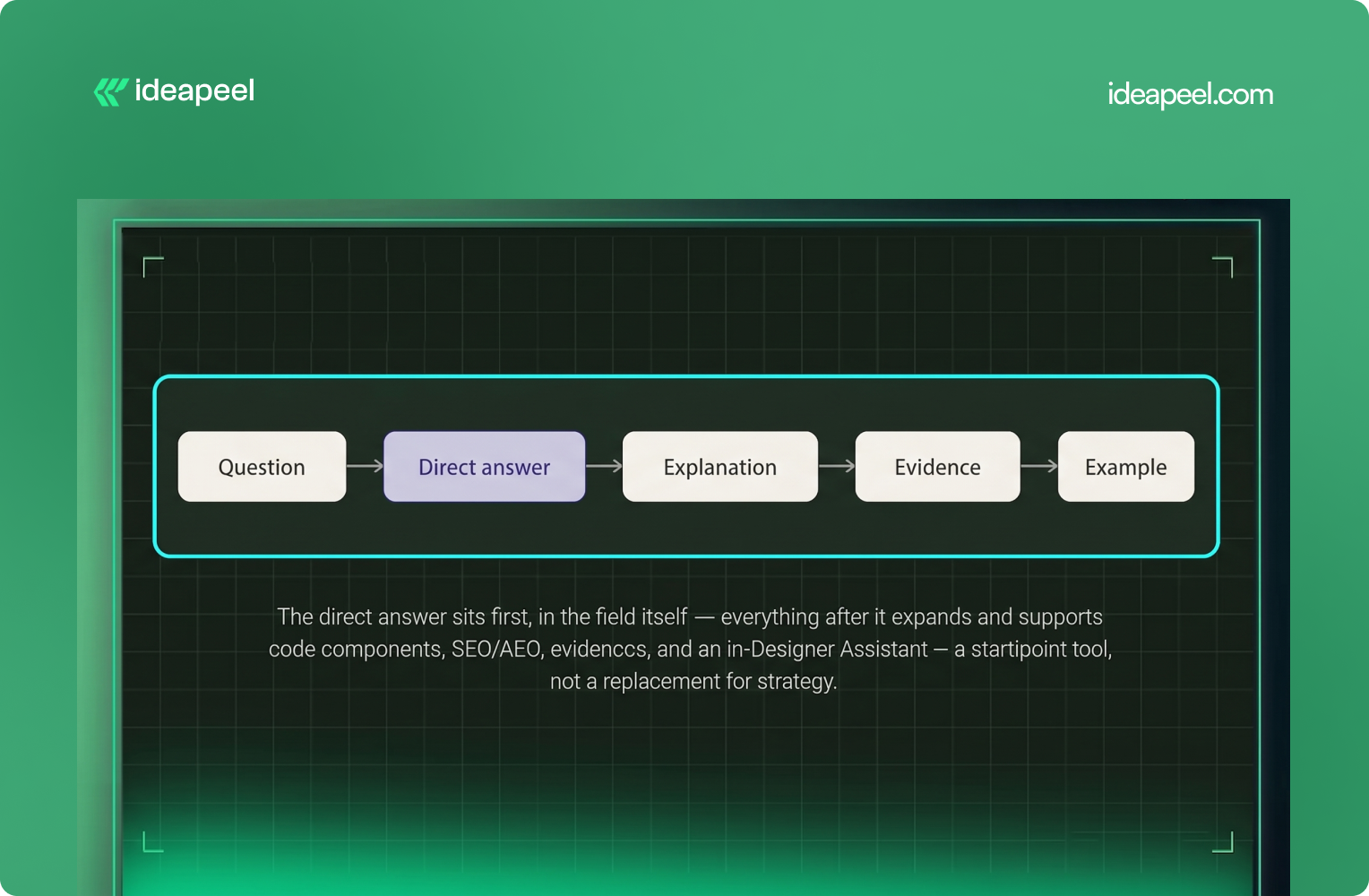
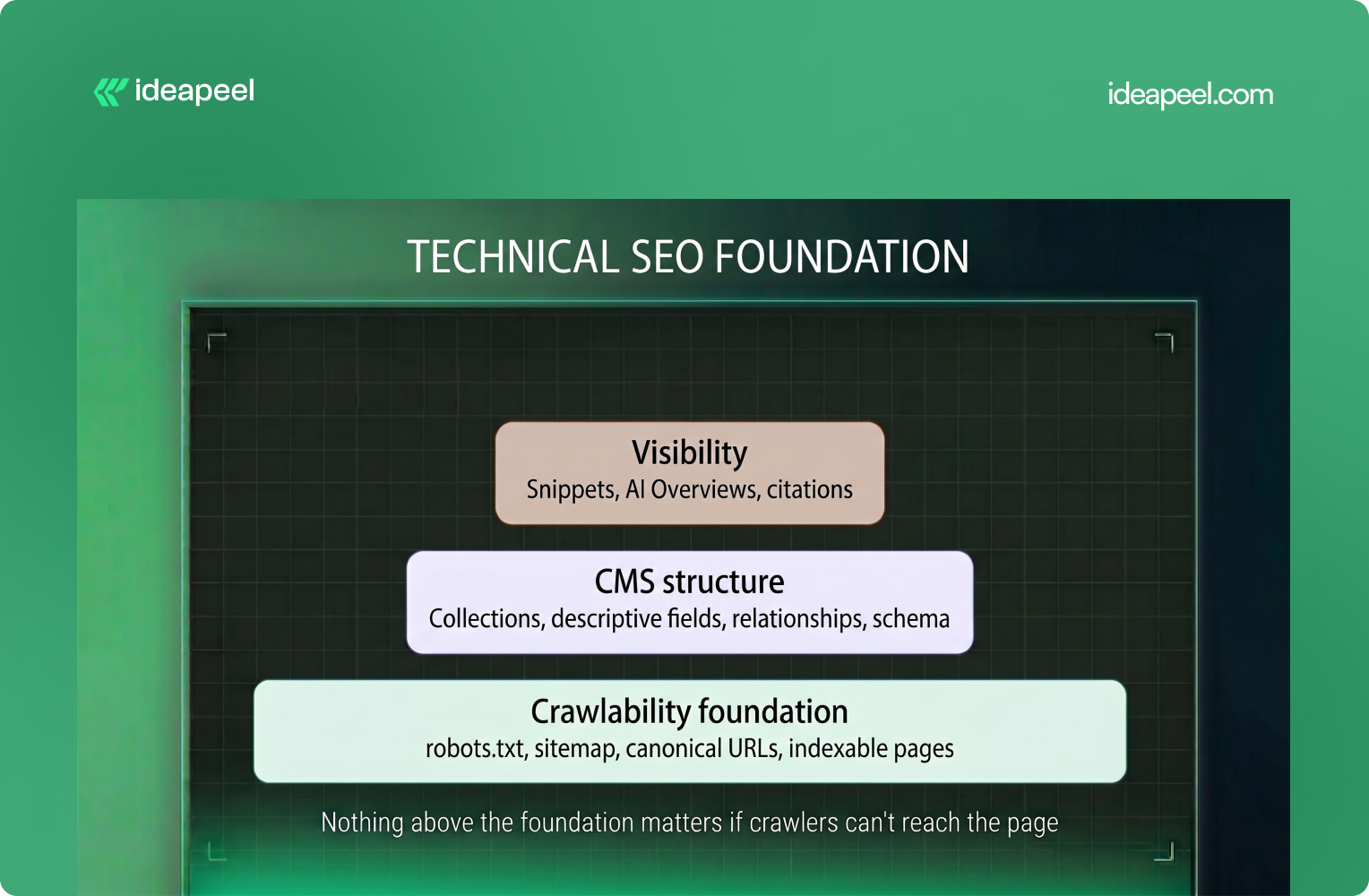
Answer Engine Optimization (AEO) for Webflow means structuring your CMS Collections, fields, and relationships so that search engines and AI systems can identify what your content is about, how it connects to everything else on your site, and which parts of it actually answer a question. Do that well, and you make it more likely to earn featured snippets, appear in AI Overviews, and get referenced by tools like ChatGPT or Perplexity, though none of that is ever guaranteed.
AEO doesn't replace SEO. It builds on the same fundamentals: useful content, crawlability, indexing, clear information architecture, internal linking, and authority. The Webflow-specific opportunity is that your CMS can do far more of this work than most sites let it.
Most "AEO for Webflow" advice stops at the page level: write a direct answer, add an FAQ block, sprinkle in some schema, call it done. That's not wrong; it's just incomplete. It treats each blog post as its own island, when the thing actually deciding whether Google or an AI system can understand your site sits one layer below the page: the CMS itself.
This guide focuses on the part most articles skip, designing the CMS so that structure, not just copy, carries the weight.
Key Takeaways
- Your Webflow CMS is more than a publishing tool; it's the foundation of your content architecture.
- Use descriptive fields (Short Answer, Primary Topic, Author Expertise, Related Questions) instead of generic ones like "Text 1."
- Connect content through Reference and Multi-reference fields wherever the relationship genuinely makes sense.
- Put direct answers near the top of important pages, then expand on them.
- Use schema markup to describe eligible content accurately, not exhaustively.
- Build internal links around topics and entities, not just for link count.
- Keep important pages crawlable, indexable, and consistent across CMS data and structured data.
- Demonstrate real expertise and original sourcing; structure alone doesn't build trust.
- Treat AEO, GEO, LLM optimization, and SEO as overlapping practices, not separate systems.
- Never assume CMS structure, schema, or an llms.txt file guarantees a snippet, AI Overview, or citation. It only improves your odds.
SEO vs. AEO vs. GEO vs. LLM SEO
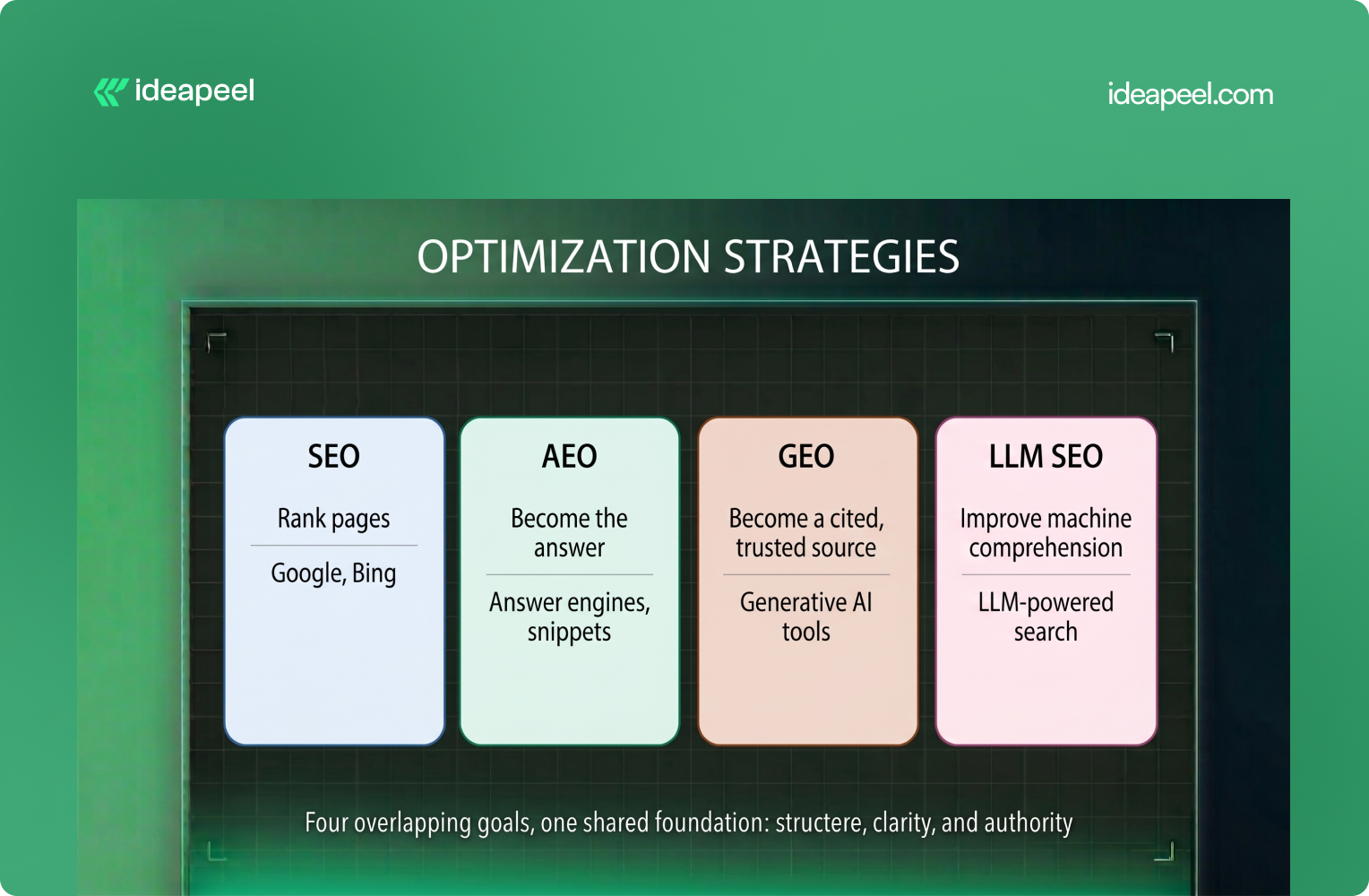
The acronyms are multiplying faster than most teams can track. Here's the short version.
These aren't four competing disciplines. They overlap heavily, and a well-structured Webflow CMS is one of the few assets that genuinely moves the needle on all four at once:
Useful content + clear structure + authority + accessibility + context
The difference is simply how that foundation gets used across different search experiences.
Why CMS Structure Matters More Than You Think
Here's the mental model worth adopting: your CMS shouldn't just store content; it should behave like a structured knowledge system, where every field has a job, and every relationship tells a search engine or AI model something about how your content fits together.
CMS fields → content structure → relationships → context → machine interpretation
Compare two blog post schemas.
Weak CMS setup:
- Title
- Body
- Image
- Author
AEO-structured setup:
- Title
- Short Answer
- Primary Topic
- Search Intent
- Key Takeaways
- Body
- Author + Author Bio
- Category / Topic
- Related Questions
- Related Articles
- Sources
- Updated Date
- SEO Title / Meta Description
- Schema Type
The second version isn't just "more SEO-friendly"; it's a different kind of object. It produces extractable answers, defined entities, and explicit relationships: the three things AI systems look for when deciding whether content is worth citing. That said, more fields don't automatically mean better interpretation; the point isn't field count, it's that your site now carries a clearer underlying information model.
How to Structure a Webflow CMS for AEO
1. Start With Clear Entities, Not Just "Blog Posts"
Think in terms of the real things your content is about: Blog, Author, Category, Topic, Product, Service, Location, Case Study, FAQ. Each deserves its own Collection with its own fields, not a tag buried inside a generic post.
For an agency site, that might look like:
- Service → Webflow Development
- Topic → Webflow SEO
- Author → SEO Specialist
- Case Study → SaaS Website Redesign
Each entity has a distinct purpose, which is far more useful than storing everything in one catch-all Collection.
2. Name Fields for What They Mean, Not What They Are
"Text 1" tells nobody anything, not your team, not a crawler, not an AI model parsing the page's underlying data. Fields like Short Answer, Primary Topic, or Author Expertise do double duty: they keep the CMS easier for humans to manage, and the field name itself acts as a semantic signal for machines.
To be clear: the field name is not itself a ranking factor. What matters is the meaningful information stored inside it; descriptive naming just makes that information easier to maintain consistently.
3. Build Relationships Between Collections
This is where most Webflow sites leave value on the table. A typical setup has fifty isolated blog posts with no formal connective tissue. A structured one looks more like this:
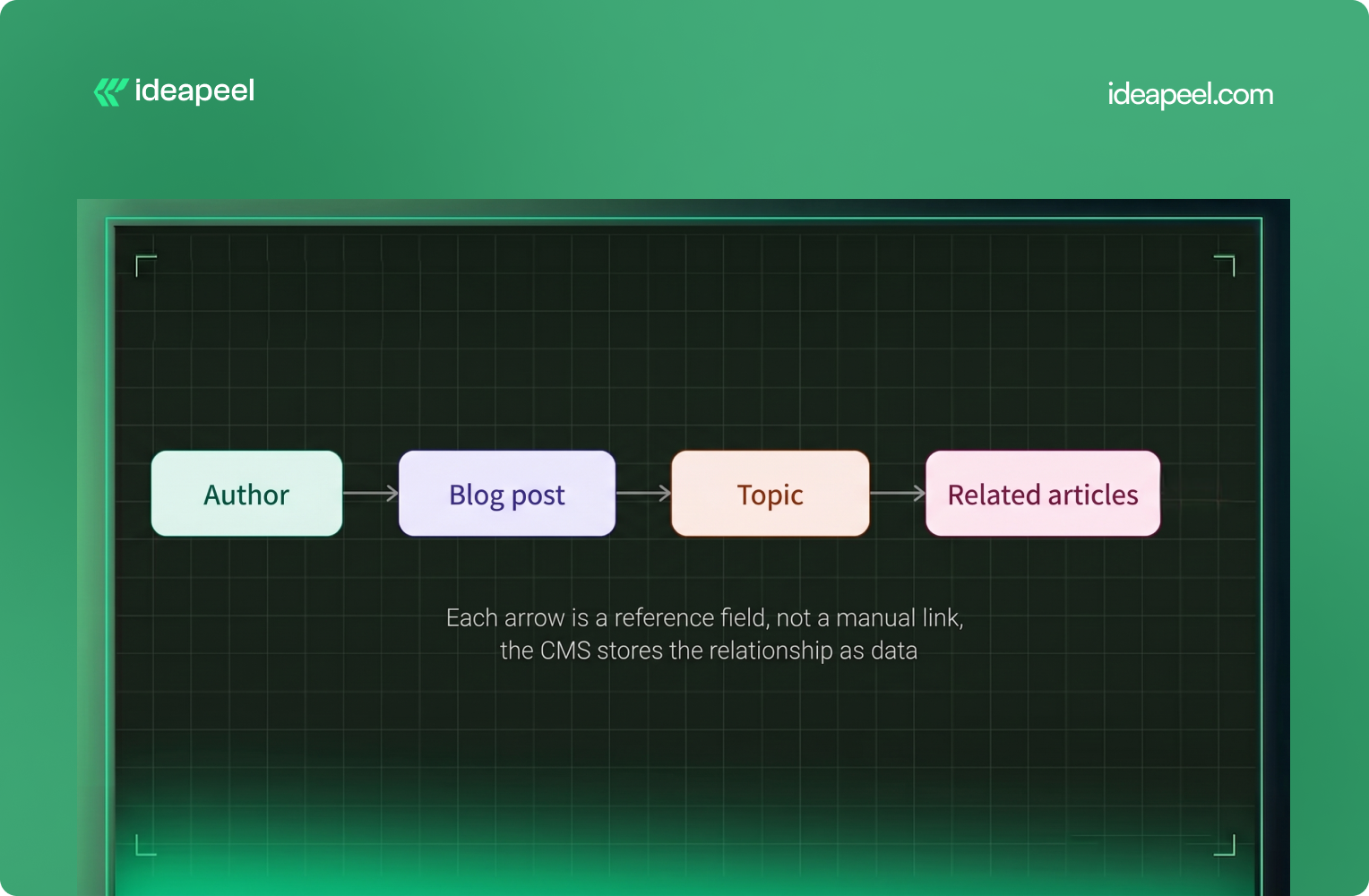
Author → Blog Post → Topic → Related Articles → Product / Service
That's not internal linking for its own sake; it's a content graph. Reference and multi-reference fields let Webflow express "this post belongs to this topic, was written by this author, and relates to these three other posts" as actual data, not just a manually inserted link. Those relationships can also power dynamic related-content sections automatically.
4. Add a Dedicated "Short Answer" Field
This might be the single highest-leverage change you can make. Create a field, literally called Short Answer, that holds a 40–60 word direct response to the implicit question the post is answering. For example:
What is Webflow AEO? Webflow AEO is the practice of structuring and optimizing Webflow content so search engines and AI answer engines can understand, retrieve, and potentially cite it in search results and AI-generated answers.
Let the rest of the article expand on it from there. Traditional blog structure buries the answer 500 words in; AEO structure puts it first and explains afterward, creating a simple, repeatable pattern:
Question → Direct answer → Explanation → Evidence → Example
5. Add Supporting Fields Where They Genuinely Help
Different content types need different fields; you don't need every field on every Collection.
Using Question-Based Headings the Right Way
Question-based headings help only when they match genuine search intent.
Compare:
- "Webflow CMS Structure" (generic)
- "How Should You Structure Webflow CMS Data for AI Search?" (specific, conversational)
The second version tells readers immediately what the section answers. But don't turn every heading into a question; content should read naturally first, and question framing should follow real search intent rather than force it.
Structuring Content for Google Featured Snippets
Structured CMS fields make it far easier to consistently produce the formats Google tends to pull into snippets: direct-answer paragraphs, numbered and bulleted lists, comparison tables, and clear definitions under question-based headings.
For example:
How do you optimize a Webflow site for AEO?
- Structure your CMS around meaningful content entities.
- Add direct-answer fields.
- Use clear, specific headings.
- Connect related content through relationships.
- Add relevant structured data.
- Confirm crawlability and indexing.
- Demonstrate expertise and supporting evidence.
That's easy for a reader to scan and gives search systems cleanly structured information to extract. But one caveat is worth stating plainly: none of this guarantees a snippet. Google decides what gets featured; CMS structure only improves your odds; it doesn't buy a placement. Any AEO advice that promises otherwise is overselling it.
Schema Markup With Webflow CMS
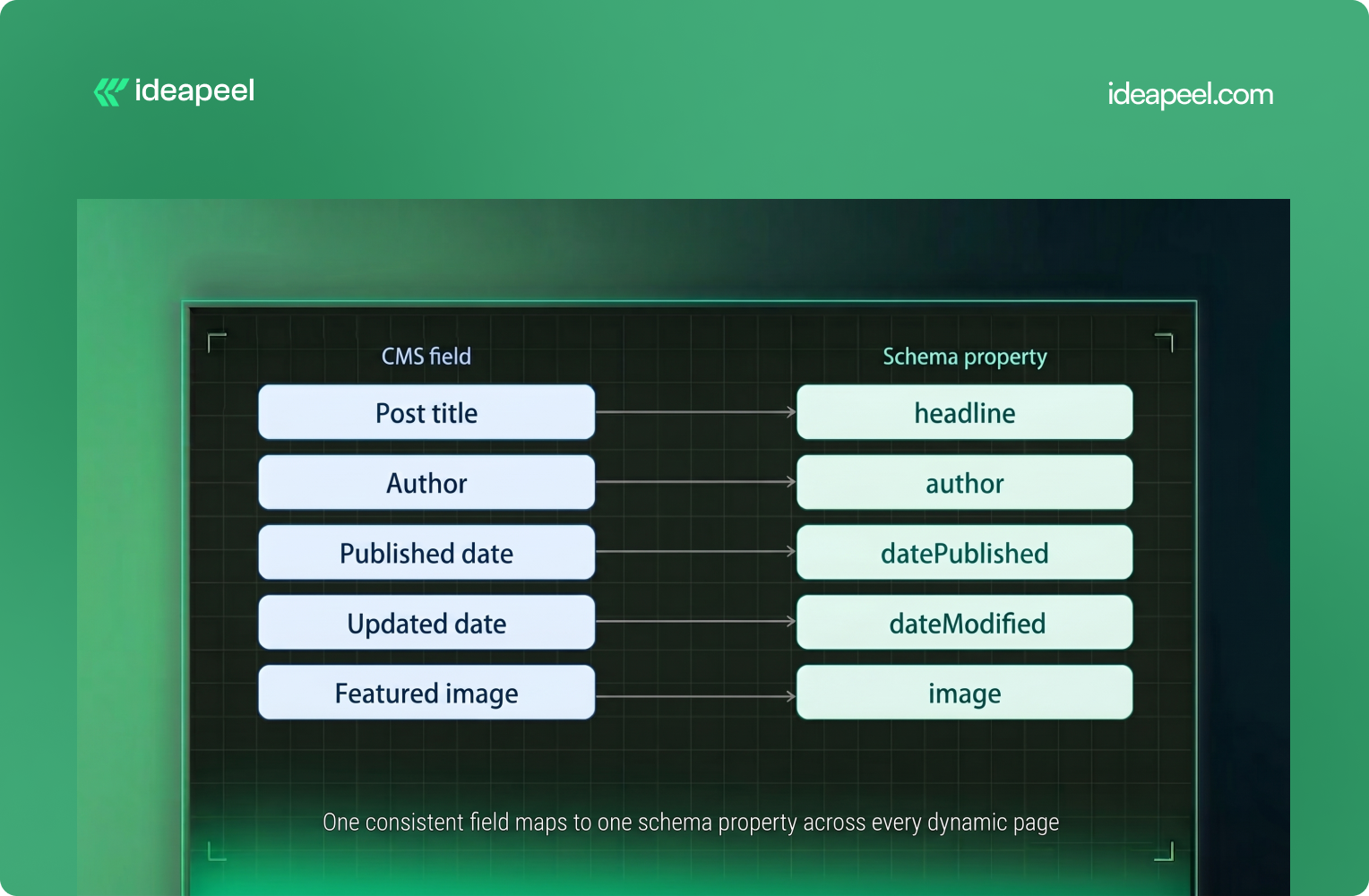
Schema is where CMS structure and machine-readability meet directly. The idea: map CMS fields to schema properties so dynamic pages generate valid structured data automatically, instead of someone hand-coding JSON-LD for every post.
The architecture flows like this:
Webflow CMS → CMS Fields → Collection Template → Dynamic Content → JSON-LD → Search Systems
This scales far better than manually building structured data for every article. One rule matters more than any other here: consistency. If your CMS shows one publish date and your structured data shows another, you've created conflicting signals; your visible content and your schema should describe the same page the same way.
Which Schema Types Should You Use?
- Article, the baseline for editorial blog content.
- Product, for genuine product pages.
- Organization / Person, for company and author information.
- BreadcrumbList, for page hierarchy and navigation.
- LocalBusiness, for eligible local business pages.
- FAQPage, only when a page genuinely contains qualifying question-and-answer content that's visible on the page, not as a blanket tactic.
Relevant schema beats maximum schema. Tagging every page with every schema type you can think of doesn't help; it just adds noise, and structured data never guarantees a rich result or an AI citation on its own.
[[inner-cta]]
Internal Linking as an AEO and GEO Signal
Internal links do more than pass authority around your site. They tell search engines and AI systems how your topics relate to each other, which pages support which claims, where the depth is, and how confidently a page can be trusted as part of a larger body of expertise.
A simple topic cluster might look like:
Webflow SEO → Webflow CMS SEO → Webflow Schema → Webflow AEO → Webflow GEO → Webflow AI Search
A fuller cluster structure:
- Pillar Page: The Complete Webflow SEO & AEO Guide
- Supporting Articles: Webflow SEO Checklist, Webflow CMS SEO, Webflow Schema Markup, Webflow AEO, Webflow GEO, Webflow AI Overviews, Webflow Technical SEO, Webflow Structured Data
Built out with CMS relationship fields rather than one-off manual links, this becomes a genuine content graph, the kind of thing that's much harder to fake with isolated posts, no matter how well each one is individually optimized. The key is relevance: link when another page genuinely helps the reader, not to inflate link counts.
Making Content Easier for LLMs to Understand
AI systems need context to interpret information correctly. A few habits help:
Use clear entity names. Instead of "It lets you build websites faster," write "Webflow allows teams to visually design, manage, and publish websites." Naming the subject explicitly removes ambiguity.
Keep terminology consistent. If you call something "Webflow CMS," don't randomly switch to "Webflow database" or "Webflow content engine" across different posts; inconsistent terms can read as different entities.
State relationships explicitly. Instead of assuming a connection is obvious, spell it out: "Webflow CMS is the content management system used to create and manage dynamic content in Webflow." Clear language helps people and machines interpret the same page the same way.
Optimizing for ChatGPT Search and Google AI Overviews
There's no reliable trick that guarantees a ChatGPT citation. A more realistic goal is making your content accessible, useful, clear, and trustworthy. OpenAI's publisher guidance notes that public websites can appear in ChatGPT Search and that site owners can allow its crawler to access content for search discovery, but allowing crawling doesn't guarantee a specific ranking, placement, or citation.
For Google AI Overviews, don't treat it as a separate game with separate rules. Strong fundamentals still carry the weight:
Technical SEO + useful content + structured information + entity clarity + topical authority + strong internal linking = better AI-search readiness
Schema doesn't get you into AI Overviews on its own; it helps machines parse structured information, while inclusion is still governed by relevance and quality signals the platform controls. For both Google and ChatGPT, the realistic framing is "increase the likelihood your content can be discovered and cited," not "get ranked."
AEO vs. GEO, One More Time
Worth separating clearly, because they call for different work:
- AEO asks: Can an AI system extract a clean, usable answer from this page?
- GEO asks: Does that AI system recognize this brand as a credible source worth citing at all?
CMS structure, short answers, clear fields, and defined relationships mostly serve AEO. Author credibility, original research, consistent brand information, and external citations mostly serve GEO. Both share a lot of the same underlying signals (clear content, entity clarity, crawlability). Still, you need both, and neither substitutes for the other.
Authority Still Matters More Than Field Names
Worth saying directly: CMS structure helps machines understand your content. It does very little for whether they trust it. That's a separate job, and it's the one most AEO checklists gloss over.
Where relevant, your content should reflect:
- Experienced authors with real bios
- Relevant, disclosed expertise
- Original research or first-party data
- Case studies and expert commentary
- Credible external references
- Transparent update history
- Mentions or backlinks from credible sites
This is E-E-A-T by another name, and no amount of clever field architecture replaces it. A simple way to frame the whole system:
CMS structure = context. Content quality = usefulness. Authority = trust. You need all three.
[[question-block]]
Crawlability: Robots.txt, Sitemaps, and llms.txt
None of this architecture matters if important pages aren't accessible to crawlers. Review your:
- robots.txt
- XML sitemap
- Canonical URLs and indexing directives
- Internal linking and URL structure
- Page load performance
You may also come across llms.txt, a proposed way of providing AI-oriented information about a site. It's worth having, but it shouldn't be the center of your AEO strategy; a file can't replace useful content, strong information architecture, crawlability, internal linking, or authority. Treat machine accessibility as one part of a broader technical strategy, not a shortcut around it.
A Practical Webflow AEO Checklist
CMS
- Clear, purpose-built Collections
- Descriptive field names (not "Text 1")
- Logical relationships between Collections
- Author, topic, and category fields on every content type
- Direct-answer fields for important content types
On-Page Content
- One clear H1, question-based H2s where intent supports it
- Direct answers near the top
- Short paragraphs, lists, and tables where they genuinely help
- Relevant internal links supported by real evidence
Technical SEO
- Unique titles and meta descriptions
- Canonical URLs, sitemap, robots.txt in order
- Valid, accurate JSON-LD schema
- Fast, crawlable pages
AI Readiness
- AI crawlers allowed where visibility is wanted
- Consistent terminology for key entities
- Strong topical clusters instead of isolated posts
- AI visibility monitored where reliable tooling exists
Common Mistakes Worth Avoiding
A few claims show up constantly in AEO content that don't hold up:
- "Schema guarantees a snippet or a ChatGPT citation." It improves eligibility and machine understanding, nothing more.
- "llms.txt alone will get you ranked." It's a small accessibility signal, not a ranking mechanism.
- "AEO replaces SEO." It builds on SEO fundamentals; it doesn't substitute for them.
- "Stuffing keywords into every CMS field helps." It doesn't , it just adds noise for both readers and machines.
- "A bigger CMS is a better CMS." Only create fields that represent genuinely useful information.
- "More schema is always better." Structured data should accurately describe the page, not maximize markup.
The more defensible version: AEO builds on solid SEO fundamentals while improving how clearly your content can be understood, extracted, and represented by AI systems. That's a less exciting sentence than "guaranteed AI visibility" , but it's the true one.
Measuring Whether Any of This Is Working
Track it the same way you'd track any SEO initiative, plus a few AI-specific signals.
Organic search: impressions, clicks, rankings, featured snippet appearances, organic traffic.
AI search (where reliable data is available): referral traffic from AI tools, whether your brand appears when you query ChatGPT or Perplexity directly about topics you cover, and AI visibility tooling that platforms, including Webflow itself, have started building natively.
One AI answer citing your page isn't proof of a working strategy. Look for trends over time, not single data points.
The Real Takeaway
Don't just optimize the page. Optimize the CMS behind it.
The strongest AEO-ready websites are built with clear Webflow Collections, structured fields, and connected content from the start. This makes information easier for both people and AI systems to understand.
At ideapeel, we build Webflow websites with SEO, AEO, CMS architecture, and conversion in mind, not as separate tasks.
Explore our Webflow SEO Guide, Webflow SEO Checklist, or Webflow SEO Agency Guide for B2B SaaS to go deeper.
Need a Webflow site built for search and AI? Explore ideapeel's services or contact us.
[[last-cta]]
Webflow AI is Webflow's collection of AI-powered features for building, managing, and optimizing websites. In 2026, it covers seven areas: the AI Site Builder, AI-generated design sections, AI copy, CMS Collection generation, AI code components, SEO/AEO optimization, and an in-Designer AI Assistant. It speeds up the first draft of a site significantly, but it does not replace human strategy, brand judgment, or final quality control.
Key takeaways
- Webflow AI now goes far beyond generating a homepage - it also writes CMS content, builds code components, and runs SEO/AEO audits.
- The output is a fully editable, real Webflow project, not a locked template.
- Webflow AI is best used as a starting-point assistant rather than a replacement for a web designer or developer.
- AEO (Answer Engine Optimization) is becoming as important as traditional SEO, because AI systems like ChatGPT, Claude, Gemini, and Perplexity now send real traffic.
- Humans still own strategy, UX decisions, brand voice, conversion design, and final QA - AI handles the repetitive first pass.
What Is Webflow AI?
.webp)
Webflow AI is the set of AI features built into the Webflow platform that help you generate, populate, and optimize a website. Instead of starting from a blank canvas, you describe your business in a prompt, and Webflow AI produces a structured, multi-page site with a real design system - colors, type scale, spacing, and layout - that you can edit in the standard Webflow Designer.
The important distinction: Webflow AI doesn't hand you a locked template. Every generated page is a normal Webflow project underneath, which means nothing about the output is off-limits to a developer or designer who wants to change it.
Entity relationships worth knowing:
- Webflow → a visual website development platform
- Webflow AI → Webflow's AI feature set for generation and optimization
- Webflow CMS → the content management layer Webflow AI can populate
- AEO → optimizing content so AI answer engines can find, understand, and cite it
What Can Webflow AI Do in 2026?
.webp)
By 2026, Webflow AI's scope has expanded well past "generate a homepage." Here's the full feature set.
AI Site Builder
You provide a text prompt describing your business, and Webflow AI scaffolds a complete multi-page site - sitemap, homepage sections (hero, features, testimonials, CTA), and internal pages - built on a real design system rather than a static template.
AI Design and Sections
For any section the AI generates, you can cycle through multiple layout variants without rebuilding anything by hand. This gives you creative control over structure without starting from zero.
AI Copy Generation
Webflow AI drafts headlines, body copy, and calls-to-action based on your prompt, plus image alt text for every image it places. This clears the "blank page" problem, but the copy is a first draft - it still needs a brand-voice pass before it ships.
CMS Collection Generation
This is one of the biggest 2026 additions. Webflow AI can populate entire CMS collections at once - product descriptions, blog post drafts, job listings, or seasonal campaign content - instead of generating a single static page.
AI Code Components
Describe an interactive element - a pricing calculator, a multi-step form - and Webflow AI can generate a working code component that plugs into the Designer canvas, extending what's possible without a full custom build.
SEO and AEO Optimization
Webflow AI can audit a site and fill gaps in meta titles, meta descriptions, alt text, heading structure, and schema markup. On the AEO side, it helps structure content so AI answer engines can parse and cite it - a newer priority as more discovery happens inside ChatGPT, Gemini, and Perplexity rather than a traditional search results page.
AI Assistant
A conversational agent inside the Designer that reads your site's existing classes and CMS structure, then generates new sections, refactors layouts, drafts CMS content, or suggests SEO fixes - all without leaving the canvas.
[[inner-cta]]
How Webflow AI Changes the Web Design Workflow
The traditional path to a first draft - wireframe, mockup, build, then customize - usually takes days before there's anything to react to. Webflow AI compresses that into a first pass that takes minutes: prompt in, structured responsive site out. That shifts where time actually gets spent. Instead of burning the first few days on setup, a designer or agency can spend that time on strategy, content accuracy, and the details that make a site feel like it belongs to one specific business instead of a category of businesses.
This matters most for two groups:
- Agencies and freelancers get a working draft to put in front of a client on day one, instead of a flat wireframe. Client sign-off tends to move faster when there's something clickable to react to.
- Non-designers and small businesses get a professional, mobile-ready starting point without hiring an agency or wrestling with a rigid template builder.
How We Use Webflow AI in Real Projects
.webp)
Here's the honest breakdown of where Webflow AI earns its place in a real project, and where it doesn't.
What We Automate
- Initial sitemap and page structure
- First-draft section layouts and copy
- Bulk CMS population (product descriptions, listings, seasonal updates)
- Image alt text generation
- Baseline meta titles and descriptions
What We Still Do Manually
- UX research and information architecture decisions
- Brand voice editing on every piece of AI-drafted copy
- Keyword strategy and search-intent mapping
- Conversion rate optimization and CTA strategy
- Final QA before anything goes live
The pattern holds across every task: AI handles the repetitive first pass, a person makes the judgment call.
How to Use Webflow AI Step by Step
- Describe your website. Write a clear prompt covering what your business does, who it serves, and any brand direction you already have.
- Generate the initial site. Webflow AI produces a multi-page draft with a design system and placeholder content.
- Review the AI output. Check layout choices, copy accuracy, and image placement before touching anything.
- Customize the design. Open the Designer and adjust colors, typography, spacing, and section layouts to match your actual brand.
- Optimize content and SEO. Rewrite copy for brand voice and target keywords, then check the AI-generated meta titles, descriptions, and schema markup.
[[question-block]]
Webflow AI for CMS Automation
Can Webflow AI generate CMS content? Yes. Webflow AI can populate entire CMS collections at once - writing draft product descriptions, job listings, or blog content across dozens or hundreds of items rather than one page at a time.
Beyond raw generation, Webflow AI (often paired with no-code tools like Make or Zapier and an AI API) can:
- Pull data from an external source (a spreadsheet, a form submission) and auto-populate CMS items
- Draft unique product descriptions across a large inventory
- Generate structured summaries for social snippets or newsletters from long-form content
- Auto-tag and categorize CMS items for easier navigation
- Provide first-pass translations for multilingual sites
Common CMS automation mistakes to avoid:
- Generic prompts that produce near-duplicate content across items (bad for SEO)
- Skipping a review stage, which lets AI-generated text overflow or break a layout
- Publishing AI output without a brand-voice pass, resulting in bland, generic copy
- Over-relying on AI for keyword targeting, which can drift into keyword stuffing
Webflow AI for SEO and AEO
Can Webflow AI help with SEO? Yes. It can auto-generate meta titles and descriptions, suggest internal links between CMS items, and generate schema markup - but keyword strategy and search-intent alignment still need a person reviewing the output.
Can Webflow AI help with AEO? Yes. Webflow's AEO tools focus on structuring content so AI answer engines - ChatGPT, Gemini, Perplexity - can find, understand, and cite it: clear question-answer formatting, strong schema, and content that gives a direct answer instead of burying it in a paragraph.
Traditional SEO targets a search results page. AEO targets the answer an AI system gives someone who never clicks through to a website at all. As more discovery moves into that format, treating SEO and AEO as separate checklist items - rather than one combined content strategy - is becoming the outdated approach.
Webflow AI vs Wix AI vs Framer AI
.webp)
The differentiator for Webflow AI is that the output is a real project with full Designer access - nothing is locked behind the AI's original structure.
What Webflow AI Does Well
- Turns a blank page into a structured, responsive draft in minutes instead of days
- Produces clean, editable output that follows Webflow's own best practices
- Handles tedious, repetitive tasks (alt text, meta descriptions, bulk CMS entries) accurately enough for a first pass
- Gives non-designers a genuinely professional starting point
- Keeps every generated element fully editable - nothing is a locked black box
Where Webflow AI Still Falls Short
- Generic design risk. Because the AI draws from a component library, sites can start to look similar without a designer adding a distinct point of view.
- No real strategy. It doesn't know your target audience, your competitive position, or what makes someone convert - that's UX research, brand strategy, and CRO, and it's still a human job.
- Existing sites aren't fully supported. The AI Site Builder is built for new sites (or sites that started as AI-generated) - it isn't designed to retrofit a site that wasn't originally built with it.
- SEO/AEO depth is still manual. The AI can fill in the basics; keyword strategy and competitive content depth still require a person.
Can Webflow AI Replace Web Designers or Developers?
Short answer: No. Webflow AI generates a strong starting point - layouts, copy, and basic styling - but it doesn't replace UX research, brand strategy, conversion planning, or creative direction. A designer or developer still needs to review, customize, and optimize what it produces before it's ready for real users.
Best Webflow AI Workflow for Agencies
.webp)
For agencies and freelancers, the highest-leverage way to use Webflow AI follows a clear lifecycle rather than a single generation step:
Research → Strategy → Prompt → AI Site Structure → AI Design/Sections → AI Content → CMS Population → SEO Optimization → AEO Optimization → Human UX Review → Conversion Optimization → Publish → Measure & Improve
Used this way, Webflow AI compresses the setup phase of a project so the team's time goes toward the parts that actually differentiate the site: strategy, brand voice, and conversion design.
Final Verdict
Webflow AI in 2026 is more than an AI site builder. It can help generate site structures, content, CMS items, AI code components, and SEO/AEO improvements. It makes the workflow faster while keeping the Webflow project fully editable.
The best approach is to use Webflow AI for the first draft and repetitive tasks, then refine the design, content, SEO, and UX manually. AI builds faster, but humans make the final decisions.
Ready to build a faster, conversion-focused Webflow website? Explore ideapeel’s Webflow development services and turn your next idea into a growth-ready website. (ideapeel)
- Learn more about Webflow SEO in 2026 and improve your website’s organic visibility. (ideaeel)
- Follow our Webflow SEO Checklist for 2026 to optimize technical SEO, content, and AEO. (ideapeel)
- See why growing SaaS brands choose Webflow in our guide to Webflow for SaaS in 2026. (ideapeel)
[[last-cta]]

Quick answer: Claude helps UX writers and designers draft, audit, and rewrite microcopy - button labels, error messages, empty states, and onboarding flows - faster than doing it manually. Claude Web Chat works well for one-off drafting and brainstorming; Claude Code (the terminal tool) works better for auditing hundreds of strings across a whole product for tone and consistency. Neither replaces a human UX writer's judgment on voice, context, and what a real user needs to hear in the moment.
Most "Claude for design" content stops at a list of prompts. This guide goes further: real before/after copy, a working prompt library, and an honest answer to where Claude actually helps a UX writer versus where it just produces plausible-sounding filler.
What Is Claude for UX Writing?
.webp)
Claude for UX writing means using Claude - through the web chat or the Claude Code terminal tool - to draft, audit, and refine the small pieces of interface text that guide a user through a product: button labels, form field help text, error messages, empty states, confirmation copy, and onboarding flows. It's not a plugin or a separate product - it's the same Claude model, applied specifically to content design tasks instead of general writing or code.
Two ways teams typically use it:
- Claude Web Chat - paste a screen description or a batch of copy, get drafts or a critique back. Good for brainstorming and one-off rewrites.
- Claude Code - a terminal-based agent with direct access to your project files. Good for auditing an entire docs folder or help center for tone violations, broken patterns, or inconsistent terminology, all in one pass.
Why UX Teams Are Using Claude
The appeal isn't that Claude writes better microcopy than an experienced UX writer - it's that it removes the scanning work. Reading through 500 help center articles to find every instance of vague link text, or manually checking 40 error messages against a style guide, is exactly the kind of repetitive task that used to eat a UX writer's week. Claude compresses that to minutes, and hands back a list a human can act on.
Claude Web Chat vs. Claude Code: Which One for UX Writing?
.webp)
If you're rewriting a single onboarding screen, the web chat is enough. If you're auditing tone across a hundred-file docs folder, Claude Code does in one command what would otherwise take days.
A style guide file changes the output quality. Claude Code looks for a file (commonly named something like CLAUDE.md) in your project folder before it responds - think of it as the master style guide you'd hand a freelance writer. Without it, output defaults to generic, safe phrasing. With it, Claude consistently matches your specific voice, terminology, and formatting rules.
Writing Better Microcopy With Claude
Microcopy is where Claude earns its keep fastest, because the task is narrow: take a functional-but-flat piece of UI text and tighten it.
Before: "Submit" After (Claude draft, human-edited): "Create my account"
Before: "Error: invalid input" After: "That doesn't look like a valid email - try name@example.com"
Before: "Click here to learn more" After: "See how pricing works"
None of these rewrites required deep product knowledge - they required pattern recognition and a nudge toward specificity, which is exactly what an LLM is good at. The judgment call on tone (playful vs. formal, terse vs. warm) still needs a person who knows the brand.
Improving Error Messages With Claude
.webp)
Generic error copy ("An error occurred") is one of the fastest wins for AI-assisted rewriting, because there's a repeatable formula: what happened + why it happened + what to do next.
Before: "Something went wrong." After: "We couldn't save your changes - check your connection and try again."
Before: "Invalid input." After: "Passwords need at least 8 characters and one number."
Feed Claude a batch of raw error strings with that formula as the instruction, and it will draft consistent, specific replacements for review - far faster than a writer rewriting each one from a blank page.
Designing Empty States With Claude
Empty states are easy to overlook because they only appear before a user has data - which is exactly when they need the most guidance. Claude is useful for drafting the two things every empty state needs: an explanation of why the screen is empty, and a clear next action.
Before: "No items found." After: "You haven't added any projects yet. Create your first one to get started."
Onboarding Flow Copy With Claude
Onboarding copy has to do a lot in a few words - orient a new user, explain a step, and motivate them to continue. Claude works well as a first-draft generator here: describe the setup step and the goal, and it will draft label text, helper text, and progress-indicator copy to edit from.
Before: "Step 2 of 4" After: "Almost there - just your team size left"
The second version does the same job but gives the user a reason to keep going, which is the kind of small upgrade that's easy to draft in bulk with AI and easy to miss when writing solo screen by screen.
Real Before/After UX Copy Examples
Claude Prompts We Actually Use
.webp)
Microcopy
- "Rewrite these 10 button labels to be specific about the action, not generic verbs like 'Submit' or 'Click here': [list]."
- "Turn this placeholder text into helper text that tells the user exactly what format we expect: [field]."
- "Suggest 5 CTA variations for [action], ranging from low to high commitment."
- "Rewrite this confirmation message to feel human, not robotic: [text]."
- "List every instance of vague link text ('click here', 'read more') in this content and suggest accessible alternatives."
[[question-block]]
Error messages 6. "Rewrite this error message using the formula: what happened, why it happened, what to do next: [error text]." 7. "Here are 10 generic error messages from our product. Rewrite each to be specific and actionable: [list]." 8. "Suggest error copy for a failed payment that doesn't blame the user." 9. "Review this list of error messages for tone consistency with our style guide." 10. "What's missing from this error state - copy, recovery action, or both?"
Empty states 11. "Write empty-state copy for a dashboard with no data yet, including a clear next action." 12. "Suggest 3 versions of empty-state copy for a search results page with zero matches." 13. "Rewrite this empty state to explain why it's empty, not just that it is."
Onboarding 14. "Draft step-by-step onboarding copy for a 4-step setup wizard for [product type]." 15. "Suggest progress-indicator copy that motivates users to finish setup." 16. "Write a welcome message for a first-time user landing on an empty dashboard." 17. "Draft re-engagement copy for a user who abandoned onboarding halfway through."
Audits and consistency 18. "Scan this list of UI strings and flag any that don't match our tone of voice: [paste]." 19. "Check this content for passive voice and rewrite in active voice." 20. "Find every heading in this list that isn't in sentence case and fix it." 21. "Generate a report of tone violations against our style guide - don't edit, just list issues." 22. "Compare these two versions of onboarding copy and tell me which reduces cognitive load more."
Accessibility and clarity 23. "Review this microcopy for accessibility - flag anything unclear for screen readers." 24. "Simplify this help text to a 6th-grade reading level without losing meaning." 25. "Rewrite this multi-sentence tooltip as a single clear sentence."
[[inner-cta]]
What Claude Does Well
- Drafting first-pass microcopy fast, across many strings at once
- Applying a consistent error-message formula at scale
- Catching vague or repetitive phrasing a writer might miss on a tenth read-through
- Bulk auditing large content sets against a defined style guide
- Simplifying dense copy to a clearer reading level
Where Human UX Writers Still Win
- Brand voice judgment. Claude can follow a style guide; it can't originate one or sense when a rule needs breaking for a specific moment.
- Context only the team has. Why a particular error keeps happening, what past user complaints sounded like, what the product roadmap changes next quarter.
- Emotional tone in high-stakes moments. Error copy for a failed medical appointment booking needs a different hand than a failed newsletter signup.
- Final review. Every AI draft still needs a person deciding if it's actually right for this product, this user, this moment.
Common Mistakes
- Treating first drafts as final copy - every string still needs a human pass.
- Skipping a style guide file - without one, output defaults to generic phrasing.
- Running Claude Code in full-autonomy mode on a live folder - start with a read-only audit before letting it edit files directly.
- Auditing without a defined style guide to check against - Claude can't flag tone violations against rules that don't exist yet.
- Using AI-only copy in high-stakes error states - payment failures, account deletion, medical or financial context needs direct human review, not just a pass-through.
Claude vs. ChatGPT for UX Writing
.webp)
Both handle microcopy drafting reasonably well. The practical difference shows up in workflow, not writing quality:
- Claude Code's project-wide file access makes it stronger for bulk audits across an entire docs folder or design system - ChatGPT's web interface requires manual copy-paste per file.
- A style-guide file gives Claude's terminal tool a persistent memory of your voice across a whole session, rather than re-explaining tone in every prompt.
- For a single quick rewrite, either tool works about the same - the difference matters most at scale.
Final Thoughts
Claude doesn't make anyone a better writer on its own - it removes the repetitive scanning and first-draft work that used to eat the most time in content design. The formula holds across every use case here: let Claude draft or audit at scale, then have a human writer make the calls that actually require judgment. That's the difference between a microcopy that reads like it was generated and a microcopy that reads as someone thought about the person on the other end of the screen.
Related reading: How We Use ChatGPT in Our Web Design Process · How We Use Figma AI in Real UI/UX Projects · Claude vs ChatGPT for Designers · UX Design Process
Explore Related Topics
- How AI Is Changing UI/UX Design in 2026
- How We Use ChatGPT in Our Web Design Process
- UX vs. UI Design: What Makes Them Different?
- UI Design Trends to Watch in 2026
Ready to improve your product experience? Start a project with ideapeel and turn AI-assisted design work into a clear, accessible, and user-centered experience.
[[last-cta]]
.webp)
Quick answer: Figma AI speeds up early-stage UX/UI work, generating first-draft layouts, cleaning up layers, writing placeholder copy, and building FigJam boards for research and workshops. It does not replace human judgment on visual hierarchy, brand feel, accessibility, or final design decisions. Our team uses it every week, and it never ships a design on its own.
Most articles about Figma AI are written by people testing it for the first time on a demo file. We use it on paid client projects with real deadlines, so this guide is built from that, not a feature tour.
What Is Figma AI?
.webp)
Figma AI is a set of AI-powered features built into Figma and FigJam, plus a large ecosystem of community plugins, that help designers move faster through research, layout generation, content drafting, and file cleanup. Figma's own AI tools live across FigJam (board generation, sticky-note sorting) and Figma Design (layout generation, content suggestions, layer renaming, Model Context Protocol support for design-to-code handoff). Community plugins extend this further with wireframe generators, persona builders, and text-to-UI tools.
It's easy to lump all of this under one label, but in practice it splits into two categories:
- Native Figma AI features, built by Figma's team, available directly inside Figma Design and FigJam
- Community AI plugins, built on Figma's open API by third-party developers, installed separately
Knowing the difference matters because native features are covered by Figma's own data and security policies, while plugins are third-party tools with their own terms.
Which Figma AI Features Actually Save Time?
Not every AI feature earns a permanent spot in a real workflow. Based on regular use across client projects, these are the ones that consistently save time:
The pattern across all of these: they remove setup time, not decision time. A generated FigJam board still needs a facilitator. A generated screen still needs a designer to fix spacing, hierarchy, and brand fit.
How We Use Figma AI in Real Client Projects
.webp)
Here's where Figma AI actually shows up in our week-to-week workflow, stage by stage.
Discovery and workshops. Before a kickoff call, we'll prompt FigJam AI to generate a rough workshop board, an icebreaker, a "how might we" prompt, and space for notes. It saves 15–20 minutes of manual board setup. After the workshop, we run the sticky-note sort and summary functions on raw notes so nobody spends an hour manually grouping post-its.
Early wireframes. When a client gives us a rough brief, say, "a booking flow for a physical therapy clinic", we'll generate a first-pass layout to react to in the kickoff conversation, rather than starting from a blank canvas. It's a conversation starter, not a deliverable.
Content placeholders. Instead of shipping wireframes full of "Lorem ipsum," we use content suggestions to fill screens with plausible, on-topic copy. Clients respond better to mockups that look close to real, and it makes internal reviews faster.
File hygiene before handoff. Auto layer naming and structure cleanup happen right before a file goes to development. This alone has cut down back-and-forth with developers who used to get files full of "Rectangle 47" and "Group 12."
Design-to-dev handoff. On projects where the client's engineering team also works inside Figma, MCP support means their coding agents can read the actual design structure, components, tokens, and spacing rules instead of interpreting a flat screenshot. That has measurably reduced misreads during the build phase.
What doesn't change: every one of these outputs gets reviewed by a designer before a client ever sees it.
[[inner-cta]]
Tasks Figma AI Does Better Than Manual Work
- Speed of a first draft. Getting from a blank canvas to something to react to, in minutes instead of an hour.
- Repetitive cleanup. Renaming layers, restructuring messy files, and organizing sticky notes- tedious, low-judgment tasks.
- Summarizing unstructured input. Turning a pile of workshop notes or research transcripts into themes a team can actually use.
- Placeholder content. Realistic copy that reads better than generic filler text during reviews.
Where Human Designers Still Make the Difference
- Visual hierarchy. AI can describe what hierarchy should look like, but it can't judge how a real layout reads to a real user.
- Brand feel. Tone, personality, and the small stylistic choices that make a design feel like this specific client, not a template.
- Accessibility judgment. AI-generated screens don't reliably account for contrast, focus states, or screen-reader logic without a human check.
- Edge cases. Empty states, error messages, and loading states are exactly the details AI-generated drafts tend to skip.
- Client context. No AI tool knows a client's history, past objections, or long-term roadmap the way the team working with them does.
If a task needs taste, context, or judgment about a real user, a designer handles it, every time.
Common Mistakes When Using Figma AI
- Treating first drafts as final designs: Generated layouts are a starting point, not a deliverable.
- Skipping the accessibility pass: AI output needs a manual contrast, alt-text, and keyboard-navigation check every time.
- Vague prompts: "Make a checkout page" produces something generic. "Mobile checkout flow with an upsell banner and three payment options" produces something usable.
- Ignoring the existing design system: Output that ignores your components and tokens creates more cleanup work than it saves.
- Skipping human review before client delivery: AI output should never reach a client without a designer's eyes on it first.
Figma AI vs Other AI Design Tools
Figma AI isn't the only option, and it isn't built to do everything. Here's how it stacks up against other tools commonly used in the same workflow:
Where Figma AI wins: teams that already have a mature Figma component library get output that respects their design system instead of fighting it, and native MCP support gives a cleaner design-to-code bridge than most competitors.
Where it falls short: it leans on your existing library to look good; a messy or thin design system means messier AI output. Free-tier credits also run out faster than Google Stitch's free plan.
Is Figma AI Worth Using in 2026?
Yes, if you treat it as a speed tool, not a decision-maker. For teams already working inside Figma with an established design system, the native AI features remove real setup time, first drafts, layer cleanup, and content placeholders without asking you to adopt a new tool. It's not worth it if you're expecting production-ready final designs straight out of a prompt; nothing on the market delivers that reliably yet, Figma AI included.
Related reading: How We Use ChatGPT in Our Web Design Process · Best AI Web Design Tools in 2026 · AI Website Builders vs. a Real Webflow Build · Figma to Webflow Guide
[[question-block]]
Keep Learning About AI-Powered Design
Figma AI is only one part of a modern design workflow. To build better digital products, it's important to understand how AI fits into research, wireframing, design systems, and development. If you want to explore more, read our guides on How We Use ChatGPT in Our Web Design Process, Best AI Web Design Tools in 2026, AI Website Builders vs. a Real Webflow Build, and our Figma to Webflow Guide. You can also learn more about our UI/UX Design Services and Webflow Development Services to see how we combine AI with human expertise to create websites that perform better for users and search engines.
Related guides from ideapeel
- How We Use ChatGPT in Our Web Design Process: https://www.ideapeel.com/blog/how-we-use-chatgpt-in-our-web-design-process
- Best AI Web Design Tools in 2026: https://www.ideapeel.com/blog/best-ai-web-design-tools-in-2026
- AI Website Builders vs. a Real Webflow Build: https://www.ideapeel.com/blog/ai-website-builders-vs-webflow
- Figma to Webflow Guide: https://www.ideapeel.com/blog/figma-to-webflow-guide
- UI/UX Design Services: https://www.ideapeel.com/services/ui-ux-design
- Webflow Development Services: https://www.ideapeel.com/services/webflow-development
Helpful Resources
To learn more about Figma AI and modern UI/UX design, you can also explore these trusted resources:
- Figma AI documentation: https://help.figma.com/
- Figma Learn: https://www.figma.com/resource-library/
- Web Content Accessibility Guidelines (WCAG): https://www.w3.org/WAI/standards-guidelines/wcag/
- Nielsen Norman Group UX Articles: https://www.nngroup.com/articles/
- Google Material Design: https://m3.material.io/
Final Thoughts
Figma AI is changing how design teams work by automating repetitive tasks and speeding up early-stage design. However, the best products still come from experienced designers who understand user behavior, accessibility, business goals, and brand identity. AI helps you work faster, but human creativity and decision-making are what create meaningful user experiences.
Whether you're building a startup MVP, redesigning a SaaS platform, or launching a new website, combining AI with expert design practices leads to better results. At ideapeel, we use AI to improve efficiency while ensuring every project is reviewed, refined, and optimized by experienced designers. If you're ready to create a modern, high-performing website or product, contact ideapeel to see how our AI-powered UI/UX design and Webflow development services can help your business grow.
[[last-cta]]
.webp)
Introduction
Most articles about ChatGPT and design are written by people who have never designed a website for a paying client.
We have. Ideapeel is a web design and development agency. We build websites for real businesses, on real deadlines, with real client feedback. So when we talk about ChatGPT, we're not guessing. We're telling you exactly how our team uses it, every single day.
ChatGPT does not design our websites. Our designers do. But ChatGPT removes a lot of the slow, repetitive work that used to eat up our time: research, first drafts, structure, and SEO groundwork. That means our designers spend more time on the part that actually matters: solving problems for the client.
This guide walks through our real workflow, step by step, from the first client call to the final Webflow build. Along the way, we share the exact prompts we use. Copy them. Change them. Make them yours.
Why We Use ChatGPT in the Design Process
.webp)
Quick answer: We use ChatGPT to speed up research, organize client information, draft UX copy, plan site structure, and support SEO. It does not make design decisions. The final design, brand direction, and user experience always come from our human designers.
Before ChatGPT, a lot of hours went into things that had nothing to do with creativity. Reading through a client's old website. Searching for competitor examples. Writing a first draft of a sitemap. Formatting meta descriptions.
Now, ChatGPT handles the first pass of that work. Our team reviews it, fixes it, and builds on it. Nothing goes live without a human checking it first.
This is the difference between using AI to think for you, and using AI to think faster with you. We do the second one.
[[inner-cta]]
Before We Open Figma
.webp)
Every project starts with research, not design. Rushing into wireframes without understanding the client leads to rework later. ChatGPT helps us move through this stage faster.
1. Understanding the Client
We start by asking ChatGPT to summarize the client's business, audience, and goals based on the information we've collected from the discovery call and their existing materials.
Prompt: "Act as a UX strategist. Based on this business summary [paste notes], identify the target audience, their biggest problems, and three website goals this business should prioritize."
2. Competitor Analysis
Instead of manually opening ten competitor websites, we ask ChatGPT to organize what it finds into patterns we can actually use.
Prompt: "Compare these three competitor websites [paste URLs or notes]. List common page sections, tone of voice, and any gaps we could fill better."
3. Building Personas
Prompt: "Create two user personas for a [industry] business. Include goals, frustrations, and what would make them trust a new website."
4. Finding User Pain Points
Prompt: "List the top 8 questions or concerns a first-time visitor to a [industry] website would have before contacting the business."
During UX Design
Once research is done, we move into structure: how the site is organized and how a visitor moves through it.
5. Sitemap Planning
Prompt: "Suggest a sitemap for a [industry] website with these goals: [list goals]. Include primary navigation and any secondary pages."
6. Mapping User Flows
Prompt: "Outline the ideal user flow from homepage to contact form for a visitor who is comparing three service providers."
7. Drafting UX Copy
Prompt: "Write three homepage hero headline options for a [industry] business. Keep each under 10 words and focused on the customer's main problem."
8. Writing CTAs
Prompt: "Suggest 10 call-to-action phrases for a [industry] website, ranging from low-commitment to high-commitment."
Every line ChatGPT produces here is a starting point. Our copywriters and designers rewrite it to match the client's actual voice.
During UI Design
This is where human judgment matters most. ChatGPT cannot see color, hierarchy, or visual balance. But it can still support the thinking behind the design.
9. Color Direction
Prompt: "Suggest a color palette direction for a [industry] brand that wants to feel [trustworthy/bold/modern]. Explain the reasoning, not just hex codes."
10. Component Naming
Prompt: "Suggest clear, consistent naming conventions for these UI components: [list components] for a Figma design system."
11. Accessibility Checks
Prompt: "Review this list of UI text for accessibility issues, including unclear link text and missing context for screen readers: [paste content]."
12. Design System Structure
Prompt: "Outline a basic design system structure for a small business website, including typography, spacing, and component categories."
Every visual decision, the final palette, layout, and hierarchy, is made by our designers in Figma. ChatGPT only shortens the thinking time before we get there.
During Development
.webp)
Once the design is approved, ChatGPT supports the Webflow build, mostly around content, SEO, and structure.
13. CMS Planning
Prompt: "Suggest a Webflow CMS collection structure for a blog with categories, authors, and related posts."
14. Meta Descriptions
Prompt: "Write three meta description options (under 155 characters) for a page about [topic], including the keyword [keyword]."
15. Schema Suggestions
Prompt: "What schema markup would help this page rank for [keyword]? List the schema types and key fields."
16. SEO Content Structure
Prompt: "Suggest an SEO-friendly heading structure (H1–H3) for a page targeting the keyword [keyword], based on this outline: [paste outline]."
Developers still review every line before it goes live. AI-suggested schema and metadata are checked against the client's actual content, not just what looks correct. [[question-block]]
50 ChatGPT Prompts We Actually Use
.webp)
The right prompt can make research, UX planning, website copy, SEO, Webflow development, and client communication much faster.
But a useful prompt should do more than ask for an answer. It should give enough context to produce something practical, specific, and ready to improve.
Below are 50 ChatGPT prompts we actually use, organized by task. You can copy, customize, and use them for website projects, marketing campaigns, SEO workflows, and content planning.
Research Prompts
Good website decisions start with good research. These prompts help you understand a business, its audience, competitors, and customer expectations.
1. Understand a Business
Summarize this business, including what it offers, who it serves, its main value proposition, positioning, and primary competitors.
2. Research Industry Trends
What are the top 5 trends in [industry] website design in 2026? Explain what is changing, why it matters, and how businesses can apply each trend.
3. Understand Customer Expectations
What do customers in [industry] expect to see on a homepage before they decide to learn more, request a quote, book a call, or make a purchase?
4. Compare Competitor Websites
Compare these two competitor websites. Identify what each website does better across messaging, UX, visual design, content, SEO, trust, and conversion.
5. Find Customer Objections
What questions, concerns, or objections might a potential customer have before booking a call with this company? Group them by trust, price, process, results, and risk.
UX Prompts
UX research and planning help determine how visitors move through a website and find the information they need.
6. Create a Website Sitemap
Suggest a sitemap for a [industry] website with these main goals: [goal 1], [goal 2], and [goal 3]. Explain the purpose of each page and how the pages should connect.
7. Map the User Journey
Map the ideal user journey from the first landing page visit to [signup/demo/purchase/contact]. Identify the information and actions users need at each stage.
8. Find Common UX Problems
List the most common UX mistakes on [industry] websites. For each mistake, explain why it hurts the user experience and how to fix it.
9. Improve Website Navigation
Suggest clear navigation labels for this website. Use language that visitors immediately understand and avoid clever, vague, or unnecessary labels.
10. Plan Above-the-Fold Content
What information should appear above the fold on a [service/product] page? Prioritize the value proposition, audience, proof, primary CTA, and information needed to encourage users to continue.
UI Design Prompts
Use these prompts to develop a consistent visual direction and stronger interface design.
11. Choose a Color Direction
Suggest a color direction for a brand that wants to feel [modern/trustworthy/premium/creative/professional]. Explain the role of the primary, secondary, accent, background, and text colors.
12. Choose a Font Pairing
Recommend 3 font pairings for a [industry] website. Explain how each combination affects readability, personality, hierarchy, and brand perception.
13. Create Design System Rules
Suggest practical spacing, typography, sizing, grid, container, and component rules for a consistent website design system.
14. Check Accessibility
Review this button and link copy for accessibility. Identify unclear wording, poor context, or potential usability issues and suggest better alternatives.
15. Name Figma Components
Suggest a scalable naming convention for these Figma components. Keep the names clear, consistent, reusable, and easy for designers and developers to understand.
Copywriting Prompts
Strong website copy makes the value proposition clear before asking visitors to take action.
16. Write Hero Headlines
Write 3 homepage hero headlines for a [industry] business. Keep each under 10 words. Make the value proposition specific and easy to understand.
17. Write an About Section
Write a short About section for this company. Explain who they are, what they do, who they help, and why customers should trust them. Use a warm and professional tone.
18. Create FAQ Questions and Answers
Write 5 useful FAQ questions and concise answers for a [industry] service page. Focus on real customer concerns and use natural questions people might search for.
19. Create CTA Options
Write 10 CTA button options for this page, starting with low-commitment actions and progressing toward higher-commitment actions. Match each CTA to the user's likely intent.
20. Simplify Website Copy
Rewrite this paragraph using shorter sentences, clearer language, and fewer unnecessary words. Keep the original meaning and make it easy to scan.
SEO Prompts
These prompts can help with keyword targeting, content structure, internal linking, metadata, and structured data.
21. Create an SEO Heading Structure
Suggest an SEO-friendly heading structure for a page targeting [primary keyword]. Create one clear H1, relevant H2s, and supporting H3s based on search intent.
22. Write Meta Descriptions
Write 3 meta description options for this page. Keep each concise, naturally include the primary keyword, communicate the page's value, and encourage qualified clicks.
23. Find Related Keywords
Suggest 10 closely related keywords and search terms for [topic]. Group them by informational, commercial, navigational, and transactional intent where relevant.
24. Find Internal Linking Opportunities
Identify internal linking opportunities that would strengthen this page's topical relevance. Suggest the source page, destination page, suggested anchor text, and reason for the link.
25. Recommend Schema Markup
What structured data and schema markup types are appropriate for a [page type] page? Explain what information should be included and when each type should be used.
Webflow Prompts
These prompts are useful when planning Webflow CMS structures, responsive layouts, filtering systems, and website launches.
26. Plan a Webflow CMS Structure
Suggest a Webflow CMS Collection structure for [content type]. Include the recommended fields, field types, relationships, and purpose of each field.
27. Define CMS Fields
What custom fields should this Webflow CMS Collection include to make the content easy to manage, filter, display, and scale?
28. Plan a Filtering System
Suggest a simple filtering and categorization system for a Webflow portfolio or blog. Explain which CMS fields should power the filters and how users should interact with them.
29. Check Responsive Design
Create a responsive Webflow launch checklist covering navigation, typography, spacing, images, CMS layouts, buttons, forms, interactions, and mobile usability.
30. Write Contextual Alt Text
Write descriptive and accessible alt text for these images based on their purpose and surrounding content: [image list and context]. Avoid keyword stuffing.
Client Communication Prompts
Clear communication keeps projects moving and makes technical information easier for clients to understand.
31. Write a Project Update
Turn these rough project notes into a clear and professional client update. Summarize completed work, current progress, pending items, and next steps.
32. Turn Feedback Into Action Items
Summarize this client feedback into 3 clear action items. Separate required changes from optional suggestions and prioritize the most important work.
33. Follow Up on a Proposal
Draft a polite follow-up message for a client who has not responded to our proposal. Keep it professional, concise, and helpful without sounding pushy.
34. Explain a Technical Term
Explain [technical term] in simple language for a non-technical client. Use one practical website example and explain why the concept matters.
35. Prepare for a Kickoff Call
Based on this project brief, create talking points and important questions for the kickoff call. Cover goals, audience, content, design, functionality, SEO, timeline, and success criteria.
Content Planning Prompts
Content planning becomes easier when topics are connected to audience needs and search intent.
36. Generate Blog Topics
Suggest 10 blog topics for a [industry] audience. Prioritize topics based on real customer problems, search intent, business relevance, and opportunities to demonstrate expertise.
37. Create a Blog Outline
Create a detailed outline for an article about [topic]. Use a clear H1, logical H2s and H3s, concise sections, useful examples, and questions readers are likely to ask.
38. Find Useful FAQ Questions
Suggest specific questions people are likely to search for about [topic]. Prioritize questions that can be answered clearly and directly.
39. Turn an Article Into a LinkedIn Post
Turn this article or outline into a concise LinkedIn post. Start with the main insight, explain the key takeaway, and end with a natural reason for readers to explore the full article.
40. Create a Content Calendar
Create a one-month content calendar for [industry/topic]. Include weekly themes, article topics, search intent, target audience, primary keyword, and the business goal of each piece.
Final Review Prompts
Before publishing a website or article, use these prompts to find unclear sections and improve the final experience.
41. Review Page Copy
Review this page copy for clarity, readability, grammar, structure, and flow. Identify anything confusing, repetitive, vague, or unnecessary and suggest specific improvements.
42. Check Brand Voice
Review this content against our brand voice: [describe brand voice]. Identify sentences that feel inconsistent and rewrite them to match the intended tone.
43. Find Confusing Sections
Review this page from a first-time visitor's perspective. List anything unclear, missing, repetitive, distracting, or difficult to understand.
44. Improve Conversion Potential
Suggest 3 practical ways to improve this page's conversion potential. Consider messaging, trust signals, CTA placement, page structure, friction, and user intent.
45. Improve FAQ Content
Review this FAQ section for clarity, natural language, completeness, and usefulness for search users and AI answer systems. Suggest questions or answers that should be added or improved.
Design Thinking Prompts
These prompts help explore better visual solutions without adding unnecessary complexity.
46. Communicate Trust Visually
What are 3 effective ways to communicate trust on a homepage? Consider testimonials, case studies, client logos, statistics, credentials, design hierarchy, and visual proof.
47. Design a Pricing Table
Suggest a clear pricing table layout with 3 tiers. Explain how to communicate the differences between plans, highlight the recommended option, and make comparison easy.
48. Create an Alternative Hero Section
Suggest 5 creative alternatives to a standard hero banner for a modern website. For each concept, explain the layout, content hierarchy, visual element, and user action.
49. Simplify a Multi-Step Form
Review this multi-step form and suggest ways to reduce friction while collecting the necessary information. Recommend which fields should be removed, combined, reordered, or made optional.
50. Make a Page Feel More Premium
Suggest ways to make this page feel more premium without adding clutter. Consider typography, whitespace, layout, imagery, content hierarchy, micro-interactions, consistency, and visual restraint.
Mistakes We Avoid
ChatGPT is useful, but only inside its limits. We never let it make these calls:
- Final UI decisions: Layout, spacing, and visual hierarchy come from trained designers who understand how people actually scan a page.
- Brand strategy: ChatGPT doesn't know a client's history, reputation, or long-term vision. That comes from real conversations with the client.
- Creative direction: AI tends to suggest safe, average ideas. Standout design comes from human taste and experience.
- Visual hierarchy: ChatGPT can describe hierarchy in words, but it can't see or judge a real layout the way a designer can.
- User testing: No AI tool can replace watching a real person struggle with a real interface.
If a task needs judgment, taste, or real client context, a human handles it. Every time.
Our Final Workflow
Here's the process in its simplest form:
- Research: Understand the client, audience, and competitors.
- ChatGPT: Draft sitemap, UX copy, and content structure.
- Figma: Design the real layout, visuals, and interactions.
- Webflow: Build the site with CMS and responsive structure.
- SEO: Add metadata, schema, and internal linking.
- Publish: Final human review, then launch.
AI supports every stage except the one that matters most: the actual design decisions.
Final Thoughts
ChatGPT helps us work faster, but it doesn't replace great design. We use it to speed up research, organize ideas, write first drafts, and improve SEO. Every important design decision still comes from our team.
The best websites combine AI with real experience, creative thinking, and a deep understanding of users. That's how we build websites that not only look great but also perform well.
Want to Learn More?
If you enjoyed this guide, check out these related articles:
- Best AI Web Design Tools in 2026: What We Use, What We Dropped & Why
https://ideapeel.com/blog/best-ai-web-design-tools-in-2026 - Figma AI in Practice: Where It Speeds Us Up, Where It Still Needs a Human
https://ideapeel.com/blog/figma-ai-in-practice - AI Website Builders vs. Webflow: What You Actually Get
https://ideapeel.com/blog/ai-website-builders-vs-webflow
You can also browse more web design tips on our blog:
https://ideapeel.com/blog
Ready to Build Your Next Website?
Whether you need a custom Webflow website, a Figma to Webflow conversion, or a complete website redesign, we're here to help.
👉 Explore our services: https://ideapeel.com/services
👉 Let's talk about your project: https://ideapeel.com/contact
This version is easier to read, naturally supports SEO, and encourages both users and AI search engines to discover more content through relevant internal links.
[[last-cta]]
.webp)
AI website builders are faster to launch. Webflow is faster to run. AI wins the first version; Webflow wins every version after it. The right choice depends on who updates your site next month, a marketer or a developer, more than any feature comparison.
That single question decides more of these projects than any pricing page or feature list. Here's the full breakdown, so you can answer it for your own team.
What AI Website Builders Actually Do
AI website builders generate a working website from a prompt or a short brief. Tools like Claude, Lovable, Cursor, v0, and Bolt.new can produce a real, deployable codebase in minutes. Consumer-facing tools like Wix ADI, Framer AI, and Squarespace AI generate a site inside their own platform using the same idea: describe the business, get a layout.
They're genuinely good at a specific set of jobs: a landing page to validate an idea, an internal tool prototype, a portfolio, a placeholder site while a product or funding round comes together. For those cases, shipping something in under an hour beats a multi-week build every time.
The category struggles once a site has to do more than exist, once it has to convert, scale, and get updated constantly by people who don't write code.
What a Real Webflow Build Includes
A custom Webflow build is a different kind of deliverable. It bundles design, hosting, a native CMS, and forms into one platform, built visually rather than generated from a prompt. The output is production-grade code your team can actually maintain: clean HTML, exposed SEO fields, and a component system a marketer can edit without touching a line of it.
The distinction that matters here isn't "AI vs. no AI." Most serious Webflow teams (ours included) use AI heavily too, for wireframing, for content, for component generation that gets imported into the platform. The distinction is whether the site ends up as generated output or as an owned, editable system.
AI Website Builders vs. Webflow: Feature-by-Feature Comparison
Design Quality & Brand Differentiation
.webp)
AI builders pull from the same training data every other user's prompt draws from. They've seen the same hero sections, the same pricing layouts, the same testimonial carousels, so the output is competent but rarely distinctive.
Two competitors using the same tool with a similar prompt can end up with sites that look like siblings. For a company trying to signal credibility to a discerning buyer, that's not just an aesthetic problem. Buyers notice templated design, and they conclude the business behind it.
A custom Webflow build starts from brand and positioning rather than a template library, so nothing on the page is borrowed from a pattern thousands of other sites are also using.[[inner-cta]]
The best comparison key points between AI Website Builder vs Webflow builder
1. SEO Performance & Technical Foundation
.webp)
Are AI website builders SEO friendly?
They can be, but inconsistently, and it depends heavily on the specific tool and how much technical control you take. SEO isn't just keywords; it's site architecture, semantic HTML, Core Web Vitals, schema markup, internal linking, and crawlability.
AI-coded sites built with tools like Claude, Cursor, or v0 and hosted on Vercel can actually reach the highest technical ceiling available, because you control the raw HTML, meta tags, and structured data directly. Consumer AI builders sit at the other end. They frequently ship bloated code, weak heading hierarchy, and slower load times baked into the platform itself.
Webflow sits in between by default and pushes toward the strong end without requiring a developer: titles, meta descriptions, alt text, redirects, sitemaps, and schema are all exposed and editable by a non-technical team.
The honest takeaway: both approaches can rank well. For most businesses, content quality and site structure decide rankings more than the platform does, but the platform decides how easily your team can act on that.
2. AEO & Answer Engine Readiness: The Comparison Nobody Else Is Running
.webp)
This is the part most comparisons skip entirely, and it's quickly becoming the more important one. Ranking on Google is no longer the only goal. Increasingly, the site needs to be structured so ChatGPT, Gemini, Perplexity, and AI Overviews can extract and cite it directly.
That readiness comes down to three things: clean structured data (schema markup), self-contained answer-first content blocks, and semantic HTML that an AI crawler can parse without guessing at hierarchy.
Consumer AI builders generally lose here. They optimize for visual output, not markup quality, so schema is often missing or generic, and heading structure gets flattened for design reasons. AI-coded builds can reach full AEO readiness, but only if a developer deliberately implements it; it isn't automatic. Webflow is the one platform of the three that exposes FAQ schema, Article schema, and clean semantic tags natively,
which means a non-technical content team can build AEO-ready pages without waiting on engineering for every markup change. If AI search visibility matters to your business, and for most B2B and content-driven sites in 2026 it does, this is a real, underweighted factor in the decision.
3. CMS & Content Management
This is the part people forget when they build with AI: a generated codebase has no content editor built in. You add a headless CMS- Strapi, Sanity, or Contentful are the common picks- and someone has to model the content, wire it to the site, and keep it running.
That's real, ongoing work, and it's exactly what Webflow bundles by default. For a content-heavy site (a large blog, a resource library, multiple languages), the CMS question often is the platform decision, not a footnote to it.
4. Performance & Maintenance Over Time
If you only take one thing from this article, take this: the deciding factor is rarely how the site gets built. It's who changes it every week.
With an AI-coded stack, a copy change or a new page usually routes back to a developer, even with a headless CMS wired in. Fast to build, slow to hand over. With Webflow, marketing edits content, ships new sections, and hits publish- no developer, no deploy, no ticket.
Play it forward: a team shipping ten web changes a week gets ten self-serve edits on Webflow, or ten engineering tickets on an AI-built site. That queue, not the initial build, is where the real cost and frustration live.
5. Customization & Scalability Ceiling
AI-coded builds have effectively no design ceiling; anything you can describe, a developer can build. But every new section is a code change, a review, and a deploy. Webflow lets a team build new sections visually from existing components, within a system that's bounded but, for the vast majority of marketing sites, far above what the site actually needs. The ceiling only becomes a real constraint for highly interactive, app-like experiences, which usually belong on a custom stack anyway.[[question-block]]
6. Total Cost of Ownership
Sticker price is the least useful number here.
AI-coded stack costs:
- Build: developer time (senior review isn't free, even with AI speeding up the first draft)
- Hosting: usage-based (cheap at low traffic, unpredictable at scale)
- Services: a separate CMS, forms, sometimes search, each its own subscription
- Every change: more developer time
Webflow costs:
- One flat plan covering site, hosting, and CMS
- Predictable, bundling what the AI stack bills separately
- No extra charge when the team makes changes
Rule of thumb: the AI-coded stack can win on cost if you already have in-house engineers who'd be maintaining a codebase anyway. Webflow usually wins on predictable total cost of ownership for a marketing site.
When an AI Website Builder Is the Right Call
- You're pre-revenue and validating an idea with a minimal landing page
- The site is an internal tool prototype, not customer-facing
- You need a placeholder while a product or funding round comes together
- It's a personal portfolio or single-page site with no conversion requirements
- You're racing a hard deadline for a short-lived campaign or event page
When a Custom Webflow Build Is the Better Choice
- It's a marketing site, blog, or set of campaign pages a non-technical team will update often
- Speed of ongoing change matters more than owning the raw code
- You don't want engineering to be the bottleneck for every piece of web content
- Predictable, bundled cost matters more than maximum technical flexibility
- The site needs to support real content operations: a growing blog, multiple markets, a resource library
- AI search visibility (AEO/GEO) matters, and you need a non-technical team to maintain that structure over time
Where Squarespace, Wix AI, and Framer AI Fit In
.webp)
Webflow vs AI builders isn't really a two-horse race. Squarespace and Wix AI sit at the easy end of website building: type a prompt, and the platform generates a full site in seconds, complete with a hero section, a few landing pages, and a working sitemap, no design skills needed. Framer AI is a builder like Webflow in spirit, closer on design control, and closer to a complete design tool than a template generator, which is why it's often the AI website many small teams reach for when they just need to launch a website quickly. For a startup building a first version, or a marketing team testing a new website before committing budget, that's a fair way to use AI.
The comparison businesses actually need to make in 2026 isn't AI builder vs Webflow in the abstract. It's whether the site has to scale. An AI agent or AI assistant genuinely helps early: it drafts copy, suggests a design system, and can produce a complete website from almost nothing. But few AI-generated sites stay consistent once a team starts shipping fast. Webflow's CMS keeps every CMS item, the hosting and CMS setup, and the sitemap update in one place, with clean CSS that's simple to optimize for both classic search and AI-generated answers. For e-commerce, SaaS, or any business planning to scale, that's what separates a live website from a scalable one.
So when people ask if AI website builders are worth it, or try to compare AI options against each other, the honest answer is: use AI to draft, then refine and build inside a platform designed to hold up. Choose Webflow, or another platform like Webflow, when brand consistency, a real design system, and long-term analytics matter more than how fast the first, beautiful website went live. Builders like Squarespace and Wix AI are a fine place to start; websites with Webflow are where most businesses end up once the site has to actually perform.
The Hybrid Approach Most Teams Actually Use
.webp)
The either-or framing is usually wrong. The pattern that works splits the decision by surface, not by company:
- Product, app, or anything behind a login: a custom stack, built fast with AI tools and owned in code.
- Marketing site, blog, and campaign pages: Webflow, so marketing owns it without filing engineering tickets.
Each surface lives where it performs best, and the two connect cleanly. This is why most companies that get past the first six months end up running both: a custom, AI-assisted product alongside a Webflow marketing site, rather than migrating from one to the other.
Final Verdict
Both paths can produce a genuinely good website. The real question was never which one looks better at launch; it's who's maintaining and updating it three years from now. AI wins on speed to a first version. Webflow wins on speed to the hundredth change, with a predictable cost structure, native AEO-ready markup, and no engineering queue standing between your team and a published page. Most companies, once they think it through honestly, end up using both: a custom product built with AI, and a marketing site on Webflow, rather than forcing one tool to do both jobs.
Ready to Build the Right Way? Talk to ideapeel
If you're weighing this decision for your own site, the fastest way to get a straight answer is to map out who's actually going to be making changes next month, and let that person's skill set decide the platform. That's the exact conversation we have with clients every week.
At ideapeel, we build both sides of this equation: custom, AI-assisted products for teams that need to own their code, and fully custom Webflow marketing sites for teams that need to move fast without an engineering queue. We'll tell you plainly which parts of your site belong where, with no incentive to push you toward one tool over the other.
Explore more from ideapeel:
- Webflow Development Services: see how we plan, design, and build production-ready Webflow sites end to end
- SEO & AEO Services: the technical and content setup we run so your site ranks on Google and gets cited in AI answers
- UI/UX Design Services: the research-led design process behind every custom build, not just a visual pass
- Webflow vs. Wix: Which One Is Better?: a deeper platform comparison if you're still weighing your options
- Webflow Development Agency Guide: what to look for when choosing a Webflow partner, including AEO and GEO capability
Book a free discovery call, and we'll map out exactly which parts of your site should be Webflow, which should be custom, and why, before you spend a dollar on either.[[last-cta]]
.webp)
AI won't replace your web designer in 2026 - but it has already replaced half their busywork. Over the past year, we ran real client projects through nearly every AI web design tool worth testing.
Some earned a permanent spot in our stack. Others quietly dropped after a few weeks. This is the honest version of that list: what we kept, what we cut, and whether AI can actually replace a human designer.
In this article: what AI web design actually means, the tools we use every week, the five we walked away from, free vs. paid picks, and a straight answer to the question everyone in this industry is asking right now.
Key Takeaways
- AI web design tools are excellent at production work - wireframes, layout variants, first-draft copy, color systems - and still weak at brand nuance, hierarchy judgment, and strategic decisions.
- Our internal wireframing phase dropped from roughly 3 days to under a day once we standardized on AI-assisted layout tools.
- No tool we tested reliably replaces a human designer end-to-end. The best ones speed up the first 70% of a project and hand the last 30% back to a person.
- Best overall for design teams: Figma AI. Best for prompt-to-live-site: Framer AI. Best free option: Relume's free tier for sitemaps and wireframes.
- If a tool promises a "complete website in seconds" with zero human review, treat the output as a first draft, not a final product.
What Is AI Web Design?
AI web design is the use of machine learning models to generate, suggest, or automate parts of the website creation process - layout structure, visual hierarchy, copy, imagery, and in some cases, deployable code - based on a text prompt or existing brand input, reducing the manual production time a human designer would otherwise need.
It's different from a traditional website builder. A template-based builder (think classic drag-and-drop platforms) starts you with a fixed layout you customize by hand. An AI-native design tool starts from a prompt or a business description and generates a layout, palette, and copy specific to that input - no template selection required. Some tools stop at the design/mockup stage; others go all the way to a deployable, hosted site. That distinction matters more than almost any other feature comparison, and it's the first thing to check before you commit to a tool.
How Does AI Web Design Actually Work?
Most AI web design tools follow the same basic loop, regardless of how polished the interface is:
.webp)
- Input: describe the business, paste a brand brief, or upload existing assets.
- Generation: the model proposes a layout, copy, and visual system based on that input.
- Refinement: you (or the tool's AI) adjust spacing, hierarchy, and content by hand or by re-prompting.
- Export or deploy: the result becomes editable design files, exportable code, or a live hosted page.
The tools mostly differ in where step 3 happens and how much control you get over it. That's the real basis for comparison - not how fast step 2 looks in a demo video.[[inner-cta]]
The AI Web Design Tools We Actually Use
These are the tools that survived past the trial period and are still part of our weekly workflow.
.webp)
Figma AI
Figma AI handles smart layout suggestions, auto-tidies components, and generates responsive variant screens across breakpoints. What changed for us: when a homepage needs to adapt across mobile, tablet, and desktop, we get a starting set of layout variations in minutes instead of manually rebuilding each breakpoint by hand. Best for: design teams already living inside Figma who want AI as a layout accelerator, not a replacement for the design system. Limitation: credit-based usage on paid tiers means heavy exploration can burn through your monthly allowance fast.
Framer AI
Framer takes a written prompt and generates a styled, interactive, deployable landing page - not just a mockup. What changed for us: it's now our default for fast client concept pages, since a prompt like "modern SaaS landing page, dark theme, minimal typography" produces something close to presentation-ready on the first pass. Best for: designers and small teams who want to go from prompt to live page without a separate dev handoff. Limitation: deep customization still requires learning Framer's own editor, which has a real learning curve.
Relume
Relume solves the blank-page problem at the planning stage. You describe the project goals, it generates a full sitemap, then converts approved pages into high-fidelity wireframes populated with realistic (not lorem-ipsum) placeholder copy. What changed for us: client presentations got noticeably more effective once wireframes had real-sounding copy instead of filler text. Best for: the planning and sitemap phase, before any visual design begins. Limitation: it's a planning tool, not a design tool - you still need Framer, Webflow, or Figma to finish the job.
Webflow AI
Webflow's AI features assist with CSS styling, class generation, and prompt-based component creation, while still respecting Webflow's precise HTML/CSS box model. What changed for us: for client work that needs pixel-accurate, developer-friendly output, this is the only tool on this list we'd hand directly to an engineering team without a rebuild. Best for: technical designers and teams that need production-grade code, not just a visual approximation. Limitation: the precision comes with a steeper setup and learning curve than prompt-first tools.
Midjourney
Midjourney doesn't touch layout at all - it generates visual assets. What changed for us: hero images and on-brand illustrations that used to require a stock photo budget or a photoshoot now come from a well-written prompt, and the quality regularly beats stock photography for hero sections. Best for: hero imagery, icon sets, and illustration concepts that get dropped into a real design tool afterward. Limitation: it's an asset generator, not a web design tool - it never touches structure or code.
Uizard
Uizard turns rough sketches - including genuinely bad hand-drawn ones - into structured prototypes fast. What changed for us: early-stage concepting with a client in the room went from a whiteboard sketch to a clickable prototype in the same meeting. Best for: early-stage concepting and client workshops where speed matters more than polish. Limitation: output quality drops noticeably once you move past simple screens into complex, data-heavy interfaces.
[[question-block]]
How to Use AI Web Design Tools
.webp)
1. Define Your Website Goals
Start by deciding what you want your website to achieve. Identify your target audience, business goals, and the pages you need. A clear plan helps AI generate more accurate layouts and content.
2. Create Your First Design
Use an AI web design tool to generate a sitemap, wireframe, or homepage from a simple prompt. Include details about your business, brand style, and preferred design to get better results.
3. Customize the Design
Don't rely on the AI output as your final website. Edit the layout, colors, typography, images, and content so the design reflects your brand and creates a better user experience.
4. Optimize for SEO and Performance
Before publishing, improve your website by using clear headings, optimized images, internal links, meta titles, meta descriptions, and a mobile-friendly layout. A fast, well-structured website performs better in both search engines and AI search results.
5. Review Before You Publish
Test your website on different devices, check all links and forms, and make sure the content is accurate and easy to understand. AI speeds up the design process, but a final human review ensures your website looks professional and delivers the best results.
Pro Tip: AI works best as a design assistant, not a replacement. Use it to speed up planning, wireframing, and first drafts, while relying on human creativity for branding, UX, and final design decisions.
The 5 We Dropped (and Why)
Nobody publishes this part, which is exactly why it's worth reading. These all looked promising in testing and didn't survive contact with a real project.
None of these are bad tools in isolation. They just didn't earn their place once weighed against the time they cost us versus the tools above.
Free vs. Paid AI Web Design Tools - What's Worth Paying For
The pattern across nearly every tool here: free tiers are genuinely useful for testing and single small projects, but professional, repeated use pushes you to a paid plan within the first month.
AI Web Design vs. Traditional Web Design - What's Actually Different
- Speed: AI-assisted wireframing and layout exploration can cut early-stage timelines from days to hours. Final polish still takes roughly the same amount of time either way.
- Cost: Lower upfront cost for simple sites; the gap narrows fast once a project needs custom branding, complex functionality, or accessibility work.
- Customization ceiling: Template and AI-generated sites both hit a wall when a brand needs something genuinely unique. Human-led design still wins for high-stakes, brand-defining work.
- Who it's best for: AI-first tools suit startups, solo founders, and agencies handling high volumes of simpler sites. Traditional, human-led design still wins for complex, brand-critical, or highly regulated projects.
Will AI Replace Web Designers?
No - but it has already absorbed the parts of the job that used to eat the most time. That's the honest, unhedged answer.
We've watched our own wireframing phase shrink from about three days to under one. That time didn't disappear - it moved. Designers on our team now spend it on strategy conversations, content architecture, and revision rounds that used to get rushed at the end of a project. The tools didn't cut headcount; they changed what the headcount does.
The honest risk isn't "AI replaces designers." It's that designers who refuse to use these tools will lose client work to designers who deliver the same quality faster. The shift already happening is competitive, not existential - and it rewards the people willing to treat AI as a production accelerator, not a creative director.
How to Choose the Right AI Web Design Tool for Your Project
Run through these four questions before picking a tool:
- Are you designing or deploying?
If you need a live, hosted site, look at Framer or Webflow. If you need mockups for a client or dev team, Figma or Uizard fit better. - Solo or team?
Team-based tools (Figma AI, Webflow) justify their learning curve when multiple people share the file. Solo freelancers often get more value from faster, prompt-first tools like Framer. - What's the budget?
Free tiers are fine for a single small project. Repeated professional use almost always needs a paid plan within the first month. - How brand-complex is the project?
The more unique the brand needs to feel, the more the project needs human-led design with AI as an assistant - not the other way around.
Quick cheat sheet: Planning a sitemap → Relume. Need a live site fast → Framer. Working inside an existing design system → Figma AI. Need pixel-accurate developer handoff → Webflow. Need hero imagery → Midjourney. Early client workshop → Uiza
Ready to Build a Better Website?
AI web design tools can help you build websites faster, but great design still needs human creativity and strategy. The best results come from combining AI with experienced designers.
Need a website that looks great and performs even better? Explore Ideapeel's Webflow Development, UI/UX Design, and Figma to Webflow services, or visit the ideapeel Blog for more web design and AI insights. Ready to start? Contact ideapeel today and let's build something exceptional together.
[[last-cta]]
.webp)
If you built your website on Webflow two years ago and have not looked at what the platform can do in 2026, you are working with a completely different tool than what you think you have.
Webflow is no longer just a design tool. Since the beginning of 2026, it has evolved into what the company now calls an "agentic web marketing platform." That is not marketing language. It reflects a real, fundamental shift in what the platform does and who it is built for.
This guide covers everything that changed in 2026: the new AEO suite, the Claude connector, the next-generation CMS, the pricing restructure, and what all of it means for your search visibility in a world where AI is answering questions before users ever click a link.
What Is AEO and Why Does It Matter More Than Traditional SEO Right Now?
.webp)
What is Answer Engine Optimization (AEO)?
Answer Engine Optimization (AEO) is the practice of structuring your website content so that AI-powered search tools like Google's AI Overviews, ChatGPT, and Perplexity can find, understand, and cite your pages as authoritative answers. Unlike traditional SEO, which focuses on ranking in a list of blue links, AEO focuses on becoming the source that AI models pull from when a user asks a question.
What is the difference between SEO and AEO?
Traditional SEO optimizes for search engine crawlers and click-through rankings. AEO optimizes for AI models that extract, summarize, and cite content in conversational responses. SEO brings traffic to your site. AEO makes your brand the answer before a user even reaches your site.
Both matter. In 2026, you need both, and Webflow is one of the first platforms to build native tools for both at the same time.
Webflow's AEO Suite: What It Is and What It Actually Does
Webflow's AEO tools are built into the platform's Audit panel. They sit inside your Workspace, alongside your existing SEO controls, and they are designed to help your site get cited by AI models, not just ranked by search engines.
Here is what the AEO suite covers:
LLM Visibility Tracking: Webflow's built-in analytics now include an AEO dashboard that shows you traffic and conversions referred by large language models. You can see which AI tools are sending people to your site, which pages they are landing on, and whether those visits convert.
AEO Agents: These are native AI agents inside Webflow that scan your site and identify gaps in schema markup, content structure, and page architecture. They flag what is hurting your citeability the likelihood that an AI model will pull from your content and prioritize fixes by impact.
Competitive Benchmarking: The AEO suite includes tools to compare your AI visibility against competitors. You can see whether a competitor's page is being cited more frequently than yours for a shared topic, and understand structurally why that is happening.
Who gets AEO features? AEO agents are available on the Team plan and Enterprise. Basic AEO audit functionality is available to paid Workspace users across plans.
How Do You Actually Use AEO to Win AI Overviews?
How do you format content to appear in Google's AI Overviews?
To appear in Google AI Overviews, format each section of your content with a question as the H2 or H3 heading, followed immediately by a direct, concise answer of 40 to 80 words. Use schema markup to declare the content type. Write in plain, declarative language; avoid vague claims and opinion-heavy sentences that AI models cannot cleanly extract.
A few things that consistently improve citeability across AI tools:
Write one clear answer per section. AI models are not looking for nuanced paragraphs they are looking for the most direct, quotable response to a specific question. The faster your content gives them that, the better.
Use FAQ sections on every product and service page. A well-structured FAQ block is one of the highest-returning investments you can make for AEO. Short questions. Direct answers. Plain language.
Use structured data. FAQ schema, HowTo schema, and Article schema all signal to AI crawlers that your content is organized, factual, and citation-worthy.
Keep your content current. AI models favor recently updated, high-authority pages. A blog post from 2022 with no updates is being outcompeted by content that reflects what is happening now.
[[inner-cta]]
The Claude + Webflow Integration: What It Actually Unlocks
.webp)
What is the Webflow MCP connector? The Webflow MCP connector is an official integration between Webflow and Claude, launched on February 9, 2026. It uses Anthropic's Model Context Protocol (MCP) an open standard that lets AI models interact with external tools through a common protocol. The connector gives Claude direct read and write access to your Webflow CMS, metadata, pages, and variables, without custom code or complex configuration.
This is not a Zapier workflow. It is a first-party integration you can activate in under three minutes from the Claude interface.
What Can You Actually Do With the Claude + Webflow Connector?
Once connected, Claude can interact with your Webflow site through two sets of tools:
The Designer API handles everything: visual element creation, style management, CSS variables, components, and responsive breakpoints.
The Data API handles your content layer: CMS collections, items, fields, localization, SEO metadata, and custom code.
In practical terms, here is what marketing teams are using it for right now:
Bulk SEO Audits in Minutes: Claude reads your CMS pages through the connector, finds meta titles over 60 characters or missing target keywords, proposes corrected versions, and applies fixes. Tasks that previously took a team half a day can now run in under 30 minutes.
Bulk CMS Content at Scale: You can generate dozens or hundreds of CMS items from a single prompt session. One agency used the connector to produce 50 coherent property listing pages in 30 minutes after Claude analyzed the structure of their existing entries.
Schema and Metadata Management: Claude can audit your entire site for schema gaps, flag missing alt text, check canonical tags, and apply fixes across hundreds of pages at once.
Self-Optimizing Content Loops: Marketing teams are using the connector to run ongoing SEO maintenance without involving developers in every update. Claude audits, identifies, recommends, and applies all through the same interface where you run your content strategy.
One important operational note: for production sites, set the connector to manual approval mode at first. This way Claude asks for your confirmation before applying any changes, so you can review exactly what is happening before it goes live.
[[question-block]]
AI Code Components: Why Webflow Deprecated App Gen
On April 27, 2026, Webflow deprecated its earlier "App Gen" feature and replaced it with AI Code Components. This was a deliberate strategic decision, not a feature removal.
App Gen was a site generation tool: describe a site, get a generated layout. It worked well as a starting point, but it sat outside your design system. What it produced needed significant cleanup before it could live in a real production site.
AI Code Components work differently. You describe a complex element in plain language a custom pricing calculator, an interactive comparison table, a filterable resource library and Webflow generates production-ready React code that integrates natively with your existing design system.
Why does this matter for SEO and AEO?
Custom interactive components built with AI Code Components can be structured with clean semantic HTML, proper schema markup, and readable content architecture all from the start. There is no post-generation cleanup required to make the output search-engine readable. You build the component, it integrates with your system, and the SEO and AEO foundations are already there.
The Next-Gen CMS: Why Structured Content Is the Foundation of GEO
.webp)
What is Generative Engine Optimization (GEO)? Generative Engine Optimization (GEO) is the practice of structuring your website's content and data in a way that makes it easy for AI-powered generative search tools to understand, use, and recommend your brand. While AEO focuses on being cited in AI answers, GEO focuses on the underlying data architecture that makes your site readable and authoritative to AI systems in the first place.
AI systems need structured, relational data to work with. They are not just reading your pages; they are parsing the relationships between your content, your entities, and your authority signals. The stronger your content architecture, the more usable your site becomes for generative tools.
Webflow's next-generation CMS was built with this in mind.
What Changed in the Next-Gen CMS?
Increased Scale: The new Premium plan includes 20,000 CMS items and 40 Collections as standard. Previous plans capped at 10,000 items and required paid add-ons to go higher. For content-heavy sites resource libraries, feature pages, blog archives, dynamic landing pages this removes a ceiling that was causing real operational friction.
Deep Nesting: Webflow now supports three-layer nesting and up to 10 nested collection lists per page. This allows for content architectures that were previously impossible on the platform: complex relational structures like content hubs, interlinked use-case pages, and multi-tiered resource libraries.
Why does deep nesting matter for GEO?
AI search tools do not just read pages. They understand the relationships between pages, which topics connect, which content clusters around which entities, and which sites have genuine depth on a subject versus thin coverage across many topics. A site with three levels of relational content is architecturally more authoritative to a generative AI model than a site with flat, disconnected pages.
What is an llms.txt file?
An llms.txt file works like a robots.txt file, but instead of directing search engine crawlers, it directs AI language models. It tells AI tools which pages on your site are most authoritative, what your preferred citation details are, and how to interpret your content. It is a direct signal to AI crawlers about where to focus when they are deciding what to read and potentially cite.
Webflow is among the first major website platforms to offer native support for this file. For sites that want to influence how AI tools discover and use their content, this is not a small thing. You are giving AI models a structured map to your most important content on your terms.
Technical SEO in 2026: What Webflow Handles Out of the Box
Technical SEO has changed. In 2025 and 2026, Google's ranking signals include how fast your pages respond, how stable your layout is as it loads, and how well your site performs for real users on real devices. These are not soft signals; they are direct ranking factors.
What are Core Web Vitals and why do they affect rankings?
Core Web Vitals are three performance metrics that Google uses to measure real-user page experience: LCP (Largest Contentful Paint) measures how long the main content takes to appear; INP (Interaction to Next Paint) measures how quickly the page responds to user actions; and CLS (Cumulative Layout Shift) measures how much the page layout moves while loading. Sites that pass Core Web Vitals thresholds rank higher and provide better user experiences that keep visitors on the page longer.
Here is what Webflow handles automatically in 2026:
Global CDN Hosting: Webflow sites run on Fastly's Tier 1 global CDN with over 100 data centers. This means Time to First Byte (TTFB) how quickly a server responds to a request is handled at the infrastructure level, not at the configuration level. You do not need to set up a CDN. It is already there.
Image Optimization: Webflow automatically converts images to WebP and AVIF formats and applies lazy loading by default. Unoptimized images are one of the most common causes of poor Core Web Vitals scores. Webflow removes that problem from your to-do list entirely.
Canonical Tags and Noindex Controls: As of mid-2025, native canonical tag management and page-level noindex controls are built into the platform. You no longer need custom code or third-party plugins to handle these technical SEO fundamentals.
Alt Text Generation: Webflow's AI tools can generate descriptive alt text for images across your site. This matters for accessibility compliance and for how AI search tools interpret your visual content.
Clean Semantic HTML: Webflow's output produces clean, structured HTML that both search engines and AI crawlers can read easily. For sites using AI Code Components, the React output integrates with this clean foundation.
Webflow 2026 Pricing: What Actually Changed
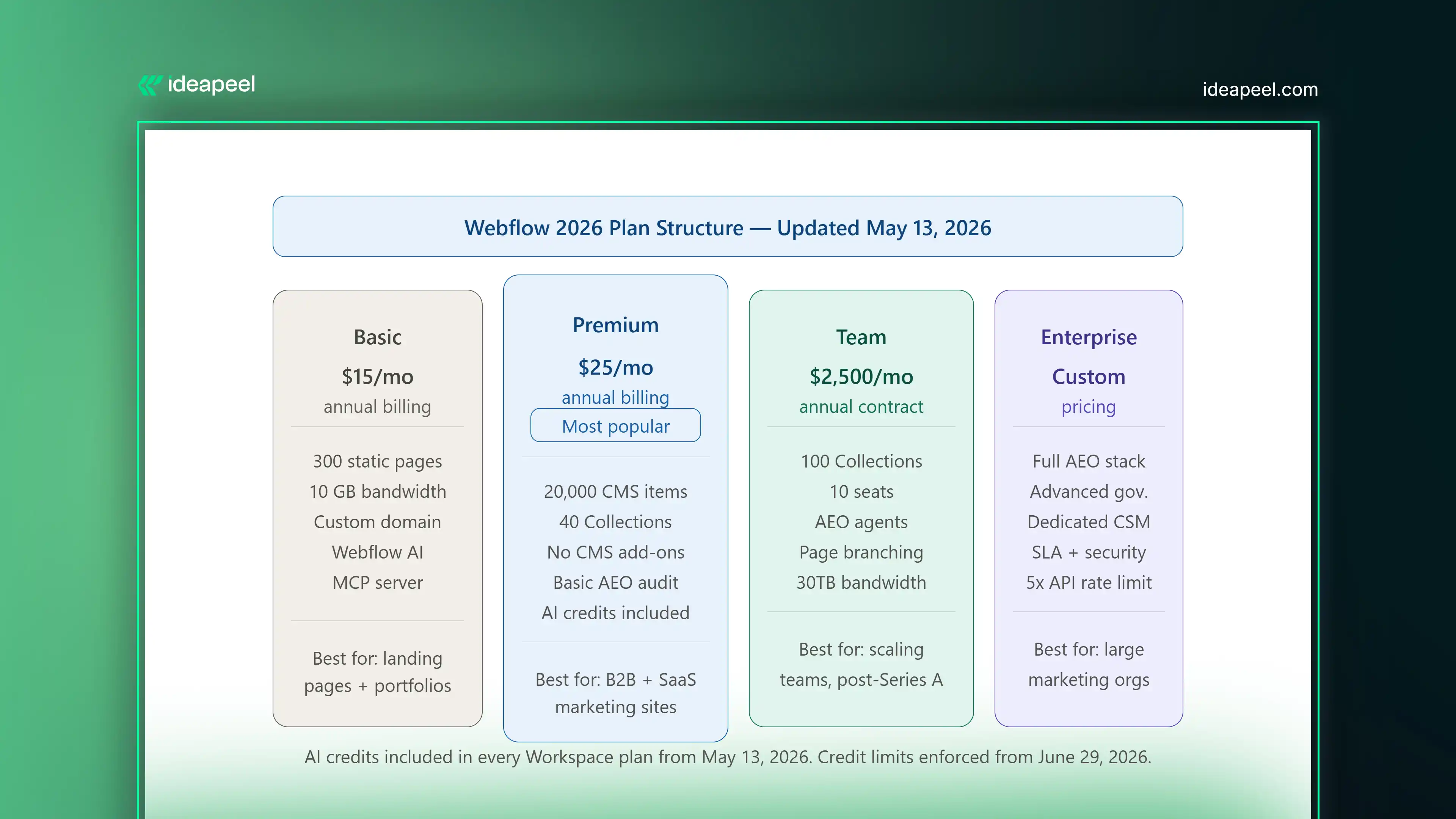
What changed in Webflow's 2026 pricing? On May 13, 2026, Webflow merged the legacy CMS and Business site plans into a single new Premium plan, introduced a new Team plan between Premium and Enterprise, and added AI credits to all Workspace plans. The changes affect new accounts immediately and existing accounts at their next renewal date.
Here is a clear breakdown of the current plan structure:
Basic Plan ($15/month, annual): For landing pages, portfolios, and sites that do not need a CMS. Includes 300 static pages, 10 GB bandwidth, custom domain, Webflow AI, and MCP server access.
Premium Plan ($25/month, annual): The main plan for content-heavy marketing sites. Includes 20,000 CMS items, 40 Collections, and removes the need for CMS add-ons entirely. This is the right starting point for most B2B marketing sites and SaaS websites.
Team Plan ($2,500/month, annual contract): A new all-in-one plan for teams that have outgrown self-serve but are not ready for Enterprise. Includes 100 CMS Collections, 10 seats, Localization, AEO agents, page branching, single-page publishing, publishing workflows, a site activity log, custom SSL certificates, security headers, and 30TB of bandwidth. Requires reaching out to Webflow directly; not available as a self-serve purchase.
What Is Webflow Optimize and Do You Need It?
Webflow Optimize is a separate add-on that starts at $299 per month and scales by page views. It adds native A/B testing, multivariate testing, and AI-driven personalization directly inside the platform.
For conversion-focused B2B and SaaS marketing sites, this matters because it removes a key reason to use a third-party testing tool. Your A/B tests run inside the same interface where you build and manage your site. Your personalization logic is connected to the same CMS that powers your content.
When do you actually need Optimize? If you are running a meaningful volume of traffic through key landing pages and you are not systematically testing variations, Optimize pays for itself quickly. For sites below 25,000 monthly page views on conversion-critical pages, the standard plan tier is the starting point.
Webflow vs. Framer in 2026: What Is the Actual Difference?
This is a question that comes up constantly, and the honest answer is that they are solving different problems.
Framer is excellent for design speed. If you want a beautiful landing page or a portfolio site built and live quickly, Framer is a strong choice. Its AI generation tools are fast, its template ecosystem is strong for visual work, and the learning curve is lower for designers who have not worked in a CMS-heavy environment.
Webflow is the right choice when your website is a business growth system rather than a design deliverable. If your site needs a real CMS architecture, deep content relationships, AEO optimization, a Claude integration, custom interactive components, team publishing workflows, or scalable data structure, Framer is not built for that in the same way.
The bottom line: Framer is a design tool with publishing capabilities. Webflow in 2026 is a growth platform with design capabilities. Which one you need depends on what problem you are actually trying to solve.
What Is a Relational Authority Hub and Why Should You Build One?
Traditional SEO advice focuses on individual pages. Rank page A for keyword A. Rank page B for keyword B. In 2026, that approach is insufficient on its own.
AI search tools do not just evaluate individual pages. They evaluate sites as entities, looking at the breadth and depth of your coverage on a topic, the relationships between your content, and whether your site reflects genuine expertise on a subject or just a collection of keyword-targeted pages.
What is a relational authority hub? A relational authority hub is a content architecture where your core topic pages, subtopic pages, supporting articles, case studies, and FAQ content are all interconnected through deliberate internal linking, shared schema vocabulary, and consistent entity references. Instead of a flat structure of individual pages, you build a web of connected content that signals depth and expertise to both human readers and AI systems.
Here is what this looks like in practice on a Webflow site:
Your main product or service page links to three or four deep-dive supporting pages on specific aspects of that service. Those supporting pages link to relevant case studies and FAQ pages. Your FAQ pages link back to relevant product pages. Your blog content links to all of the above. Every page uses consistent terminology, entity naming, and schema markup.
Webflow's Next-Gen CMS makes this architecture significantly easier to build and maintain than it was on previous versions of the platform. Three-layer nesting and 10 nested collection lists per page means you can model complex relational content without needing a custom CMS or a headless architecture to do it.
Webflow AEO Checklist: What to Do on Your Site Right Now
If you are using Webflow in 2026 and you want to improve your visibility in AI-powered search, here is a practical starting checklist:
Content Structure
- Format each major section with a question-based H2 or H3 heading, followed by a direct 40 to 80 word answer
- Add a dedicated FAQ section to every product, service, and landing page
- Write in plain, declarative language; avoid vague claims that AI models cannot extract cleanly
- Keep your most important pages updated; AI models favor recent, accurate content
Technical Signals
- Enable schema markup for FAQ, HowTo, and Article content types
- Set up your llms.txt file to direct AI crawlers to your most authoritative pages
- Check that every image has descriptive alt text; use Webflow's AI alt text generation if you have a backlog
- Run a Core Web Vitals check in Google Search Console and resolve any failing pages
CMS and Architecture
- Map your internal linking structure; make sure your most important pages receive links from multiple related content pieces
- Use Webflow's AEO audit panel to identify schema gaps and content structure issues
- If you are on the Team or Enterprise plan, run your AEO agents on key page clusters and action the priority recommendations
Monitoring
- Set up the AEO analytics dashboard to track LLM-referred traffic separately from organic search traffic
- Note which pages are receiving AI-referral visits and what content format those pages use; this tells you what is working and where to replicate it
How does Webflow compare to WordPress for SEO and AEO in 2026?
Webflow's technical SEO foundations are handled at the platform level; image optimization, CDN performance, canonical tags, and page speed are built in. WordPress requires plugin management, hosting configuration, and ongoing maintenance to achieve comparable baselines. For AEO specifically, Webflow's native AEO agents and Claude integration currently have no direct equivalent in the WordPress ecosystem. The tradeoff is that WordPress has a larger plugin and developer ecosystem; Webflow offers a tighter, more managed platform with fewer moving parts to maintain.
The Bottom Line on Webflow in 2026
Webflow's 2026 updates make it more than a website builder. With AI-powered SEO, AEO tools, Claude integration, and smarter CMS features, it's built for the future of AI search.
To stay ahead, optimize your website for both Google and AI search by improving your content structure, using llms.txt, and creating high-quality, connected content.
Need help building an AI-ready Webflow website? Explore ideapeel's Webflow Development, Webflow SEO Services, and UI/UX Design Services to create a faster, smarter, and search-optimized website that drives real business growth.
[[last-cta]]
.webp)
If your B2B or SaaS website is getting traffic but not enough leads, demo requests, or sign-ups, the problem is usually not your ads or your offer. Most of the time, it is the experience your website gives people when they land on it.
A UI/UX audit helps you find exactly where that experience breaks down. It shows you what is confusing visitors, what is slowing them down, and what is stopping them from taking action.
This guide covers everything you need to run a proper UI/UX audit for your B2B or SaaS website. You will learn what a UI audit checks, what a UX audit looks at, how both connect to conversion rate optimization (CRO), SEO, and website speed, and you will get a full checklist you can use right away.
What Is a UI/UX Audit?
A UI/UX audit is a structured review of your website or product. It looks at how your site looks, how it works, and how easy it is for visitors to do what they came to do.
The audit identifies design problems, usability issues, slow performance, confusing navigation, and anything else that gets in the way of a good user experience.
Definition of a UI Audit
A UI (User Interface) audit reviews the visual side of your website. It looks at colors, fonts, buttons, images, icons, spacing, and design consistency. The goal is to make sure your website looks professional, clear, and on-brand on every page.
Definition of a UX Audit
A UX (User Experience) audit reviews how people move through your website. It looks at how easy tasks are to complete, whether the journey from landing page to conversion is smooth, and where visitors drop off or get stuck.
Why UI/UX Audits Matter for B2B & SaaS Companies
B2B buyers do a lot of research before they make a decision. If your website is hard to navigate, confusing to read, or slow to load, they will leave and check your competitor instead.
For SaaS companies, the website is often the product's first impression. If your site does not clearly explain what the product does and make it easy to sign up or book a demo, you lose the user before they even try the product.
In B2B, 80% of purchase decisions are influenced by customer experience rather than price alone. That means how your website feels to use directly affects your revenue.
Signs Your Website Needs a UI/UX Audit
Here is a quick snapshot to check whether your site is due for an audit right now.
Quick Snapshot Checklist
✓ High bounce rates, visitors are leaving without engaging
✓ Low demo requests, people are not clicking your main CTA
✓ Poor lead generation, forms are not converting
✓ Low engagement, users are not clicking deeper into the site
✓ Navigation issues, people are getting lost or confused
✓ Slow page speed, pages are taking too long to load
✓ Mobile usability problems, the site does not work well on phones
If you are seeing even two or three of these signs, a UI/UX audit will tell you exactly what to fix.
Understanding UI Before Starting Your Audit
What Is UI (User Interface)?
UI is everything a visitor sees on your website. It includes your colors, fonts, buttons, images, icons, spacing, and layout. Good UI design makes a site look clean, professional, and easy to scan at a glance.
Bad UI design creates confusion. When buttons are different sizes on different pages, or when the color scheme clashes, or when text is too small to read, visitors feel something is off, even if they cannot name what it is. They leave.
Core UI Elements to Audit
When you audit your UI, you look at these specific elements:
Colors: Does the color palette match your brand? Are colors used consistently across all pages? Does the main CTA button stand out from the background?
Typography: Are fonts easy to read on both desktop and mobile? Is there a clear visual difference between headings, subheadings, and body text?
Buttons: Do all buttons follow the same style, shape, and size? Is there one clear primary button per section?
Forms: Are forms simple? Do they only ask for information that is actually needed right now?
Icons: Are icons easy to understand? Do they match the style of the rest of the design?
Images: Are images high quality? Do they show real product value or real people? Are they optimized so they do not slow the page down?
Visual hierarchy: Can a visitor quickly tell what is most important on each page? Is the headline bigger than the body text? Does the CTA stand out?
Design consistency: Does every page look like it belongs to the same website?
Why UI Matters for SaaS and B2B Websites
SaaS and B2B buyers judge your product by the look of your website. If the design feels outdated or inconsistent, they wonder if your software has the same problems. A clean, consistent UI builds trust before a single word is read.
UI Audit Checklist
✓ Brand colors and fonts are consistent across all pages
✓ Typography is readable on all screen sizes
✓ Button styles are consistent, one clear primary style per section
✓ Spacing between elements is even and intentional
✓ Design meets basic WCAG accessibility standards
✓ Website looks good and works correctly on mobile devices
[[question-block]]
Understanding UX Before Starting Your Audit
What Is UX (User Experience)?
UX is how your website feels to use. It is not about how it looks; it is about whether people can actually accomplish what they came to do. Can they find your pricing page easily? Can they fill out a contact form without friction? Can they understand your product in 30 seconds?
Good UX is invisible. When it works, people flow through your site naturally and reach the outcome they were looking for. When it fails, they bounce.
Key UX Factors to Evaluate
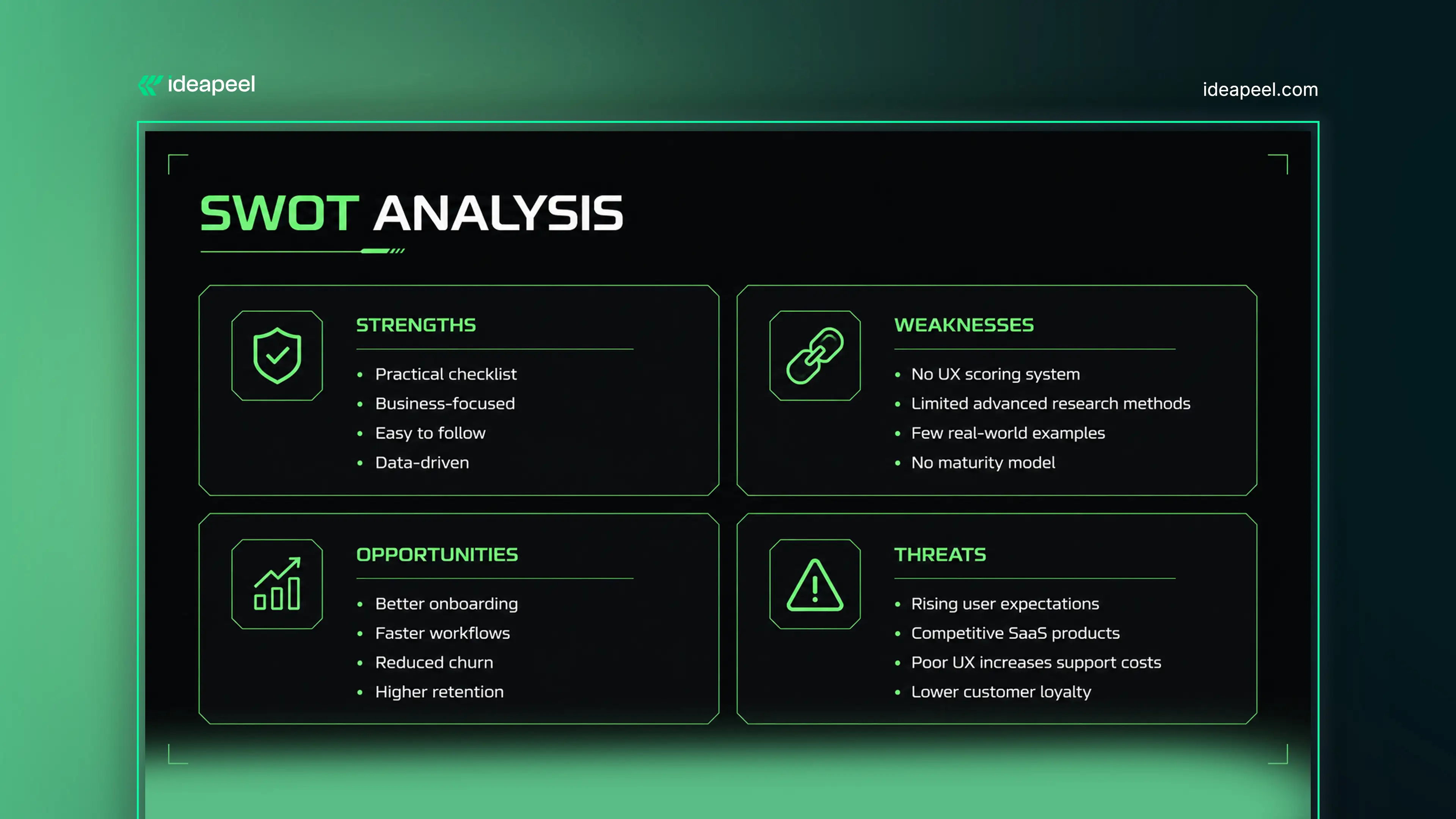
Usability: Can visitors complete key tasks quickly and without confusion?
Accessibility: Can people with visual or motor impairments use your site?
User flow: Is there a clear path from the landing page to the conversion point?
Navigation: Can users find what they need without hunting?
Performance: Does the site load fast enough to keep people from leaving?
User satisfaction: After using your site, do visitors feel like it was easy and worth their time?
Why UX Impacts Revenue
70% of users abandon signup flows due to friction or confusion, and 44% of users who experience usability issues do not return. These are not small numbers. Every piece of friction on your site is quietly costing you sign-ups, demo requests, and revenue.
Every second of load time delay reduces conversions by 7%. That alone makes performance a UX issue, not just a technical one.
UI vs UX, What's the Difference During an Audit?
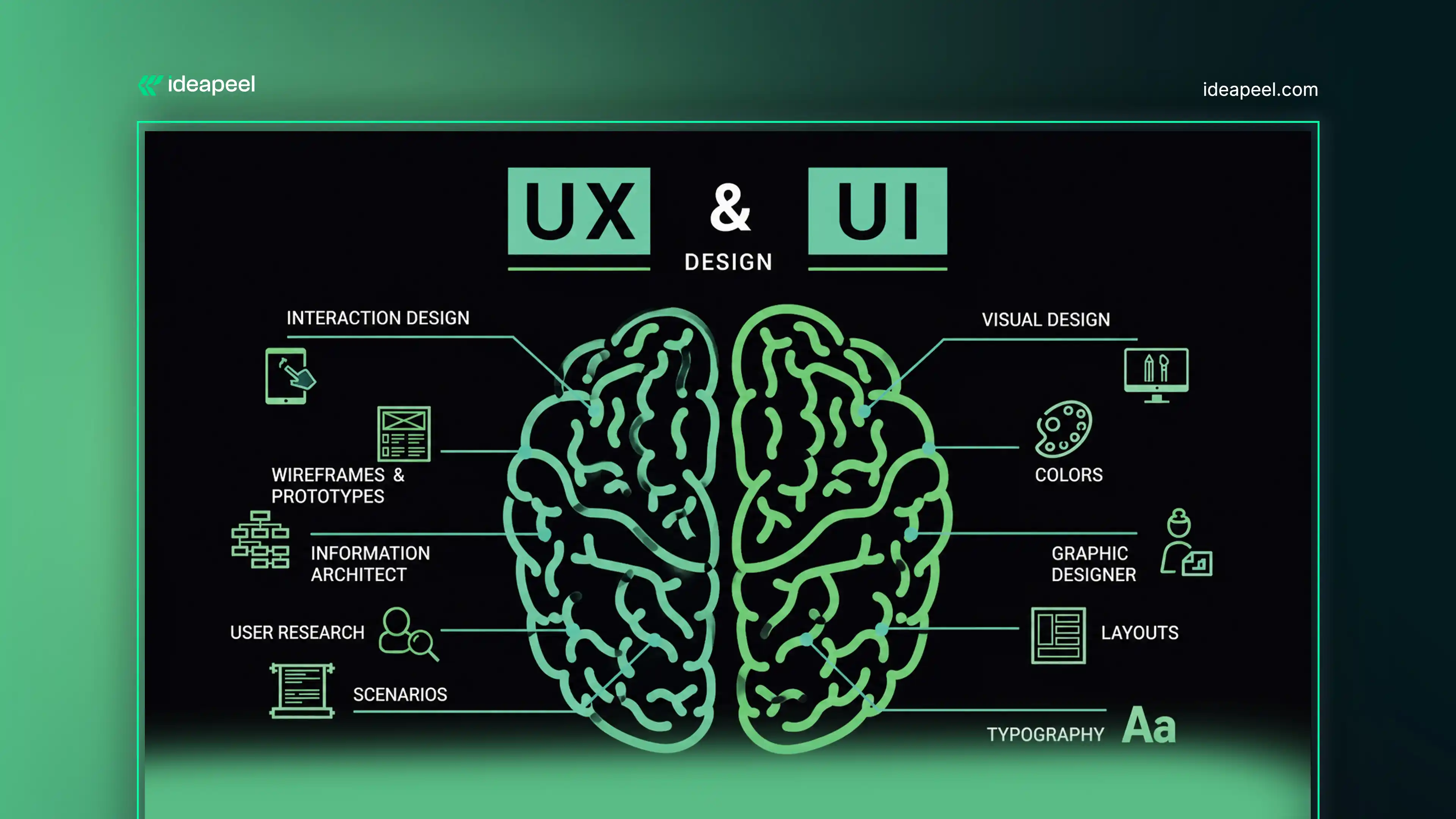
This is one of the most common questions people ask when they first hear about audits. The short answer: UI is what you see, UX is what you feel.
What is the difference between a UI audit and a UX audit? A UI audit focuses on the visual design of a website: colors, typography, buttons, icons, images, and design consistency.
A UX audit focuses on the user's experience, whether navigation is easy, whether tasks can be completed without friction, and whether the site guides users naturally toward conversion. Both audits are needed because a site can look good but be hard to use, or be easy to use but look unprofessional.
UI vs UX Comparison Table
Read the full guide ui vs ux
[[inner-cta]]
How UI and UX Work Together
UI and UX are two sides of the same coin. A strong UI creates the right first impression. Strong UX keeps the visitor engaged and moves them toward action. When both are working well together, your website converts.
When UI is strong but UX is weak, the site looks great, but visitors get lost and leave. When UX is strong, but UI is weak, the flow is logical, but the site looks untrustworthy, and visitors still leave.
Common UI and UX Problems Found During Audits
These are the issues that come up most often in real B2B and SaaS website audits:
- Buttons that are too small or too similar to the background
- Menus that use internal jargon instead of plain language
- Hero sections that talk about the company, not the customer's problem
- Forms with too many required fields on the first step
- Pages that work fine on desktop but break on mobile
- CTAs that appear in only one place per page
- Slow load times caused by large uncompressed images
Step 1 – Audit Website Design Components
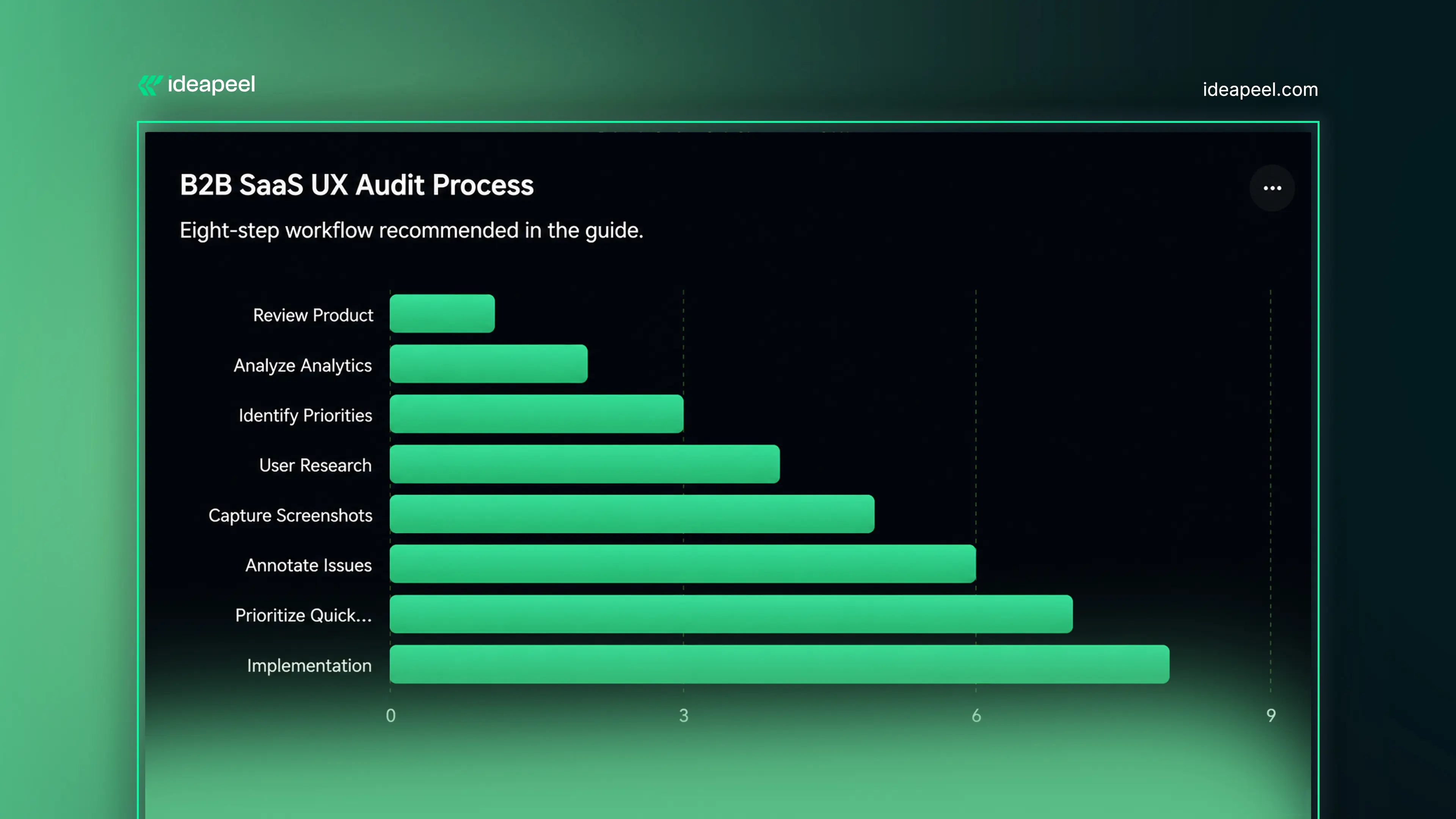
Good website design for a B2B or SaaS company is not about being flashy. It is about being clear. Every design element on your page should either help a visitor understand something or move them toward taking action.
Header Design
Your header is the first thing people see. It needs to do three things well: show your logo, provide a clear way for visitors to navigate, and include a visible CTA, whether that is "Book a Demo," "Start Free Trial," or "Get a Quote."
Check that your header stays consistent across all pages. Check that it is readable on mobile. Check that the CTA in the header is actually visible without scrolling.
Hero Section
The hero section, the first thing visitors see below the header, needs to answer three questions immediately: What does this product do? Who is it for? What should I do next?
If your hero section starts with "Welcome to [Company Name]" or focuses on your story instead of your customer's problem, it needs to change.
Calls-to-Action (CTAs)
Your CTAs tell visitors what to do next. Every page needs at least one clear CTA. The language should be specific and action-focused. "Start Free Trial" works better than "Learn More." "Book a 15-Minute Demo" works better than "Contact Us."
CTAs should be visually distinct. They should stand out from the rest of the page through color and size.
Forms and Lead Capture Elements
Long forms kill conversions. If your contact form asks for 10 fields on the first step, most people will leave without filling it in. Ask for the minimum amount of information needed right now. You can collect more later.
Reducing form fields significantly decreases friction and improves conversion rates at the critical first touchpoint.
Footer Design
Your footer should not be an afterthought. It is where visitors go when they want to find something they could not find in the main navigation. Include key links, contact information, social profiles, and a secondary CTA.
Trust Elements
B2B buyers need to feel confident before they take any action. Trust elements help with this. These include:
- Customer testimonials with real names and company logos
- Case study links
- Industry awards or recognitions
- Security certifications (especially important for SaaS)
- Well-known client logos
Step 2 – Audit Navigation and Information Architecture
Navigation is one of the most common reasons people leave B2B and SaaS websites. If visitors cannot find what they need quickly, they will not look for long. They will leave.
Main Navigation
Your main menu should be clean and simple. Use language that your customer would use, not language your internal team uses. "Reports" is clearer than "Analytics Engine." "Team Settings" is clearer than "User Management Configuration."
The main navigation menu should be in the same position on every page, use the same labels, and always be accessible. Users should never lose their sense of "where am I?"
Mobile Navigation
On mobile, your navigation needs to be just as functional as on desktop. Hamburger menus are acceptable on mobile. However, the most important links, pricing, demo CTA, and product overview should not be buried three taps deep.
Test your mobile navigation by actually using it on a phone. If it takes more than two taps to reach your most important pages, simplify it.
Mega Menus
For larger SaaS products with multiple features or use cases, a mega menu can help. But keep it organized. Group links into logical categories. Use icons or short descriptions to help visitors quickly find where they need to go.
Mega menus that are too large or too crowded create their own confusion. If you have a mega menu, audit it separately.
Breadcrumb Navigation
Breadcrumbs show visitors where they are within your site structure. They are especially important on deep content pages, like individual blog posts, feature pages, or case studies. They reduce the feeling of being lost and make it easy to go back a level.
Search Functionality
If your site has a lot of content, documentation, multiple product features, a large blog, a search function is not optional. It is essential. Visitors who cannot find something with search will leave.
Test your search. Search for your main product features, your pricing page, your contact page. If results are inaccurate or missing, that is an audit finding.
User Journey Flow
Map out the three or four most important journeys on your site. For a SaaS company, these are usually:
- Visitor lands on homepage → reads about product → visits pricing → starts free trial
- Visitor lands on a blog post → reads content → sees a relevant CTA → books a demo
- Visitor searches for a specific feature → lands on a feature page → signs up
Walk through each journey yourself. Count every click. Every extra step is friction you can remove.
Step 3 – Audit Website Content Experience
Content is not just about SEO. It is about whether the right person, at the right stage of their journey, reads the right thing and takes action.
Homepage Messaging
Your homepage needs to communicate your value proposition in 10 seconds or less. If a first-time visitor cannot tell what you do, who you help, and why they should care, your homepage is not doing its job.
Avoid vague statements like "We help businesses grow." Get specific. "We help B2B SaaS companies reduce churn through better onboarding UX" says something real.
Product and Service Pages
Product pages for SaaS need to explain features in terms of outcomes, not just capabilities. Instead of "Advanced reporting dashboard," write "See exactly which features your users love, and which ones they ignore."
Each product or service page needs a clear audience, a clear problem it solves, and a clear next step.
SaaS Feature Pages
If your product has multiple features, each major feature deserves its own page. This is good for SEO, but it is also good for users. Buyers who are researching a specific capability need a focused page, not a long all-in-one overview.
Landing Pages
Landing pages for paid ads, email campaigns, or gated content need to match the message and design of wherever the visitor came from. If your ad says "Free UX Audit Template," the landing page needs to deliver that immediately, without distraction.
Blog Content
Your blog builds trust and drives organic traffic. But a blog that publishes generic content just to fill a calendar does not build trust. Every post should answer a real question your target audience is searching for, and it should link to relevant product pages or service pages.
Case Studies
Case studies are one of the most powerful trust signals for B2B buyers. They should follow a clear structure: the client's problem, what you did, and the measurable result. Specific numbers, "reduced time-to-value from 47 minutes to 18 minutes", are far more convincing than vague claims.
FAQ Content
FAQ sections on product pages and landing pages serve two purposes. They answer the questions buyers have before they convert, and they give Google clear, direct answers it can pull into AI Overviews and Featured Snippets.
Write FAQ answers in plain language. Keep each answer between two and four sentences. Structured, specific answers get cited.
Step 4 – Audit Conversion Rate Optimization (CRO)
What Is CRO?
CRO (Conversion Rate Optimization) is the process of improving your website so that a higher percentage of visitors take the action you want them to take, whether that is booking a demo, starting a free trial, or filling out a contact form.
It is not about getting more traffic. It is about getting more results from the traffic you already have.
Why CRO Is Part of Every UX Audit
UX and CRO are closely connected. Every usability problem on your site is also a conversion problem. A form that is too long, a CTA that is not visible, a page that loads slowly- these are UX issues, and they all cost you conversions.
A proper UI/UX audit always includes CRO as part of the review, because fixing the experience fixes the numbers.
Conversion Paths to Review
For most B2B and SaaS websites, the most important conversion paths are:
Demo requests: Is the "Book a Demo" flow smooth? How many fields does it ask for? Does a confirmation email go out immediately?
Free trials: How many steps does it take to start a trial? Does the user reach value quickly after signing up?
Contact forms: Are forms short enough that people actually complete them? Is there a clear expectation of what happens after they submit?
Newsletter signups: Is the value of subscribing obvious? Is the form in the right places on the page?
CRO Metrics to Measure
Before and after any audit, track these numbers:
- Conversion rate by page and by CTA
- Bounce rate, how many visitors leave without engaging
- Average session duration, how long visitors are staying
- Exit rate, which pages visitors leave from most
- Form completion rate, how many people start a form vs. finish it
Step 5 – Audit SEO and guide to improving userWebsite Performance
Why SEO Impacts User Experience
SEO and UX are not separate disciplines anymore. Google's ranking signals now include how people experience your site, how fast it loads, how easy it is to use on mobile, how long people stay, and whether they click back to search results immediately.
Nearly 60% of Google searches in the US end without a click. If your content is not structured to be featured in AI-powered snippets or summaries, it risks being overlooked entirely.
Website Speed and UX
Page speed is a direct UX factor. Slow pages frustrate users. They also hurt rankings.
A page that takes more than 3 seconds to load will lose a large portion of its visitors before they ever read a word. For SaaS and B2B sites, where the cost per visitor from paid channels is high, slow pages are an expensive problem.
Core Web Vitals
Google's Core Web Vitals are three performance metrics that measure real user experience:
LCP (Largest Contentful Paint): How long it takes for the main content of the page to load. Aim for under 2.5 seconds.
INP (Interaction to Next Paint): How quickly the page responds when a user clicks or taps. Aim for under 200 milliseconds.
CLS (Cumulative Layout Shift): How much the page layout shifts while loading. Aim for a score under 0.1.
These three scores directly affect your Google rankings. Check them in Google Search Console or PageSpeed Insights.
Mobile Performance
More than half of B2B research starts on a mobile device. If your site has a poor mobile experience- small text, buttons that are hard to tap, content that overflows the screen- you are losing a significant portion of your audience.
Mobile cart abandonment rates reach up to 85.7%, largely due to unoptimized layouts and cluttered conversion flows. Simplifying the mobile experience can lift conversions by up to 35%.
Internal Linking Structure
Internal links help search engines understand your site's structure. They also help visitors navigate to related content. Every blog post should link to relevant product or service pages. Every product page should link to related case studies or feature pages.
Broken internal links, links that go to 404 pages, hurt both UX and SEO. Run a broken link check as part of every audit.
Technical SEO Review
Beyond speed and Core Web Vitals, a technical SEO review covers:
- HTTPS security: your site must be on HTTPS, not HTTP
- Structured data: schema markup helps Google understand your content and can get it featured in rich results
- Clean URL structure: URLs should be readable, short, and descriptive
- Proper use of canonical tags to avoid duplicate content issues
- XML sitemap is up to date and submitted to Google Search Consol
Complete UI/UX Audit Checklist for B2B & SaaS Websites
Use this master checklist to run a full audit of your website. Work through each section and mark each item as Pass, Fail, or Needs Review.
Design
- Branding is consistent across all pages, colors, fonts, and logo treatment
- Typography is readable on all screen sizes
- Visual hierarchy makes key information easy to find
- Design meets WCAG 2.1 AA accessibility standards
- Website is fully responsive on mobile and tablet
Navigation
- Main menu structure is logical and uses plain language
- Search functionality returns accurate results
- Mobile navigation is easy to use
- Breadcrumbs are in place on deep content pages
- Key user flows can be completed in 3 clicks or fewer
Content
- Homepage value proposition is clear in 10 seconds
- Product and feature pages focus on outcomes
- Blog content answers real customer questions
Case studies include specific, measurable results
- FAQ sections give clear, direct answers
- Internal links connect related content naturally
CRO
- CTAs are specific, visible, and action-focused
- Forms are short and low-friction
- Social proof is visible near conversion points
- Trust signals appear close to CTAs and forms
- Conversion tracking is active and accurate
SEO & Performance
- Pages load in under 3 seconds
- Core Web Vitals pass
- Site is mobile-optimized
- Internal links are active, no 404 errors
- Structured data is in place for key pages
UI/UX Audit Snapshot Template
After running your audit, score each area out of 5 and use the table below to get your overall UX health score.
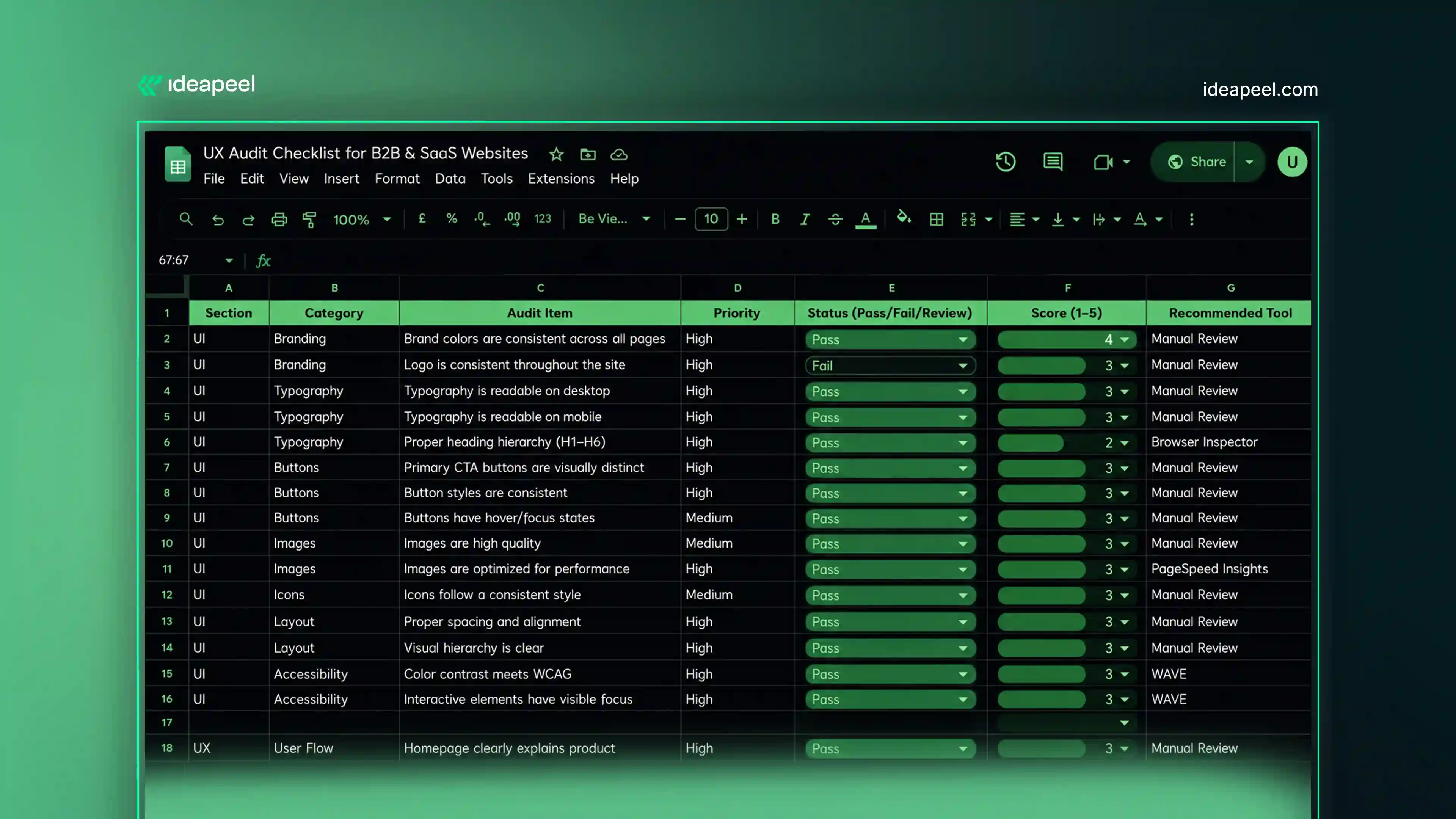
Check the master sheet: Free ui/ ux audit checklist
Common UX Audit Mistakes Found on B2B & SaaS Websites
These are the problems that come up in almost every B2B and SaaS website audit. Check if any of these apply to your site.
Confusing Navigation
When visitors cannot find your pricing page, your product features, or your contact form quickly, they leave. The fix is not always a redesign. Often it is just renaming menu items, reducing the number of top-level options, or adding a sticky header on mobile.
Weak Value Propositions
Too many SaaS websites open with "The #1 platform for [category]" or "Empower your team with [product name]." These headlines say nothing. A strong value proposition is specific. It names who the product is for, what problem it solves, and what result the user gets.
Poor Mobile Experience
Even if your desktop experience is excellent, if the mobile version has small text, overlapping elements, or CTAs that are hard to tap, you are losing a large portion of your audience. Mobile is not optional for B2B or SaaS anymore.
Slow Website Speed
Page load times and response times are a critical part of any UX assessment. Slow performance creates friction that affects every other part of the user experience. Start with image compression, then look at third-party scripts and hosting.
Inconsistent UI Design
When different pages of your site look like they were designed by different teams , and sometimes they were, it breaks trust. Visitors notice inconsistency, even if they cannot explain why something feels off. Establish a clear design system and apply it consistently.
Low-Converting CTAs
A CTA that says "Submit" or "Learn More" gives the visitor no information about what happens next. Specific CTAs convert better. "Get My Free Audit," "Start My 14-Day Trial," "Book a 20-Minute Demo" , these tell the user exactly what they are getting.
Complex Signup Flows
Trial limitations that prevent users from experiencing the product's core value can hurt conversion more than help it. If your trial is so restricted that users cannot reach the "aha moment," the trial itself becomes a barrier.
Simplify your signup flow. Reduce required fields. Let people explore before asking them to commit.
Recommended UX Audit Checklist Tools
You do not need expensive enterprise software to run a solid audit. Here are the best tools organized by category.
Analytics Tools
Google Analytics 4: Shows traffic sources, bounce rates, page engagement, and conversion events. Free and essential.
Mixpanel: Better for tracking in-product behavior and funnel drop-off. Useful for SaaS audits specifically.
Heatmap Tools
Hotjar: Shows where visitors click, scroll, and hover. Heatmaps reveal which parts of your page people actually engage with versus ignore.
Microsoft Clarity: Free heatmap and session recording tool with strong filtering options.
Session Recording Tools
Hotjar or FullStory: Record real user sessions so you can watch where people get confused, where they rage-click, and where they abandon forms.
Session recordings are one of the most valuable inputs in any UX audit. They show you reality, not assumptions.
SEO Audit Tools
Google Search Console: Tracks your search performance, Core Web Vitals, and any indexing issues.
Ahrefs or Semrush: Check for broken links, keyword rankings, and technical SEO issues. Essential for a full audit.
Performance Testing Tools
Google PageSpeed Insights Scores your page speed and Core Web Vitals with specific suggestions for improvement.
GTmetrix gives a detailed breakdown of what is slowing your site down and how to fix it.
Accessibility Testing Tools
WAVE (WebAIM) checks your site for WCAG accessibility violations and gives specific recommendations.
axe DevTools A browser extension that runs accessibility audits directly in Chrome or Firefox.
Why Choose ideapeel for UI/UX Audits?
Running a UI/UX audit takes time, experience, and the right tools. Ideapeel combines all three.
Data-Driven Analysis
Every recommendation in an Ideapeel audit is backed by real data, analytics, heatmaps, session recordings, and performance benchmarks. Not guesswork.
B2B & SaaS Expertise
Generic UX advice does not work for B2B and SaaS websites. Ideapeel specializes in the specific challenges these companies face: long sales cycles, multiple buyer personas, complex product messaging, and high-value conversion paths.
SEO + UX + CRO Approach
Most agencies audit one thing. Ideapeel audits how SEO, UX, and CRO work together, because fixing only one piece of the puzzle will not get you the results you need.
Actionable Recommendations
An audit that gives you a 90-page PDF with 200 observations is not useful if you do not know where to start. Ideapeel delivers prioritized, actionable recommendations, organized by impact and effort so your team knows exactly what to do first.
Continuous Optimization Support
A UI/UX audit is a starting point, not a finish line. Ideapeel works with B2B and SaaS teams on an ongoing basis to test, refine, and improve their websites over time.
[[last-cta]]
.webp)
Artificial intelligence has become a core part of modern Webflow workflows. From planning site architecture and writing landing page copy to generating custom code and improving SEO, AI assistants are helping designers and developers work faster than ever before.
Among the many AI tools available today, two names consistently stand out: Claude and ChatGPT. Both can assist with Webflow projects, but they excel in different areas. Choosing the right one depends on whether your priority is coding, content creation, documentation, CMS planning, or agency productivity.
In this guide, we'll compare Claude vs ChatGPT for Webflow across real-world tasks, including website planning, custom code generation, CMS architecture, SEO optimization, client documentation, and day-to-day development workflows. By the end, you'll have a clear understanding of which AI is the better fit for your projects in 2026.
Quick Answer: Which AI Is Better for Webflow?
For most Webflow professionals, ChatGPT is the stronger all-around choice. It combines coding assistance, SEO support, content creation, design brainstorming, workflow automation, and image generation in a single platform. Claude performs exceptionally well when working with large documents, comprehensive audits, and long-form project planning.
If you're a freelancer or agency building and optimizing Webflow websites every day, ChatGPT typically offers the most complete workflow. If your work involves analyzing extensive documentation or creating detailed reports, Claude is an excellent complementary tool.
Why Webflow Professionals Are Using AI in 2026
The demand for faster website delivery and higher-quality digital experiences has pushed AI into the center of Webflow development.
Teams now use AI to:
- Generate HTML, CSS, and JavaScript snippets.
- Plan CMS collections and dynamic content structures.
- Create SEO-friendly blog posts and landing pages.
- Brainstorm layouts and UX improvements.
- Produce client proposals and project documentation.
- Debug custom code and streamline development workflows.
Rather than replacing designers and developers, AI accelerates repetitive tasks so professionals can focus on strategy, creativity, and user experience.
Understanding Claude and ChatGPT
What Is Claude?
Claude is an AI assistant known for its ability to process lengthy documents and provide structured, thoughtful responses. It performs particularly well when reviewing design systems, technical documentation, project briefs, and large content libraries.
For Webflow teams managing enterprise projects or extensive client documentation, Claude can help organize information and produce detailed analyses without losing context.
What Is ChatGPT?
ChatGPT is a versatile AI assistant that supports coding, writing, brainstorming, SEO, automation, and image generation within one ecosystem. It is widely used by Webflow developers and designers to create custom code embeds, improve site content, plan CMS structures, and speed up production workflows.
Its combination of technical capabilities and creative assistance makes it especially useful for agencies and freelancers handling multiple client projects.
What Makes an AI Useful for Webflow?
Not every AI assistant delivers the same value for Webflow projects. The best tools typically excel in five areas.
Design Assistance
Strong AI tools can suggest landing page structures, user flows, style guides, accessibility improvements, and conversion-focused layouts before development begins.
Development Support
Developers often rely on AI for:
- HTML generation
- CSS optimization
- JavaScript snippets
- Custom embed code
- Responsive fixes
- API integration guidance
CMS Planning
For content-heavy websites, AI can simplify:
- Collection planning
- Multi-reference fields
- Dynamic content structures
- Blog architecture
- Scalable information models
SEO Optimization
AI can also assist with:
- Keyword-focused outlines
- Meta titles and descriptions
- Schema suggestions
- Internal linking ideas
- Content briefs
- Search optimization strategies
Client Workflow
Beyond design and development, AI improves productivity by helping create proposals, technical documentation, onboarding materials, meeting summaries, and project plans.
Claude vs ChatGPT: Quick Comparison
ChatGPT for Webflow Development
Better Front-End Development Support
ChatGPT consistently performs well when generating custom CSS, JavaScript interactions, responsive layouts, animation logic, and Webflow embed code. Developers can iterate quickly by refining prompts and debugging snippets within the same conversation.
Strong SEO Workflows
Webflow agencies frequently use ChatGPT to create:
- Blog outlines
- SEO briefs
- Meta descriptions
- Structured content
- Schema recommendations
- Internal linking ideas
Because it combines technical understanding with marketing knowledge, it is especially valuable for SEO-driven websites.
Design Brainstorming
During planning stages, ChatGPT can suggest:
- SaaS landing page structures
- Homepage layouts
- UX improvements
- Conversion-focused sections
- Content hierarchy
- Navigation ideas
These recommendations help teams move from concept to execution more efficiently.
Visual Content Creation
One notable advantage is built-in image generation, allowing designers to rapidly create hero concepts, marketing visuals, illustrations, and creative inspiration without switching tools.
Claude for Webflow Development
Long-Form Analysis
Claude shines when processing extensive design documentation, content inventories, project requirements, and large website audits. It maintains context across long inputs and produces organized outputs that are easy to review.
Documentation and Reporting
Many agencies use Claude to create:
- Technical specifications
- Standard operating procedures
- Client reports
- Design documentation
- Project summaries
Its structured writing style makes it particularly effective for collaborative environments.
Strategic Planning
When planning CMS architecture or information hierarchy, Claude often produces detailed explanations and methodical reasoning that can help teams make informed implementation decisions.
Real-World Webflow Testing
Building a CMS Structure
ChatGPT
- Faster recommendations
- Practical examples
- Scalable collection planning
Claude
- Thorough documentation
- Logical organization
- Detailed planning
Winner: Tie
Writing Custom JavaScript
ChatGPT
- Faster iteration
- Strong debugging
- Practical implementation
Claude
- Clear explanations
- Conservative coding style
Winner: ChatGPT
Creating SEO Content
ChatGPT
- Better keyword optimization
- Conversion-focused writing
- Marketing-oriented structure
Claude
- Natural language
- Strong readability
Winner: ChatGPT
Website Audits
ChatGPT
- Actionable recommendations
- Fast technical insights
Claude
- More comprehensive reviews
- Better handling of lengthy reports
Winner: Claude
Which AI Is Best for Different Webflow Users?
Freelance Designers
Best Choice: ChatGPT
Freelancers benefit from faster coding assistance, content creation, design ideation, and client communication within one platform.
Webflow Agencies
Best Choice: ChatGPT + Claude
Many agencies use ChatGPT for production tasks while relying on Claude for audits, documentation, and large-scale planning.
Developers
Best Choice: ChatGPT
Its strengths in JavaScript, HTML, CSS, debugging, and API guidance make it an effective coding assistant.
Content Teams
Best Choice: Claude
Its long-context capabilities and structured writing style make it valuable for documentation-heavy workflows and extensive content reviews.
Final Verdict
For most Webflow professionals in 2026, ChatGPT provides the most complete end-to-end experience. It supports coding, SEO, design ideation, automation, research, and content creation within a single workflow, reducing the need to jump between multiple tools.
Claude remains an outstanding option for documentation, enterprise-scale planning, and large project analysis. Teams handling complex requirements or extensive audits can benefit significantly from its strengths.
The best choice ultimately depends on your workflow, but many agencies find that combining ChatGPT for execution with Claude for analysis delivers the highest productivity and quality.