— ideapeel Blog


Did you know that 42% of SaaS startups fail due to "no market need" for their product?
As the SaaS industry continues to evolve and AI has dramatically shifted the landscape, most SaaS startups fail to survive!
The solution? Partner with the right software development company that helps you stay ahead through innovation, adaptability, and the proper strategic, agile methods to launch a product that meets customer demand.
This comprehensive guide will suggest the top 10 best SaaS development companies, highlighting strengths, industry recognition, and key advantages. So, you can select the best one that helps you navigate challenges and build products that truly resonate with your target audience.
Our Criteria for Selecting the Top SaaS Development Services in 2025
SaaS market growth will rapidly increase and reach $295 billion U.S. dollars by 2025.
We understand the significance of choosing the right SaaS development company to explore this competitive growth market further.
There's no chance of getting overwhelmed with sweet promises and ending up trapped with an ineffective platform that fails to deliver ROI and revenue.
Therefore, we've created this competitive list based on deep research and analysis that meets your business goals and drives measurable success. We've followed the criteria to choose the best SaaS development company.
1. Analyze data from reliable sources:
We started by researching from standard sources such as Forbes, Clutch, and Goodfirms.
We closely identify the user ratings and reviews on those platforms and demonstrate the list of SaaS development companies in 2025.
2. Research testimonials and customer reviews
We've studied the numerous testimonials, case studies, and reviews from the authentic website pages of development companies.
We find out how they dynamically overcome the challenges and give ultimate solutions to their clients. We've examined metrics such as,
- Timely delivery of projects
- Responsiveness
- Post-launch support
- Ability to solve complex projects
3. Certification and awards
Our selection process and examination of certifications and awards ensure a trusted and reliable SaaS development partner.
We prioritize ISO certification and AWS-certified SaaS application development. Also, the awards they achieve in a specific service should be considered.
4. Identifying technical expertise
We don't compromise our experience and technical expertise in selecting the best company.
We take companies with deep expertise in modern SaaS technologies such as cloud computing, microservices, APIs, and scalability solutions.
5. Innovation and trends
While choosing the right SaaS development platform, our software engineering team analyses whether they will follow SaaS app development trends in 2025. We scrutinized their capacity to maintain a competitive edge by utilizing machine learning, integrating artificial intelligence, and leveraging data analytics.
6. Customer support and maintenance
We evaluated companies based on post-launch support and long-term maintenance. So you do not feel lost on this journey.
Look at SaaS Software Development Trends 2025 to confidently launch your SaaS!
List of Top 10 Software Development Companies
1.ideapeel

ideapeel is a recognized software development company committed to providing top-notch, client-centric design for diversified businesses worldwide.
You'll get the desired results from a startup business, B2B, B2C, or enterprise at an affordable price.
ideapeel specializes in custom SaaS solutions that align with your business goals and ensure long-term success. This platform provides global development services, has completed 166+ successful projects, and quickly earned customer retention.
Basic information
Founded: January 1, 2022
Headquarters: Atlanta, GA
Employee Size: 20+
Completed project: 166+
Minimum hourly price: $100
Revenue generated: $330M
Notable clients: Homepark Housing, Glo Dollar, Carwisela , AlphaWave, BrightCore, Visionary Ventures,
Key Services:
- SaaS app development
- Web development and design
- UI/UX design
- Custom SaaS solutions
- SaaS integration services
- Webflow for SaaS
- SEO
- Marketing
Industries:
SaaS, Real Estate, Automotive, FinTech, E-commerce, Healthcare, Gaming.
What Sets ideapeel Apart:
Deliver user-friendly design: ideapeel focuses on building your brand identity through user-friendly website design.
Security & compliance: Ensure scalable SaaS solutions with top-notch secure service.
Ensure seamless integration: Expert in integrating advanced software as a service tool, such as CRM systems and project management tools, to enhance business efficiency.
Dedicated service: Deliver continuous post-launch support to keep your website up to date.
Get a free consultation today.
2. Cleveroad

Cleveroad is an award-winning custom SaaS application developer that provides SaaS solutions for companies of all sizes.
They completed over 170+ successful projects and continued to deliver SaaS solutions to streamline operations for 13+ years. Cleveroad has multiple tech development teams in each category to handle your project perfectly.
The best part is they offer extra services like IT consultation to grow your business with a single platform.
Basic Information
Founded: 2011
Headquarters: Claymont, Delaware, USA.
Employee Size: 280+
Completed project: 170+
Notable clients: HSBC, Nokia, Octopus
Key Services:
- Cloud-based software development
- Mobile and web applications
- UI/UX design
- DevOps integration
- Software testing
- AI-driven SaaS platforms
- Internet of Things (IoT)
Industries:
Health tech, med tech, supply chain and logistics, fintech, blockchain, and retail.
What Set Cleveroad Apart
Multi-tenant architecture: Scaling business with a certified designer team and industry expert keeps them ahead of competitors.
ISO 9001-certified quality management system: This certification reflects their commitment to delivering the high-quality development result you are looking for.
Use the best development framework and practices: Ensure your website features rich functionality and an excellent user experience to grow your business.
3. Simform

If you are looking for an enterprise-grade software development partner, then Simform is an ideal solution.
This platform is mainly a product development company within emerging fields like AI, cloud computing, and IoT—the best thing for reliable SaaS solutions in the modern era!
With 12+ years of experience in SaaS development, Simform provides innovative SaaS with the strength of the agency, development firms, and large system integrators and grows with happy customers.
Basic Information
Founded: 2010
Headquarters: Orlando, FL
Employee Size: 1300+
Notable clients: Pepsico, Microsoft, Panasonic.
Key Services
- UX design
- Custom software development
- Application development
- IoT and connected devices.
- Web 3.0 and XR
- DevOps automation
- API development.
- Microservices architecture
Industries
Retail, Healthcare, FinTech
What Sets Simform Apart
Access to cutting-edge cloud technologies: Strong partnerships with AWS, Google Cloud, and Microsoft Azure enhance resources for your business.
Strategic roadmap: Map out your needs and build a comprehensive requirement intake model and technology stack to ensure the highest visibility and ROI
Scalable solution with modern technologies: Excel in AI, cloud computing, and IoT to enhance proficiency and keep your business up to date.
4. Chetu

Chetu is a US-based one of the top SaaS development companies, popular for its cost-effective solutions.
Besides standard software solutions, Chetu focused on scaling businesses through AI-driven technologies.
This platform serves almost 40+ industries with a specialized team. Chetu is well recognized worldwide—5,000 Fortune companies use advanced software solutions and services.
Basic Information
Founded: 2000
Headquarters: Sunrise, Florida, US
Employee Size: 5000+
Notable clients: Johnson & Johnson, Clear, CloudBlue
Key Services:
- SaaS product development,
- Enterprise software integration,
- Custom cloud-based apps
Industries:
Healthcare, finance, gaming, real estate, payment, and 35+ more.
What Set Chetu Apart
Responsive design: Provide compatible software solutions and services across all devices.
Transparency: Allow clients to get open and live communication within technical teams to ensure the desired app or web experience.
Reasonable price: Popular for delivering cutting-edge software solutions and services at affordable prices compared to competitors.
5. Leewayhertz

Leewayhertz is known for its cutting-edge AI development solution that transforms the digital experience with the latest technologies.
For over 15+ years, this platform has been partnering with 500 Fortune companies and has a proven record of delivering SaaS application development tailored to clients' needs and budgets.
AI-driven software development ensures the highest security standards and proper maintenance—it gives you a hassle-free platform!
Basic Information
Founded: 2008
Headquarters: San Francisco, California
Employee Size: 100+
Notable clients: U.S. Army, Hershey's, 3M.
Key Services:
- Software development
- SaaS development
- Software consulting
- UI/UX design service
- Web Development
- Digital Transformation
Industries:
Finance, Retail, Healthcare, Manufacturing, Logistics, Insurance.
What Set Leewayhertz Apart
Strategic Roadmap: Start with a clear, realistic roadmap in 5 core steps aligned with the latest development strategies and industry-specific challenges.
Open Communication: Act and respond quickly to transform your ideas into reality—even if it's a minor feature!
6. Accenture

Accenture is a leading SaaS development company handling complex projects within global reach, including a successful partnership with Google Cloud service.
This platform earned a reputation with over a decade of experience in a wide range of IT consultations and services. Accenture deals with the modernised AI platform through end-to-end SaaS solutions.
Their vision is to scale up and lead the business through reliable software development services. Accenture has already reached a milestone of helping 9000+ enterprises across 120+ countries.
Basic Information
Founded: 1989
Headquarters: Dublin 2, Ireland
Employee Size: 799k+
Notable clients: Adobe, Alibaba, Amazon Web Services
Key Services:
- Cloud-based software providers
- Cybersecurity
- Product engineering
- Migration services
- SaaS Strategy Consulting
Industries:
Health, High Tech, Automotive, Insurance, Retail, public service and 15+ more.
What Set Accenture Apart
Globally Recognized Platform: Successful partnership with Google Cloud service, AWS, Oracle, Alibaba, and more reputed brands– deliver outstanding development solutions and consulting services.
Extensive network of experts: Ensure a robust and scalable solution with a vast industry expert team.
7. Saigon Technology Solutions

Saigon Technology Solutions is a Vietnam-based offshore software development service that provides a reliable SaaS project at an affordable range.
Over 12+ years of experience, it handled all crucial Saas application development services for startups and large enterprise organisations.
They started with three software engineers to design web and mobile apps, and now they have 400+ technical experts to deliver agile software development.
Basic Information
Founded: 2012
Headquarters: Ho Chi Minh City, Vietnam
Employee Size: 400+
Notable clients: Abbott, Standard Chartered Bank, RSM Singapore.
Key Services:
- Offshore software development
- Web development
- Mobile app development
- Custom software development
- SaaS solutions
- UI/UX design
Industries:
E-finance, e-business, logistics, transportation, healthcare, media and other industries.
What Set Saigon Apart
Cost-Effective Solution: With a highly qualified team, Saigon ensures scalable SaaS products and post-launch support that cuts off extra expenses.
Client-Centric Model: A clear roadmap and tight schedule with outlined desired deliveries for a long-run SaaS project. It is an effective solution for enterprise and complex projects.
8. Intellectsoft

Intellectsoft's highly rated software development company offers a complete development lifecycle with innovative solutions.
With 17 years of experience, Intellectsoft has a proven record of developing, testing, upgrading, or scaling digital products to enhance business growth.
Already, Intellectsoft has demonstrated 37% revenue growth in the last 2 years through digital SaaS development solutions.
From idea generation to launching your business, Intellectsoft handles everything from enterprise-class business growth perfectly!
Basic information
Founded: 2007
Headquarters: New York, US.
Employee Size: 210+
Notable clients: Nestle, Harley Davidson, Audi.
Key Services:
- Enterprise software development
- Mobile App Development
- DevOps
- IT Consulting
- UI/UX design
Industries
Healthcare, FinTech, logistics, Automotive, Retail and more.
What Set Intellectsoft Apart
Custom software development: Expertise in delivering top tyre software service that aligns with your business model.
Agile development methodology: Use agile best practices to allow flexibility and efficiently adapt to any fast change.
9. Fingent

Another software development company based in the U.S. is Fingent. Fingent has two decades of experience in dealing with 100+ clients worldwide.
They offer entirely technological and agile approaches to foster structured software platforms that competitors never leave behind.
With a dynamic team of 600+ professionals, this platform delivers the best custom SaaS solution in the U.S.
Basic information
Founded: 2003
Headquarters: New York, US.
Employee Size: 600+
Notable clients: NEC, Johnson, CBN, Sony
Key Services:
- Custom software development
- Product development
- Web development
- Mobile application development
Industries:
Financial, Real Estate, Logistics, Non-profit, Sports, Travel, and more
What Set Fingent Apart
End-to-end software development: Scaling business with extensive data analysis, research, wireframing, prototyping, and product launch.
Focus more on user experience: Designing user-friendly and interactive software web applications or mobile apps to enhance business revenue growth.
10. Geniusee

Geniusee is best for its AI-driven SaaS application development to empower businesses quickly.
This digital platform is almost successfully running with 6 years of experience through full cycle software and product development.
Genuisees tailored to tech stack for particular business and commitment to end up with the desired user-centric design.
Basic information
Founded: 2017
Headquarters: New York, US.
Employee Size: 210+
Notable clients: Nestle, Harley Davidson, Audi.
Key Services:
- Software development
- MVP development
- AI drive platform
- Cloud infrastructure
- Integration Services
Industries:
Edtech, Fintech, Real Estate, and Retail
What Set Geniusee Apart
Transparent communication: Use Jira and Slack tools to communicate with you to ensure open and transparent discussion in all stages.
Deliver on time: Never be too late, even when handling large and complex projects. Here, team collaboration and high-tech expertise are appreciable.
Checkout how SaaS differs from Custom Software development and choose the best one for your business.
Key Considerations for Selecting the Right SaaS Development Services in 2025
It's your turn now to choose the right SaaS. As you know well, which service gives the desired result according to your needs, requirements, and budget?
Identify your business needs
First, understand what challenges of business you are trying to address. Or, what must-have features or solutions are you looking for?
Example: Are you trying to scale up a large enterprise? Or want a specific feature on your mobile application. Consider what makes an actual difference in selecting the SaaS development agencies.
Evaluate expertise in a specific niche
Don't mess up with a thousand's list of SaaS services. You should select based on industry expertise in the specific niche.
Like Real estate, healthcare, or Edtech!
Communication and Collaboration
Your comfort zone is another key factor! So, please take a look at how they communicate with past clients. Are they responsive to resolve any issues during deployment?
Data security
Your data is the priority! Ensure the Saas companies have compliance certifications and protocols to secure your data.
Pricing
Consider the price model they offer with the service's outline. Does this match your budget and needs? Don't forget to select the budget based on short-term or long-term projects.
Why Choose ideapeel as a Leading SaaS Provider 2025?
ideapeel is a Web development agency specializing in designing web and mobile applications with a prioritized user experience.
Here's a reason you should choose Idea Peel for your SaaS project:
- A dynamic team of Web developers and designers.
- Focused on user-centric design at minimal cost
- Offer custom software development using agile methodologies and tech stack.
- End-to-end software development solutions to scale up your business at a high level.
- Responsive and transparent communication to resolve any issues you're addressing.
- Post-launch support and website maintenance.
How We Serve the Best SaaS Solutions 2025?
We provide an end-to-end software development process in 5 Core steps:
Schedule a meeting: We first fixed a meeting where you can address your needs, business goals, and other requirements. We prioritise everything you want and then deliver a plan for our working process.
Research: Our senior developer and industry experts are well-researched to find solutions that align with your business needs.
Design and prototyping: Our creative UI/UX designer started to make a mockup of the SaaS product to allow you to see what it will look and feel like.
Development and delivery: In the final phase, the developer transforms the mockup into a real-life product or website! We deploy, test, and ensure everything is perfect to launch.
Post-launch support: We don't end up with a development process. Ensuring nothing didn't go left, we tied up with a long-term collaboration with you and supported you through the journey.
Ready to get a successful SaaS product? Contact ideapeel today!
Conclusion
We've tried our best to introduce top SaaS providers that give you hassle-free selection for leveraging business in 2025!
Don't get the right one yet? Note down your business needs, budget, and other requirements. Next? Join a free consultation with ideapeel, and let us handle the rest!

About 75% of businesses experience productivity improvement after adopting software solutions!
Software solutions are crucial to accelerating business growth, efficiency, and customer retention to gain a competitive edge. But what type of software solution is right for your business—SaaS or Custom software development?
While choosing between SaaS and software development, you should look for key features– customization, accessibility, ownership, security, and maintenance.
In this guide, we'll explain the key differences and help you choose the solution that best suits your unique business needs. So, keep reading.
What is SaaS (Software as a Service)?
SaaS, as Software as a service, is a ready-made software solution based on cloud hosting. It is actually a subscription model-based solution that allows users to access software without purchasing or installing it on individual devices and servers.
SaaS has become the dominant software application, representing over 50% of the market. These statistics show how rapidly SaaS is commonly the best choice for all business sizes!
Common Example of SaaS:
On average, 112 SaaS apps are used by different company sizes worldwide. You may not know, but you already use SaaS for project management tasks and business operations. Such as:
Zoom: Zoom is the best video conferencing SaaS application used worldwide. It offers a subscription-based model over the Internet for users.
Shopify: Shopify is a popular SaaS Platform that provides cloud-based solutions. It allows businesses to create and manage their e-commerce store without the hassle of hosting, security, and maintenance.
What is Custom Software development?
Software development is custom-based software designed to meet specific business needs and goals.
Custom software gives you full ownership and control over design, infrastructure, data, and security. Custom software has no limited features or access as it does not interrupt third parties.
66% of businesses use custom-based software as a strategic advantage to improve efficiency.
Successful examples of Custom Software:
McDonald's: McDonald's has integrated custom software with a contactless payment system and self-serve kiosks. It contributes to an effortless payment system for users, which increases order volume!
Alibaba: Alibaba is a recognized e-commerce platform spreading its popularity locally and internationally, with billions of merchants and customers. Alibaba's cloud computing services, Alipay, and innovative retail solutions are powered by custom software to support global operations and business growth.
SaaS vs Custom Software development: Quick Comparison Chart
SaaS vs Custom Software Development: Detailed Comparison
1. Customization
Software development offers a high level of customization compared to SaaS.
Custom software tailored to unique features and solutions that are right for your business. So, there are many more options for personalization, even in future growth.
Whereas SaaS is a ready-made solution that fits all sizes of business. It focuses more on standardized solutions limited to predefined settings, themes, or configurations.
2. Scalability
SaaS is highly scalable and can easily add or remove storage, data, and resources.
As SaaS is hosted on the cloud, a business can be scaled up or down by adjusting subscription plans. So you don’t need to invest in extra hardware or software licenses.
Custom software is also scalable when it's built-in and has large-scale growth. Unlike SaaS, scalable custom software solution requires additional expertise, developer, or architecture to maintain frequent updates, security patches, and optimization.
3. Deployment phase
The deployment process of SaaS is much faster and easier than custom software development.
Depending on the project's complexity, custom software requires a longer development process, from weeks to months. Software development involves testing, configuration, integration, and deep customization.
In contrast, SaaS products are ready-to-go options. After subscriptions, you can start using the software instantly. You don't need to take the hassle of lengthy development, configuration, update, or other manual deployment– all things the providers handle.
4. Cost structure
SaaS is a more cost-effective solution than software development in the initial stage.
SaaS is a subscription-based pricing model. Mainly, it offers a tiered subscription (Basic, Pro, Enterprise) fee to use the software. So, you may scale up your business by upgrading plans.
SaaS is an affordable solution for those who don't have the resources to invest in development, infrastructure, or maintenance.
Meanwhile, traditional software requires high upfront investment due to development and infrastructure costs, regular maintenance updates, and support.
A long-term software platform–where custom software shines! You’ll receive the highest ROI if the well-designed custom software runs align with your business needs.
5. Accessibility
When it comes to easy accessibility, SaaS will leapfrog software development.
Custom-built software requires installation on an individual device or platform. This might limit the accessibility for team members who work remotely.
Unlike custom software, you can easily access SaaS products from any location and device without a specific installation or internet connection. Here, SaaS offers smooth data flow and interoperability compared to traditional software.
6. Control
In that stage, software development will get a point for full control over infrastructure, design, data, and optimization.
Custom development gives you full control over ownership, security, and compliance. You can scale up or down your business without any limitations. Again, your highly sensitive business gets proper data security within this ownership option.
On the other hand, you can only have access to SaaS products, not ownership. With a predefined design system and limited access to data management, SaaS depends on providers' offering and ownership.
7. Security
While it's about security, custom software will be ahead in this competition over SaaS.
SaaS products are hosted by third parties like Cloud. So, the service provider handles the robust security practices.
However, many SaaS providers ensure a secure platform while maintaining GDPR, HIPAA, and ISO standards. But that may not often align with your business-specific needs.
On the other hand, software development allows full control over security measures. Businesses can choose specific protocols, encryption, and access control. But, here you might have to invest in an in-house security team to maintain security patches and updates.
8. Update and maintenance
The difference between SaaS and software development is frequent updates and ongoing maintenance.
SaaS is here the most hassle-free solution. The SaaS provider handles all automatic updates and upgrades within the same subscription fee. So, users don't need to worry about downloading or installing updates and patches.
In contrast, users handle updates, maintenance, and system improvement. So, internal resources and investment are required to handle frequent updates and bug fixes by third-party developers.
SaaS VS Custom Software Development: Which One to Choose?
Still can't understand what will be more suited for your project? This time, you'll have a transparent scenario that reflects which one best suits you!
When to choose SaaS?
- Your business needs a standard solution with an initial setup.
- Have limited resources(i.e. IT team) and budget.
- Low-maintenance solution to cut off extra expenses
- A pre-built plugin or integration system aligns with your business.
- When your business requires scale easily.
- You have remote teams or businesses that require easy accessibility with multiple devices.
When to choose Software Development?
- Your business needs specific functionalities and highly scalable solutions.
- Full control over features, updates, and deployment process.
- Data security is a top priority.
- Needs a custom UI/UX design for user experience aligned with your business needs.
- Your business runs on specific niches, like Health, Finance, or Real estate.
Get the Right Software Solution With ideapeel

Should you choose prebuilt software or a custom solution? To make the right choice, it's best to consult an expert who can help you analyze your business needs and recommend the best approach.
ideapeel is a leading software development agency that prioritizes your business goals and gives you the right approach.
That's not all! You don't have to look behind. We offer a several software development solution, such as:
B2B and B2C SaaS
We offer enterprise software development or an e-commerce SaaS platform with powerful SaaS tools that are aligned with your business needs.
Scalable MVPs
We deliver minimum viable products that ensure flexibility and scalable SaaS solutions within your business growth.
Niche SaaS
Our expert team provides high-performing and customized SaaS applications tailored to your industry-specific goals and objectives.
Custom Software
Designed fully customized software with bespoke features that align with your business needs and long-term growth.
Contact ideapeel and get affordable Software solutions without any delay!
FAQs
Is software development the same as SaaS?
No. SaaS product development differs regarding key features, usage, and benefits. SaaS offers a standard solution with an initial setup at a low upfront cost. Software development requires a long-term deployment phase that allows full business ownership.
What is the difference between custom software development and SaaS?
SaaS is an initial software solution that doesn't require installation like custom software development. Again, SaaS has limited customization options. Custom software enables fully customized solutions that align with specific business needs. Custom software also has high upfront costs for updates, security, and maintenance.
Is SaaS only cloud-based?
Not all SaaS is cloud-based. However, the cloud hosts the most common SaaS software for accessibility, budget, and cost-effectiveness. There's also On-premises SaaS available, which is less common.
Conclusion
Deciding between SaaS and Software development is a tough decision. You better know which one fits your business needs.
Always pay attention to the must-have features and solutions you need from the software! And compare the prices and ROI at the same time. You'll get the perfect solution.
This discussion is over, but I won't leave you alone. Partner with ideapeel to transform your ideas into functional software! Let's collaborate to grow your business.

In today's fast-paced digital world, creating a visually stunning and functional website is essential for enhancing your online presence.
With so many website builders available, choosing the right one can be overwhelming. Two popular options are Weebly and Webflow—but which one is the best fit for you?
Look no further!
In this comparison guide, we'll break down the features, pros, and cons of Weebly vs. Webflow, helping you determine which platform best matches your needs in 2025.
Webflow: An Overview

Webflow is a no-code website builder featuring responsive and SEO-friendly website design without the hassle of complex code.
This platform is popular among web designers, developers, and large business owners who need more advanced design, customization, functionality, and premium features to scale their business anytime.
With Webflow, you may have to consider only the learning curve, but you won't regret choosing Webflow over other platforms!
Weebly: An overview

Weebly features a simple and user-friendly website that is accessible to any non-tech-savvy user. Its drag-and-drop editor allows you to create a generic website for small businesses or online stores.
Whether you want to start a basic ecommerce platform or start a small business, going with Weebly is a wise decision, as it offers basic hosting plans and features with a free plan.
Its popularity continues due to affordable solutions and quick setup for small to medium-sized businesses and e-commerce.
Webflow vs Weebly: Quick Comparison Chart
Webflow vs Weebly: Detailed Key Differences
1. Design flexibility
Webflow offers more customized design and functionality than Weebly.
Weebly has a visual drag-and-drop editor, which allows you to design a more straightforward website!
Though it's a more beginner-friendly platform for those with zero coding or development knowledge, its advantages stop here with limited customization options.
Using Webflow, you can create highly customized designs with control over every element—layout, typography, visual elements, animation, and interaction.
This website builder has freedom of design with an advanced visual editor and custom code flexibility, allowing you to create pixel-perfect platforms.
2. Templates and customization
Webflow has a wide selection of custom templates compared to Weebly.
Weebly provides pre-designed templates to help you design websites quickly, making it ideal for beginners.
However, the templates can't be customized for complex layouts or unique designs. You can only change colours, fonts, and some structural elements.
Unlike Weebly, Webflow offers a variety of templates that can be customized and tailored to brand identity. So, your website doesn't look like a typical template website.
3. Ease of use
Weebly is a more beginner-friendly website builder than Webflow.
In Weebly, a more straightforward interface and drag-and-drop functionality let you create a website with minimal effort.
However, the Webflow website presents a more challenging learning curve because of its customizable design options.
Therefore, Webflow is ideal for users who have coding knowledge and can experiment with custom code in web design.
4. E-commerce functionality
Weebly is a built-in e-commerce tool that shines more than Webflow.
Weebly is ideal for users searching for basic e-commerce features with a quick setup. You can create a simple e-commerce store with a shopping cart, product catalogs, and payment processing on the Weebly platform.
Meanwhile, Webflow offers robust e-commerce features that customize store designs. However, third-party integration is required to manage payment processing.
Webflow is only suitable for creating a highly customized platform tailored to specific business needs.
5. CMS features
Webflow's content management system is more powerful and maintains a complex content structure.
In contrast, Weebly includes a basic CMS system that supports standard blog posts and simple content structure.
So, Webflow is a better option for large enterprises to maintain dynamic content.
Weebly is beneficial for small to midsize businesses to ensure an essential online presence.
6. SEO control and integration
Webflow offers advanced SEO control and flexible integration options compared to Weebly.
Weebly includes basic SEO features and third-party integration to enhance the user experience. However, using Weebly, you are limited to detailed SEO settings like structured data or advanced meta tag management.
Meanwhile, Webflow controls meta tags, URL structure, and sitemaps. This website building also integrates with advanced SEO tools to enhance online presence effectively.
7. Hosting and performance
Considering faster loading speed and reliable hosting, Webflow is a far better option than Weebly.
Webflow offers faster website performance due to optimized and cleaner code. Webflow hosting is built on AWS and CDN integration, which ensures faster and more secure hosting.
While Weebly offers dependable hosting, it lacks advanced features such as Webflow. Weebly might also suffer from slower speeds due to bloated codes.
8. Customer support
Weebly offers extensive customer support through live chat, 24/7 email, and phone support.
Like Weebly, Webflow offers live chat support but responds within 24-48 business hours.
Wait! Webflow can exceed your expectations with a stronger community support platform than other website builders.
Webflow has a strong community platform where users get technical help from fellow members. Again, Webflow University offers webinars and e-courses for advanced technical resources.
Check out comparisons of popular website builders' platforms:
Webflow vs Weebly: Pricing
Webflow
Webflow offers a free starter plan for building and designing a website. However, a paid plan is required to get a hosting service.
Well, here's a list of Webflow pricing:
Webflow Site plans
Basic: $18/mo (billed monthly), $14/mo (billed yearly)
CMS: $23/mo (billed monthly), $29/mo (billed yearly)
Business: $49/mo (monthly), $39/mo (billed yearly)
Webflow ecommerce plans
Standard: $42/mo (billed monthly), $29/mo (billed yearly)
Plus: $84/mo ( billed monthly), $74/mo (billed yearly)
Advanced: $235/mo (billed monthly), $212/mo (billed yearly)
Weebly:
Like Webflow, Weebly also offers a free plan, and this version includes a hosting plan—which Webflow lacks.
Webflow pricing plans are primarily expensive compared to Weebly. One thing to note: Webflow's pricing is worth it for large businesses with advanced features and faster hosting plans.
Weebly Site plans
Personal: $13/mo (billed monthly), $10/mo (billed yearly)
Professional: $16/mo (billed monthly), $12/mo (billed yearly)
Performance: $29/mo (billed monthly), $26/mo (billed yearly)
Webflow vs Weebly: Choose the Best Website Builder
Choosing between Weebly and Webflow is quite a tough decision. Let's simplify it by considering website builders' specific features that align with your business needs.
Picking up Webflow is a worthy decision for the following reasons:
- Complete control over design and layout
- Advanced SEO features to improve site performance
- Premium e-commerce features—customizable product pages, rich snippets, and seamless integration with payment systems like Stripe.
- Responsive and mobile-first design.
- Suitable for large and scalable websites.
- Comfortable with a learning curve and expensive plans.
Go with Weebly if you need more straightforward features like:
- Simple and user-friendly interface.
- It is an affordable solution with basic ecommerce features.
- Running a small online store doesn't need any advanced SEO performance or customization.
- Start a small business website with free plans and hosting.
- A quick setup with minimal effort.
Partner with ideapeel to elevate your business using Webflow:

Are you looking for a digital transformation solution with Webflow?
At ideapeel, we deliver customized Webflow solutions tailored to your unique business needs and vision.
Share your goals and requirements with us for a complimentary strategic approach. Step ahead of your competitors and unlock profitable growth with ideapeel.
FAQs:
What is the best website builder?
It depends on your business objectives and needs. Overall, Webflow is the best website builder compared to Weebly. Webflow stands out for its advanced custom design capabilities, massive collection of templates, dynamic CMS, faster-hosting performance, and scalable solutions to help you grow your business without hassle.
Is Weebly 100% free?
No. Weebly has a free plan, which includes basic features and hosting plans to start a new business without cost. However, you have limited features that this free site plan offers.
Is Webflow good for SEO?
Webflow has optimized and clean code that allows for faster load speed, which ensures better SEO ranking. Again, Webflow has better control over SEO settings, including meta tags, structured data, and 301 redirects.
Wrapping Up
There's ultimately no king on the top of a long website builder list. Both Webflow and Weebly offer unique features that cater to different user needs.
Whether you want a more straightforward website, a user-friendly interface, or a quick setup to fulfill the basic needs of your startup business, Weebly will win.
Again, choosing Webflow will be an excellent decision for larger enterprises, making your online presence stand out from competitors!
So, what have you decided to go with? If it sounds like Webflow, consider ideapeel to build and launch a stunning, custom website that elevates your brand and sets you apart from the competitors.

Is it challenging to convert your existing Figma design into a live website? Then, you may be overwhelmed with so many tutorials without a clear solution.
No worries!
You don't have to spend extra hours in learning or experimenting. We've covered the most straightforward methods to migrate your static Figma design into an interactive Webflow website.
In this guide, we'll reveal how to use Figma to Webflow tools and plugins seamlessly transition without the hassle of a heavy learning curve. Let's get started.
Does Figma to Webflow Conversion Work?
While you want to save a ton of time from building design from scratch, exporting Figma design to Webflow is a great option –obviously, it works!
Just get your existing Figma design on screen. Then copy it directly to the Webflow with a standard pre-built layout and elements– it's as simple as that.
You can follow manual or automation processes to migrate Figma into Webflow. These two are:
1. Using UI Kit(manually): Complex projects requiring custom design and control.
2. Using Figma to Webflow Plugin (Automation): Quickly building basic website structure.
Get a quick guide on how to become a Webflow developer.
Method 1: Step-by-Step Guide on Figma to Webflow Migration Using UI Starter Kit
In the beginners' guide, you'll learn from the design in Figma, export the design to Webflow, and then successfully convert it into a real Website. Let's dive into the details.
Step 1: Open Figma

First, start by opening Figma in your browser. Then, go to the 'community tab' option on the right toolbar.
Step 2: Select UI Starter Kit

Search 'Webflow', and you'll see many resources related to Webflow. Select 'UI starter kit'.
Now, press duplicate, and a page will appear with different components required for design.
Step 3: Search for landify kit

Again, go to the community tab and search 'landify' as before. Here, select 'landify page UI kit.' This tool will help you to convert high-fidelity design into Webflow.
Step 4: Start design in Figma

Go to the Figma' Draft' tab. Start a Blank Canvas. Rename the draft from Figma to Webflow.
Start with the UI kit page and copy the Pre-built layout. Paste it in a draft page opened just before. Next, open the UI kit page and Select block.
Pro tips: A pre-built layout is a Webflow guideline for creating a new design.
Step 5: Create a new artboard

Open the Figma file draft again, and create a new artboard beside the previous layout. The artboard will be 1440 pixels wide. Height can be varied.
Step 6: Import Figma elements from the Landify UI kit

You'll follow the prebuilt layout per the Webflow guideline at this stage. An, just designusingn the new framework you've builn.
- Import navigation: Go to Landify UI kit and select a standard navigation. Copy and paste it into a new framework. Drag the navigation option to the correct position.
Pro tips: Delete unwanted navigation elements like the Google Play Store option.
- Import hero element: Import all the hero elements below the navigation option. Ensure all components are grouped by pressing Command+G or Ctrl+G on the keyboard.
Select all elements again, right-click, and press "Use Mask". Then, all required components from the Landify UI kit will be imported using the above process.
Step 7: Add complex gradient

To add some juicy look, create a new tab and search for “Complex gradient LS graphics”. Select the preferred gradient and copy the image.
Create a rectangle in the prepared file where you want to add gradients. Now, Paste the gradient with Command+V. Make some adjustments.
Step 8: Preparation for Figma Design Export to Webflow
Now, all are ready to export to Webflow. But, here, the element you want to be in the image and illustration should be separate. Double-click on the component and place the text outside of the group.
Step 9: Export design to Webflow

Go to the right sidebar tool and scroll to the bottom to get Export options. Click on the “+” icon and select the jpeg format.
Now, go to the menu bar on the top left bar tool. Then, select file>Export. Figma has now saved all exported elements into a folder. Get the folder in the right toolbar and select Export. This file is saved as a Zip File.
Step 10: Start a new project on Webflow

Go to Webflow.com and create a new project. Select the ‘Asset’ icon from the left sidebar tool. Go back to the Zip file. Drag and drop all elements into the Asset manager zone.
Step 11: Repeat the Figma design
Go to the Add Elements icon (+) and select Layout. A prebuilt layout and other elements will appear on the plugin modal window.
- Setup navigation: Now, click on 'Sticky Nav’. Then, click the Nav icon settings option and choose the navigator image. Ensure the High Dpi and adjust the size (100 pixels)
Copy and paste from the Figma to web flow draft file you've prepared before. Now, adjust the background color, size, bottom, and others to your preference.
- Setup hero section: Go to Add element>Layout>hero overlay from the plugin modal window. Simply drag it and place it on the screen.
Step 12: Customize the design

After positioning, click on the background. Then, select the styling icon from the top right bar. Scroll down to the Image & gradient option. Delete the rgba (0,0,0,0.6) option from here.
Now, change the image by selecting the image from the asset manager. Get the navigator option and now jump to ‘Centered Container’.
Click on the position from the right bar. Change it from Static to Relative.
Next, select color styles and button styling and create a swatch card. Adjust the color, position, and sizes according to your needs. You may add animation to a custom template available on the Webflow library.
Note: Continue to add sections and elements within the same process.
Step 13: Launch your website
You've now got an initial Webflow site to launch. You can update the design, elements, or other settings anytime after launch. So, go to live with confidence.
Method 2: Figma to Webflow Conversion Using Plugin
This process is just about copy and paste! How? Transfer design directly to Webflow using these simple steps.
Step 1: Run the Figma to Webflow Plugin

Go to the Figma ‘Community’ tab and search for the Figma to Webflow plugin [HTML, CSS and Website] launched by Webflow labs. Press the 'Try it Out’ button.
After that, a draft document will appear on the screen within the plugins' information. Click ‘Run’.
Step 2: Connect your Webflow Account
You'll have suggestions for Figma and Webflow auto layouts. Click the Next button continuously; then, you'll be asked to connect your Webflow account.
Connect your existing account or create a new Webflow account. It's free!
Next, select the Workspace. Then select ‘authorized app’. After this, there'll be a confirmation on the screen.
Step 3: Start the design
Go back to the ‘Figma’ tab. Here, you'll see the Webflow link has already been connected. Tap on the ‘let's started’ button.
When you open the plugin, you'll see a library of pre-made components. Forget about making a design from the Scratch. There's no more hassle now!
Step 4: Use Webflows' Div frames to build the basic foundation
Pick up a Nav Logo on the screen. Next, add the hero section and necessary elements for a complete frame.
Step 5: Open the Webflow App
Jump to the Webflow site tab, select a new site button, and then a blank site. Name your site and wait to create a site.
Step 6: Export design to Webflow
Again, open the Figma tab. Just choose the Webflow site from the plugin page, where the designs from Figma are to be shifted.
You'll see the ‘Copy to Webflow' option below. Click it on and select ‘Copied to Clipboard'. Now, press Command+V to paste the selected section.
Here you go! Follow this process to copy and paste other components and variables and get a successful export.
Step 7: Go to mobile
Ensure Responsive Webflow Design with the mobile icon option on the top bar screen. Check if it's responsive across all screen sizes.
Step 8: Customize, test, and publish
You've only got the basic foundation of your website. Use global styling to customize the heading, font, paragraph, color, and necessary elements. Next, add animation for a better user experience and bring life to your website.
Next, test whether everything is going perfectly to launch your first webflow website. Conduct a trial of how it looks when live.
Congratulations! You already know the process of how to convert Figma to Webflow!
Launch your new website!
Ready to Convert Figma to Webflow?

Wait! What we already discussed above is the basic Webflow foundation from Figma design. That will not eventually work for your web development project.
So, do you want a fully functional and dynamic Webflow website? ideapeel will help you out.
ideapeel as a Webflow expert agency, helps you transform Figma design into a realistic Website with seamless animation and custom templates integration.
Our Webflow designer ensures that your website is visually stunning, responsive, and fully SEO optimized– that actually works!
What to find else?
Partner with ideapeel and let us handle the complex migration seamlessly –cheers to a smooth transition!
FAQs
Can I export from Figma to Webflow?
You can export Figma to Webflow with a plugin by Webflow Labs by following a a few steps. These are-
- Run the Figma to Webflow plugin on your screen.
- Connect to your Webflow account and go back to the Figma tab.
- Use Webflows' Div frames to build the basic foundation.
- Open the Webflow App and create a new site.
- Export design to Webflow
- Ensure Responsive Webflow Design
- Customize, test, and publish
Can Webflow integrate with Figma?
Yes, Webflow can integrate with Figma within a plugin. Just go to the Figma Community tab. Search for Figma to Webflow plugin. Next, run it. It'll act as a bridge between two platforms. You can easily export the figma design to Webflow.
Is it better to design in Figma or Webflow?
Figma is popular for creating designs or prototyping. You may turn this static Figma design into an interactive website design in Webflow. So, depending on your project, the decision between Figma or Webflow, it may vary.
Final thoughts
If you are primarily familiar with Figma, converting it into Webflow can be slightly challenging.
There are a few differences in features between Figma and Webflow. So, getting a basic concept of Webflow workflow and features will help you to stay ahead.
One more thing: Your Website is your credentials. So, don't let it seem unprofessional! Take the help of experts to build a stunning and responsive website that aligns with your business. Here, consider ideapeel and make a schedule today!

No-code and low-code platforms have dominated the web design market, with Squarespace and Webflow standing out as the top no-code website builder tools.
Starting with a Squarespace website is a great choice, especially for beginners, as it's user-friendly and allows non-developers to create basic websites easily.
However, as your business grows and you require more advanced customization and design flexibility tailored to your specific needs, migrating to Webflow becomes a wise decision.
Planning to migrate from Squarespace to Webflow? This article provides the ultimate guide, complete with troubleshooting tips—from exporting content to domain transfer. Let's dive in.
Why migrate Squarespace to Webflow?
Still confused about whether migrating to Webflow will be profitable? Then, look out for the reason why Webflow is the ultimate website-building platform where you need to convert:
1. Greater design flexibility and customization
Webflow offers a code-friendly visual editor that allows complete control over layout design, visual elements, and interaction. You can easily customise the design to fit your business needs and requirements.
On the other hand, Squarespace design and functionality customization are limited to pre-built templates.
2. Advance CMS
Webflow's CMS is an excellent choice for managing complex content structures with dynamic content.
It provides user-friendly custom collections to streamline content for blogging, a portfolio site, or an ecommerce store.
3. Improve SEO
Both Squarespace and Webflow provide SEO features, but Webflow has better control over technical SEO.
You have precise control over meta descriptions, structured data, and 301 redirects in Webflow compared to the Squarespace website.
4. Fast website performance
Webflow is built with cleaner code, which features faster loading performance. It ensures a seamless user experience and better ranking on search engines.
Unlike Webflow, Squarespace may suffer from slower speed performance with bloated codes.
5. Offers team collaboration
Using Webflow, you can empower your team or agency to work together in web design and development.
Whereas the Squarespace website also provides team access but doesn't have advanced collaborative features like Webflow.
6. Advanced interaction and animation
Webflow allows you to create complex animations and design elements—like scroll effects, hover interaction, dynamic animation, and more—that engage the user experience.
But there's a basic animation and transition effect available in Squarespace without any customization option.
Read more about Wix vs. Webflow.
Step-by-Step Guidelines on Squarespace to Webflow Migration:
Here's a practical way to migrate your site to Webflow:
Step 1: Export content from the Squarespace site
The very first step you need to do is to export your existing content. For this, you need to follow the basic steps below:
- Go to your Squarespace account and select the settings option.
- Then, navigate Advanced> Import/Export.
- Select Export and download your content as an XML file. Save this file for the next step.
Note: This XML file only contains text, blog posts, and pages. But it won't include images, designs, or custom code.
Step 2: Import content into Webflow
Now, open your Webflow account and create a new project where you can migrate the site's content.
Unlike Wordpress, there's no tool to migrate content from Squarespace to Webflow. Again, you can face issues with XML files when importing them into Webflow.
Therefore, you can follow two solutions:
1. Convert XML file into CSV file:
Here, you need to use Wordpress.org (which is totally free to use). Set up a WordPress site and run it locally on the desktop using localWp.
Next, download the Wordpress All Export plugin. Import the XML file and export it in WordPress format (CSV file). Then, import the CSV file into Webflow.
2. Import content manually:
Go to CMS (Content Management System) in Webflow. Here, you need to transfer content manually. Create a collection and copy and paste the blog post, pages, or other types of content into the appropriate fields in Webflow.
Step 3: Recreate the design
You'll need to manually recreate the design. You have two options: either start building the Squarespace design from scratch or use a template to rebuild the design and migrate content from Squarespace to Webflow.
Recreate layouts, structure, and styling using Webflow's tool.
Step 4: Download and upload media files
Download all images, videos, audio blocks, and media files from your existing website. Next, go to Webflow Asset Manager and upload all media files here.
Step 5: Recreate or update custom code
If you already have custom code (JavaScript, CSS, etc.) used in the Squarespace site, then it needs to be updated within your Webflow.
Add custom code in the Webflow multiple blog pages directly through Settings>Custom Code for site-wide code or page-specific code.
Note: Some Squarespace's code might not be compatible with Webflow.
Step 6: Reconfigure forms and integration
If your Squarespace website includes forms (contact forms, email opt-ins) or third-party integration, you need to reconfigure these to work with Webflow.
The good news is that Webflow offers Form Blocks to create custom forms. Again, Webflow allows you to add third-party integration tools like CRM, email marketing, and analytical tools.
Step 7: Setup domain and hosting
Webflow offers hosting, and you need to set it up in a single step.
Just go to Site Settings>Hosting and choose a plan that fits your needs and budget. Unlike Squarespace, you can have the most reliable and scalable hosting plans for your large project using Webflow hosting.
Next, connect the Squarespace domain to Webflow.
Step 8: Test and publish your new site
Before launching your Webflow website, ensure that everything is perfect on the site. The checklist would be:
- Internal and external links
- Test forms and interactive elements.
- Update SEO properly and set up 301 redirects to ensure search engine rankings.
Ok! You're now ready to publish your new Webflow website.
Bonus: How to transfer domain from Squarespace to Webflow
Before transferring your domain from Squarespace, there are two different methods you need to consider:
1. Transfer the domain into a new register:
- You need more control and flexibility
- Fully ownership over domain and DNS settings
2. Connect the Squarespace domain to Webflow:
- You need a quicker setup
- Have limited domain management
- Still, pay Squarespace for domain renewal.
Method 1: Transfer the domain into a new register
Step 1: Unlock your domain on Squarespace site
Go to Setting>Domain. Click on the domain and then select the domain lock option.
Step 2: Get the EPP code
Now, go to the Domain option again and find the transfer out option.
Click on 'Send Transfer Authentication Code'. Here, you'll receive an email with the EPP code.
Step 3: Transfer your domain to the new domain register
Choose a new domain name registrar (Godady, Namecheap, or Google Domains).
Log into the new domain registrar and find the Transfer domain option. Enter the new domain name and EPP code.
Now, it might require small fees or one-year subscription fees to transfer the domain. Confirm the transfer by paying the fees as required. You may need to wait for 24 to 7 days to confirm the transfer domain.
Step 4: Point it into Webflow
You need to add a custom domain and update DNS settings. Next, ensure your DNS record has been updated with tools like WhatsMyDNS.
Then, make sure your SSL certificate is active. Now, you have successfully transferred your domain and published your new website.
Method 2: Connect Squarespace domain to Webflow
Step 1: Add your domain to Webflow
Go to your Webflow site and find Project Site Settings. Scroll down to the publishing tab and find out the custom domain selection.
To add a custom domain, see the complete guidelines from the Webflow help centre.
Step 2: Update DNS setting
Log into your Squarespace account. Then, go to the domain settings and update the DNS records to point to Webflow servers.
Now, add A records and CName records provided by Webflow.
Step 3: Set the primary domain in Webflow
Go to Webflow Project Site Settings > Publishing > Custom domain selection.
Select the domain to which you have just connected. Save it as the primary domain and click Save Changes.
Step 4: Wait for DNS propagation
It'll take at least 24-48 hours to propagate fully. Be patient for DNS changes.
Get a Seamless Transition from Squarespace to Webflow with ideapeel
Are you scared of migrating your Squarespace website to Webflow without any hassle?
Be confident! We're with you to ensure a smooth transition besides designing a power-packed website.
Here's a reason why you should choose ideapeel to handle the entire migration process:
Offers a pre-scheduled meeting:
First, we analyse your current Squarespace website and provide you with a strategic approach to ensure a successful migration process.
Then, we will take your opinion and start further progress with a confirmation.
Design website within Webflow innovation:
Our highly skilled team recreates your design to be tailored to your business needs. We use sophisticated Webflow tools to ensure user experience through a well-designed website.
Ensure SEO-friendly and responsive design:
After migrating content and updating custom codes and media files, our team focuses on SEO settings and responsive design.
So, your website doesn't get away from search engine ranking and still gets traffic.
Real-time feedback and transparent communication:
We offer transparent communication in every detail of work and ensure real-time feedback. So you can get the desired result that engages your audience.
Post-launch support:
We don't just stop at designing a website; we provide continuous updates and maintenance to ensure your online presence stays fresh, secure, and effective.
Ready to migrate from Squarespace to Webflow?
Join ideapeel and get an effortless migration today!
FAQs
Can you transfer Squarespace to Webflow?
Yes, you can transfer Squarespace to Webflow following the simple steps below:
1. Export content from Squarespace by saving an XML file
2. Convert the XML file into a CSV file and import content into Webflow
3. Recreate website design
4. Download and Upload media files
5. Update custom code
6. Configure forms and integration
7. Transfer Squarespace domain to Webflow and setup hosting
8. Test your site and then finally publish
How to move a Squarespace domain to Webflow?
Here's a step-by-step guideline to move the Squarespace domain to Webflow effortlessly:
1. Unlock your domain on Squarespace
2. Get the EPP code
3. Transfer your domain to the new domain register
4. Point it to Webflow and update DNS settings
Is Webflow better than Squarespace?
Yes. Webflow can be a better option when you need more customization and design flexibility tailored to your business needs.
However, Squarespace is known as a beginner-friendly website builder platform and is ideal for simple, template-based web design.
Conclusion
Migrating from Squarespace to Webflow seems easy when you have Webflow's coding knowledge.
However, Squarespace and Webflow, both website builders, have different layouts, CMS, designs, and other features.
So, it's better to seek a Webflow expert agency that cuts off the extra expense of hiring expert web developers.
At ideapeel, we're committed to providing you with the best migration services from any site to Webflow.
From migrating content to publishing your new Webflow website, we provide all the core steps to ensure a smooth transition. So, don't look further. Get in touch today!


The global low-code platform market is forecast to amount to approximately 65 billion U.S. dollars by 2027, highlighting the growing reliance on such technologies in today's marketing landscape.
When the conversation turns to low-code or no-code website builder opinions, two names often emerge as tough contenders: Wix and Webflow.
While both platforms feature an intuitive layout and a beginner-friendly platform, Wix users like you struggle with website issues like unresponsive design, slow site speed, and fewer customization options.
Webflow is a power-packed solution that addresses these issues by offering every feature that is somewhere missing in Wix! So, how do you migrate from Wix to Webflow?
In this article, you'll get a quick guideline on effortless Wix to Webflow migration with practical tips. So, stay tuned.
Benefits of Using Webflow Over Wix
Is migrating a Wix website to Webflow a worthy decision? Let's decide clearly with a scenario of Webflow advantages over Wix.
1. More design flexibility
Wix is a user-friendly and quick option to create generic websites. And its advantages stop here.
Meanwhile, Webflow enables the creation of highly bespoke and responsive designs with plenty of customization. It is user-friendly, and you have complete control over layout, styling, and animation. Webflow offers more design flexibility and custom code to build a unique website.
2. Responsive design
One area where Wix often falls short is responsive design, where Webflow excels.
Generally, Wix doesn't produce responsive websites. Their builder relies on an old model where they used to create two separate websites—one for desktop and another for mobile users.
In contrast, Webflow features a fully responsive design. It is designed with device-specific breakpoints and tools like Flexbox or Grids that ensure elements resize perfectly.
3. Better SEO control
Again, Webflow offers convenient on-page editing and advanced SEO settings like custom meta tags, alt attributes, and 301 redirects, all with complete control over HTML.
Wix has limited control over SEO from its journey. So, switching from Wix to Webflow can benefit you by generating traffic and driving sales.
4. Fast-loading performance
Faster loading speed is another crucial factor for SEO rankings.
Webflow provides cleaner code, which results in faster loading speed. It's a fully power-packed website design with HTML, CSS, and JavaScript. So, you don't have issues with slow performance at all.
Wix is considered a heavier codebase platform that leads to slower site speed.
5. Offers scalability
Webflow offers excellent scalability for growing businesses or complex projects.
With Webflow, you'll get an advanced CMS collection, e-commerce features, and a high level of integration to grow your business. Wix is a good choice for small- to medium-sized business websites.
Explore more on Wix vs. Webflow to get valuable insights!
How to Migrate from Wix to Webflow: Step-by-Step Guide
Moving your website from Wix to Webflow requires a complex procedure that is only managed through technical expertise.
From redesigning the entire website to exporting all content to Webflow, ideapeel maintains a tight schedule and quality transformation without hassle.
Let's find out how the migration project works with ideapeel:
Step 1. Planning your migration
Before moving the website from Wix to Webflow, back up your data first; it'll ensure that you won't leave anything that needs to be exported.
- Go to CMS in your site's dashboard.
- Select More Action
- Now, click Backup
In this stage, we first analyze your current Wix site. Then, outline your website conversion challenges and the desired outcome so that your business goal remains the same without the effect of transition.
Step 2. Export content from Wix
Next, list the URLs, content, images, and videos you want to export from Wix.
Since Wix doesn't offer the ability to migrate your content directly to Webflow, we manually export all selected content to Webflow, ensuring a smooth transition and speeding up the content migration process.
Step 3: Design your Webflow site
You can either redesign a fresh, structured Webflow design. Or, recreate the current Wix website on Webflow.
At ideapeel, our Webflow developer team closely works with your assistance and approaches the best design strategy that aligns with your brand identity.
While redesigning or recreating a new design, we implement the same structure and aesthetics of your existing Wix site. Your regular visitor will get the same vibrancy on the new website. It'll make it easier for users to find older content or information as before.
That's not all. We focused more on the failings of existing website design and then improved the navigational and visual quality.
Step 4: Import content to Webflow
We import your site's content to Webflow and ensure nothing is left behind. Also, we assure you about the maintenance of specific website features.
Text: Move text from Wix to Webflow CMs and static pages.
Images: Download images and re-upload them to the Webflow Asset Manager.
Blog post: Export blog posts into a CSV file and import the CSV file into the CMS collection of Webflow.
Step 5: Ensure website SEO performance
We ensure your website ranking on search engines remains consistent after migrating from Wix to Webflow.
Therefore, we use SEO best practices to boost website traffic to your website and stand out on SERP (Search Engine Ranking Page)
Meta title and description: Setup SEO tags for each page
Alt tags for images: Add descriptive text for each image for better rankings
Sitemap and Robot.txt: Enable sitemap and robot.txt from Webflow settings
Step 6: Set up 301 redirects
Another crucial part of migrating a website from Wix to Webflow is to set up 301 redirects.
Well, you don't have to worry about this technical step. We redirect all the crucial links to your new website so your visitors directly reach you without finding 404 pages.
Step 7: Test your site
Before publishing a website, our experts test your website's performance and ensure all things have been done perfectly. The checklist is:
- Page layout
- Responsiveness
- Internal and external link
- Interactive elements
- Load speed and performance
Step 8: Launch your website
After successful migration to the Webflow site, we are ready to launch your website. With your confirmation, the new Webflow site will finally go live.
We don't end up only launching your website. As a Webflow agency, we believe in long-term relationships to help you with your website's journey. We monitor and troubleshoot any issues at any time in the future. So, you can contact us without any hesitation.
Wix to Webflow Migration: How We Ensure Smooth Transition
Want to migrate your website to Webflow? No more delay! Our expert Webflow agency team will handle all the complex migration processes excellently. Here's how we deal with the migration process:
Initial Consultation: We first analyze your current site and outline your needs. Then, our expert team proposes a strategic plan and schedule that reflect your brand.
Mapping out custom design: Our experienced team ensures that a fresh and unique design matches your brand identity and is optimized for SEO.
Export and import content: We ensure a seamless migration from Wix without missing any URL, blogpost or images
Real-time feedback and communication: You'll get real-time updates about what's happening while migrating your website. You can share your feedback on what changes you need in specific designs or elements. Our team will prioritise your thoughts and try to give you the expected result.
Partner with ideapeel to migrate from a Wix website to a Webflow website:
As an expert Webflow agency, we specialize in custom coding, template design, and visual elements to deliver the fully optimised website you envision.
We've successfully helped 50+ renowned businesses migrate to Webflow, achieving stunning results. See the transformation in our latest projects.
Contact ideapeel today and take your website to the next level
FAQs
How to migrate Wix to Webflow?
You can migrate Wix to Webflow with the following simple steps:
Step 1: Planning your migration
Step 2: Export content from Wix
Step 3: Design your Webflow site
Step 4: Import content to Webflow
Step 5: Ensure website SEO performance
Step 6: Set up 301 redirects
Step 7: Test your site
Step 8: Launch your website.
Is Webflow better than Wix?
Webflow is better than Wix in terms of responsive and customized design, better SEO, advanced CMS collection, and speed performance. Wix is a good choice for a generic website, with most template options and affordability.
Can I sell products on Webflow?
Yes, you can sell products with Webflow e-commerce. You can create a shop with a customized design, manage products and orders, use a payment gateway, and use the dynamic CMS of the Webflow platform.
Final thoughts
The transition from Wix to Webflow is not at all challenging. With the proper guidance, expertise, and support, you'll go far with Webflow!
One challenge you may face is the learning curve of Webflow. Coding knowledge can make the journey smoother and unlock Webflow's full potential.
Again, the struggle behind transferring your domain is also a matter. No worries.
Our expert team will assist you in connecting your domain from Wix to Webflow after migration.
However, migrating from Wix to Webflow is just the beginning. True success lies in creating a visually stunning and functional design that attracts visitors and enhances their experience. And that's where Ideapeel comes in—we ensure your design is gorgeous and user-friendly.
Let's restart a journey to Webflow and bring success together.

No doubt! WordPress has had a high peak in popularity. However, its users end up with frustrating issues and switch to other website-building platforms.
A survey revealed that the reasons WordPress users are frustrated are site editing difficulty (17%), less security (16.4%), and dropped performance (16.2%).
At this stage, Webflow comes, and we see a dramatic scenario of huge WordPress to Webflow conversion.
There's a profitable reason for migrating to WordPress from Webflow—that's what you are looking for!
This guide will reveal the top benefits and challenges of switching from WordPress to Webflow. So you can confidently make the migration decision without further delay! Let's dive in.
Why Does WordPress to Webflow Conversion Work?
Here's a list of the top reasons why you should switch from WordPress to Webflow:
1. Drag-and-drop functionality
Webflow's drag-and-drop editor lets you easily design website layouts with customised templates. You can create a professional-looking website without writing a single line of code.
2. Responsive design
About 53.8% of web designers say that website owners redesign their websites for not being responsive. With Webflow, you don't have to worry!
Webflow features a responsive design that satisfies mobile users with a more user-friendly and fast-loading website. WordPress can often fail because of the wide usage of plugins.
3. Built-in SEO tools
Webflow boosts your website traffic with built-in tools—create meta titles and descriptions, add sitemaps and 301 redirects.
Unlike WordPress, you don't have to integrate SEO metric tools or third-party services that ensure a hassle-free website with SEO score revenue.
4. No need for numerous plugin
As a WordPress user, you may know how frustrating it is to update plugins manually to ensure top-notch website performance.
But Webflow also makes it slightly helpful with no tools or rules!
5. Enhance security
While choosing a reliable hosting provider is crucial, Webflow has a built-in high-performance hosting service.
That means you get all secured data for your website without even a third-party hosting integration.
6. Cost-effective solution
WordPress is somewhere labelled as a more plugin-reliable platform. You must regularly update plugins, maintain security, and search for an expert to handle, which increases investment.
Webflow is a platform designed to reduce costs by handling heavy-lifting tasks, increasing SEO optimisation, and providing reliable hosting.
While the expense of hiring advanced web developers is also cut off, shifting to Webflow is a wise decision!
Learn more about WordPress vs. Webflow.
Factors to consider before switching from WordPress to Webflow
You may have to consider a few limitations when migrating your WordPress, such as:
1. Learning Curve
Move to Webflow if you know essential CSS, HTML semantics, and box models. Otherwise, you'll be frustrated with Webflow's basic functionality, and problems will arise in another section of this platform.
Wait! That doesn't mean you have to memorise the code!
2. Limited tools and integration
As a WordPress user, you heavily rely on tools and integration! Let me be clear: you don't have a similar chance to use several tools and plugins in Webflow.
3. SEO Impact
Without proper SEO practices, migrating from WordPress to Webflow will lower your website's performance.
4. Less CMS Flexibility
WordPress started as an intense blogging platform and became a power-packed content management system.
Thus, you'll lose flexibility for complex or large-scale content businesses while choosing Webflow.
5. Content migration tool
The worst part is that the Webflow website has no automated migration tools. So, you can have a headache migrating a large amount of content that needs to be manually uploaded. While maintaining SEO tactics, it's tough to migrate the content of a large-scale business.
Common Challenges and Solutions for Successful Migration to Webflow
URL changes
The common challenge is altered URL structure, which can cause broken links and drop the Google ranking of your websites.
- The user will end up with a 404-error page.
- Google won't crawl your website.
Quick Solution
- Planning your URL structure: You can export the current URL link list as a blueprint for your new Webflow website.
- Use 301 redirects: This setting will help old website visitors directly land on your new website without losing traffic.
Missing content
Depending on the size of your WordPress site, you might miss dynamic content, blog items, or even a webpage while transferring all of the content from WordPress to Webflow.
Quick solution
- Map it out: Make a folder for all blog posts and static pages, and then manually check whether anything is left.
Missing functionality
As we mentioned, web flow layout, functions, and CMS entirely differ from WordPress. So, your team may find it hard to catch the Webflow tactics at the initial stage.
Quick solution
- Hire Expert: Hiring a Webflow development agency will solve the case faster.
Migration Bugs
Your blog post anchor text, metadata, alt tags, and internal linking may be missing or broken while switching from WordPress to Webflow, leaving you off the SERP (Search Engine Ranking Page).
Quick solution:
- Analysis and test: Before launching the webflow site, prepare your backup folder and checklist. Test the site to see whether it performs smoothly or not.
Are you ready to switch from WordPress to Webflow? Discover a step-by-step guide on smoothly transitioning from WordPress to Webflow!
Hassle-free WordPress to Webflow Migration with ideapeel
Want a seamless migration to Webflow without any complexity and errors? Well, ideapeel is here to help you out.
ideapeel is an expert web flow agency where we ensure a smooth transition from WordPress without anything left behind.
We covered everything from exporting all contents to maintaining website speed performance to launch a successful Webflow website quickly.
Why Choose ideapeel for Successful WordPress to Webflow Migration?
How does ideapeel benefit you with the WordPress to Webflow transition? Here's the reason why ideapeel is the best platform to give you the desired Webflow platform:
Expert Webflow developer team: Our expert Webflow developer and designer team with expertise in specific fields ensures a successful transition in a short period without compromising quality.
User-Centric Design: Our team streamlines the migration process with proper planning, transforming existing content, and redesigning WordPress aesthetics to give your regular visitors a similar vibe. It'll enhance user experience and keep visitors engaged like before.
Responsive design: We don't only end up with a visually stunning website. Also, we ensure the website performance remains top-notch across all screen sizes.
Post-launch support: Testing, development, and SEO performance—we ensure all core steps are done before and after launching your new website. We are committed to delivering ongoing maintenance and support whenever it is needed.
Let ideapeel handle the complex migration in a short time without losing SEO ranking.
Join us today!
FAQs
Why switch from WordPress to Webflow?
Switching from WordPress to Webflow has several advantages! Such as:
- No need to install or update plugins like WordPress
- Built-in SEO tools
- More responsive design
- Better user experience
Why choose Webflow over WordPress?
WordPress frustrates users with numerous plugins, frequent updates, and site editing difficulties. Meanwhile, Webflow does not need a plugin or have complex security issues. It has built-in SEO tools and hosting providers. So, you don't need to integrate third-party systems like WordPress.
Is Webflow better for SEO?
Yes, Webflow is better for SEO. Most technical SEO features are easily accessible on Webflow. With a clear, user-friendly layout, high-performing speed, and responsive design, Webflow tackles half of the SEO.
Final Words
WordPress and Webflow—website builders—are the most formidable competitors in this digital landscape! But Webflow can be more convenient and rich in features to get ahead of your business with robust security and SEO performance!
Whether you've decided to leave WordPress or start a new website, Webflow can be a profitable platform you can try once!
Well, get ready to jump into Webflow with ideapeel! Enjoy an effective migration to Webflow without taking any hassle!

Searching for UX and UI design differences but feeling overwhelmed by non-practical examples? Well, you're in the right place!
UX design and UI design—both terms are used interchangeably in digital product development. However, there is a significant difference between UX and UI, which has never been noticed.
User experience design (UX) simplifies users' engagement with solving problems! On the other hand, user interface design (UI) ensures a more functional and intuitive interface that is easy to use.
In this complete guideline, we'll break down the user experience vs. user interface with practical examples to give you a clear answer!
Plus, we'll include a beginner's career guide to help you kickstart your journey as a UI or UX designer in 2025. Stay tuned!
What is UX Design: A Short Overview
UX design stands for user experience design that reflects how users interact with or feel about the product or service.
User experience involves numerous tasks that are directly connected to user satisfaction. Such a UX design ensures the quick and easy action a user wants—a visible button at the right corner of the website to subscribe to.
That means user experience design helps to simplify the functionality, layout, and product features that give users a steady, fast experience without further confusion.
UX designer roles and responsibilities
When you become a UX designer, you must conduct multiple tasks to ensure a seamless user experience. Here's how the UX role deals with that:
1. Research users
UX designers first research target audiences and collect personal information, their pain points, and what they seek.
It helps designers to note down what gives customers a value-driven product.
2. Competitor analysis
UX designers map out similar products that are already available in the market. In this case, he knows what features can be included in their digital product and gets revenue!
3. Make wireframes
In this section, a UX designer maps a rough skeleton that defines the user's journey from beginning to end. Mainly, it's a documentation or layout of UI design.
4. Testing usability
UX designers test to determine whether the interface meets the user's expectations. Are customers facing issues or confused about taking action?
5. Contribute to solutions
The UX designer's ultimate role is to break down the issues into solutions and improve user experience.
What is UI Design: A Short Overview
UI design stands for user interface design, simplifying putting on particular things from screen size to a page. In short, user interface design is the visual look and implementation of UX design. It involves front-end typography, buttons, icons, dropdown menus, and interaction.
UI designer responsibilities
UI designers are vital in designing the final product or services per UX design. Here's the overview of UI designer roles:
1. Create high-fidelity wireframes:
After receiving UX wireframes and customer flow data, UI designers produce high-fidelity wireframes.
2. Design visual elements
UI designers then design typography, color palette, style, font, spacing, and visual elements.
3. Finalize user interaction
Create interaction designs like buttons, dropdowns, and sidebars for a reader-friendly interface.UI designers also consider designing micro-interaction elements like small animations or transitions that help guide the user's action
UX vs. UI: Quick Comparison Chart
Detail key differences between UX and UI Design
Want to get a clear concept of UX and UI design? Check out this detailed comparison of UX and UI and explore the key features that set them apart.
1. Focus
UX design focuses more on the user experience and how they feel when using a product. In comparison, UI design creates a screen-to-screen visual design for better intuitive interfaces.
An example can help you to understand better! When designing a mobile app, UX design decides what features to include in product design and how it works.
User interface design focuses more on designing the layout and correctly placing the buttons or typography.
A gorgeous user interface design can't succeed until it's compatible with a user-friendly experience.
2. Involves
UX design involves a broader number of tasks than UI design.UI design focuses on just a single part of UX design. UX design involves tasks like:
Research
UX design involves researching users' personal information, pain points, and the solutions they seek!
Brainstorming
UX designers create user flow diagrams to ensure a smooth user experience when getting through it! Also, planning a rough skeleton of user interface design, known as a wireframe, is involved in this step.
Implement
This is the only one where the user interface designer is involved! They transform the design into a practical and final output interacting with users, such as front-end typography, branding, buttons, and dropdown menus.
Testing usability
Here, UX designers investigate how user engagement works, whether they face difficulties or have a seamless experience!
This is the fundamental difference made! UI designers handle the implementation part of the whole structure of UX design. In other words, UI/UX designers primarily work as UX designers.
3. Dependency
UX design depends on key features of product design and user engagement. At the same time, UI design is more reliant on UX design.
UX designers must plan and discuss the product's design, features, and user satisfaction with developer teams and colleagues. In contrast, a UI designer works after the UX development is completed.
4. Difficulty
Considering learning and implementing, UX design is slightly more complicated than UI design.UX designers must conduct in-depth research, surveys, and inquiries to plan. It's tough for UX designers to solve real user problems and ensure a smooth experience quickly.
UX designers must also balance website technical tasks to satisfy customers' specific needs and obtain business goals! On the other hand, UI designers need technical expertise to put everything in the right place according to user experience design. It's a far easier option.
So, yeah! That's a considerable amount of work involved in UX design compared to UI design.
5. Time frame
UX design takes longer to plan, execute, and test in a whole process than UI design.
From fundamental planning with teams to a great user satisfaction rate! It needs a longer way to ride without exact time boundaries.
The UX design process is complete until the desired user engages without issues. Most importantly, a responsive design. Until it receives additional reviews, UI designers can relax with just one task! Sorting and reviews—that simple?
No! But it is fast compared to user experience design!
6. Role in product
The function of both design systems in the finished product ultimately distinguishes them.
The focus of UX designers is on how users engage with product elements. These can include information flow, layout, and functionality to determine how to visualize those successfully.
UI design unwraps the user experience design, which actual users get to see and experience. It designs the expected product features and new ideas into easy-to-use tools or options.
How to build careers in UX and UI design:
In this digital era, UX and UI designers are the highest-paying jobs in the tech market.
According to Glassdoor, UX designer salaries will get an average of $65k-108k annually in the United States. UI designer jobs will pay almost the same as UX designer jobs.
That means the demand for skilled UX designers or UI designers is increasing rapidly. However, in this highly competitive market, it can be challenging to secure entry-level positions.
It's hard to survive in this field without advanced technical design skills and expertise. So, the more you explore and adapt to build your UX career, the higher your chances of securing an expected job!
Step-by-Step Guide on UX and UI Career Paths:
How do I get into it? Here's the ultimate guide to becoming a UI or UX designer as a beginner:
1. Understand the basic
First, you must identify what skills match your ambition and what you can do the best.
A scenario of UX vs. UI already gives you some hints. Be practical and choose one option to move forward.
You can take several free courses available online, like the Udemy course.
2. Master tools and specific skills
After learning the fundamentals, enrich your UX and UI skills! Mastering essential tools and skills helps you to get ahead faster!
Well, here are some essential tools you need to adapt first! Such as:
- UX design skills: learn wireframes, prototyping, research methods, and user testability.
- UI Design Tool: Sketch, Figma, Adobe XD.
Pro tips: A professional diploma in UX design will take you ahead of competitors.
3. Start practicing
Try looking for a free project from clients or make your website to carry on practicing.
Learn from faults and improve your skills more. Try free resources to explore UX or UI design in more depth.
4. Look for an internship opportunity
It's time to test your skills in a real-world situation. With an internship program, you can enhance your skills and build a strong portfolio to showcase projects.
5. Showcase your project
Use Behance, Dribble, and other platforms to showcase your projects. It'll help you attract potential clients from social media platforms. Connect a large number of people and build a network.
6. Apply for jobs
The final step that you desire is a high-paying job! Stay motivated and apply for a full-time job.
You can also try freelancing on Fiverr or Upwork platforms.
Continue learning and move forward!
FAQs
What is the difference between UI and UX design?
The main difference between UI and UX is based on design focus.
UX is more focused on user satisfaction to convert customer retention, whereas UI design allows intuitive layouts and interfaces for users. UX is how a user feels about your product or services. UI is how interactive design and elements are visually appealing.
What comes first, UI or UX?
UI comes fast when designing a product or service. UX design involves researching users, planning or brainstorming, creating wireframes, and testing usability. After all, a UI designer creates the final wireframes and designs interfaces according to UX.
Which is more challenging, UI or UX?
UX design is comparatively more complex than UI design. You need to adapt more skills and deal with multiple tasks compared to UI design.
Final Words
This debate on key differences between UX and UI will continue! As both UI and UX designs work together. But you've already figured out the actual difference between UI and UX.
Well, UX and UI design are crucial in making specific products or services at their peak!
Every business owner knows the importance of a UX or UI designer in improving user experience! So, they are looking for a highly skilled UI or UX designer!
Want to get in?
Then, build a strong portfolio of one of these particular skills and explore your career!
Migrate your WordPress website to Webflow without losing SEO and traffic. Just follow the right rebuild strategy using Webflow CMS, use the export plugin and set up 301 redirects carefully.
Well, WordPress to Webflow migration can be a lucky game for your business. But this migration process can be overwhelming without the right guidance.
Read this entire article to get a profitable website transformation. And find out practical troubleshooting tips, expert insights, a free checklist template, and export plugin tools.
Common Concerns When Migrating WordPress to Webflow
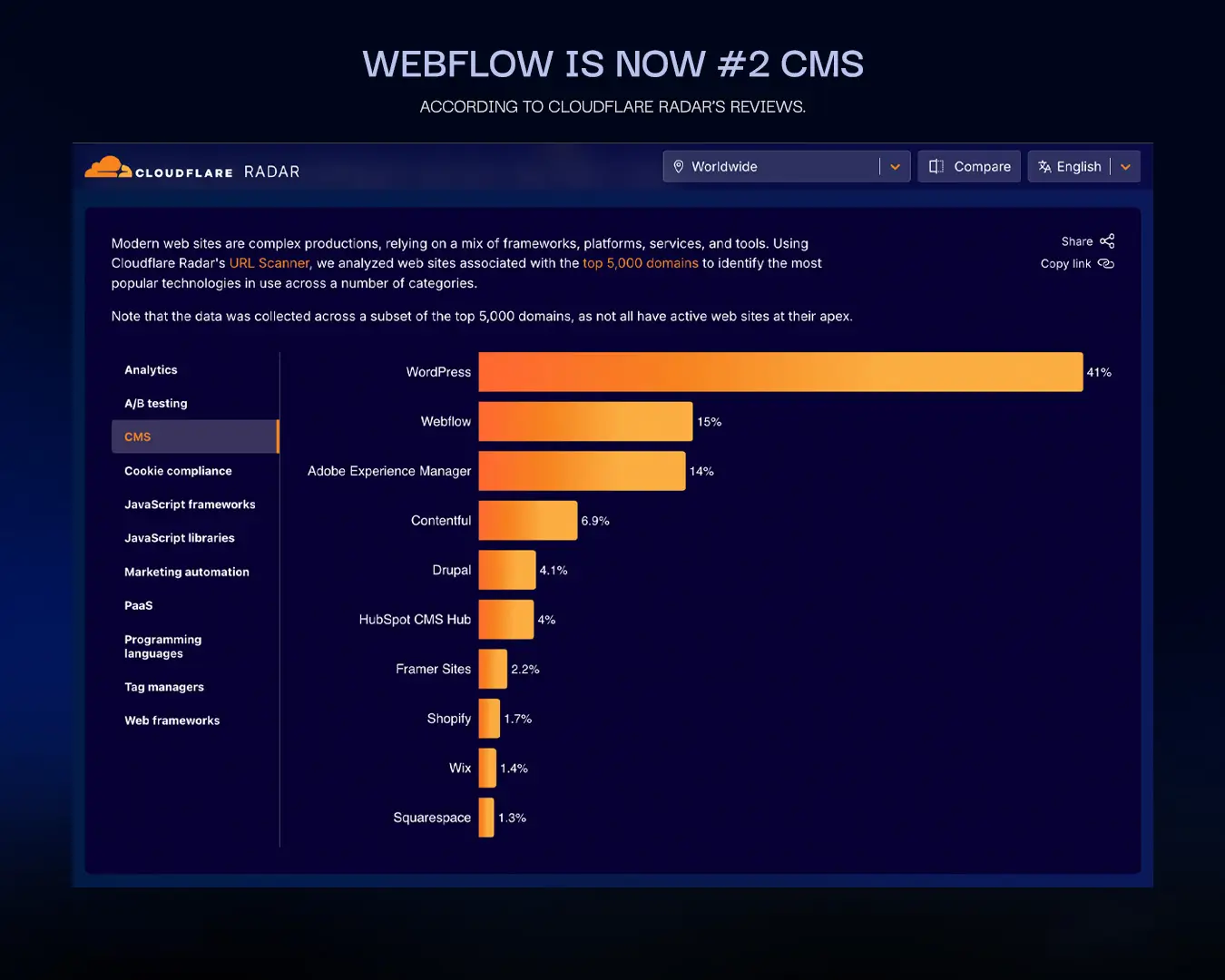
You may fear so many things when deciding to migrate from a WordPress site to Webflow in 2026.
According to Cloudflare Radar’s review, Webflow is now #2 CMS after WordPress. Business are now migrate from WordPress what this year reviews clearly showing.
Of course, Webflow migration for businesses can feel like a big step, with risks like SEO loss or potential downtime.
Here's the quick overview of what to be concerned and what not to!
1. Loss of SEO rankings and traffic
You won't lose SEO rankings. With proper 301 redirect and SEO metadata preservation, your Google ranking and traffic will remain the same.
2. Broken links or 404 errors
Set up a comprehensive redirect map and test each critical URL. Webflow allows 301 redirects through its hosting settings.
3. Best plugin and checklist
You can use the WP All Export Plugin to migrate WordPress blogs to Webflow. And, obviously, prepare a checklist before migration and launching a new site. So, you won't miss any content, links, or data.
4. Webflow vs. WordPress
Fear of switching to Webflow can be a risk for you? Here's a point you can make migration to the Webflow with more confidence.
Suitable for non-tech users: Even if you and your team aren't familiar with HTML code/ technical excellent– Webflow is an easier-to-manage CMS than WordPress.
More security: Webflow site is much safer as there are no plugin vulnerabilities.
No extra cost: Built-in SEO tools, hosting, and backup that reduce monthly maintenance costs and extra charges.
Read a more in-depth guide on the benefits and challenges of migrating from WordPress to Webflow.
Step-by-Step Guideline on WordPress to Webflow Migration
Are you prepared for migrating a website to Webflow? This migration guide will help you make the switch more effortlessly with practical examples. Let's dive in.
Step 1: Create a to-do list.
Start your migration by creating a “Webflow Migration Checklist” in an Excel sheet.List all the steps you need to follow to successfully migrate your website from WordPress to Webflow.
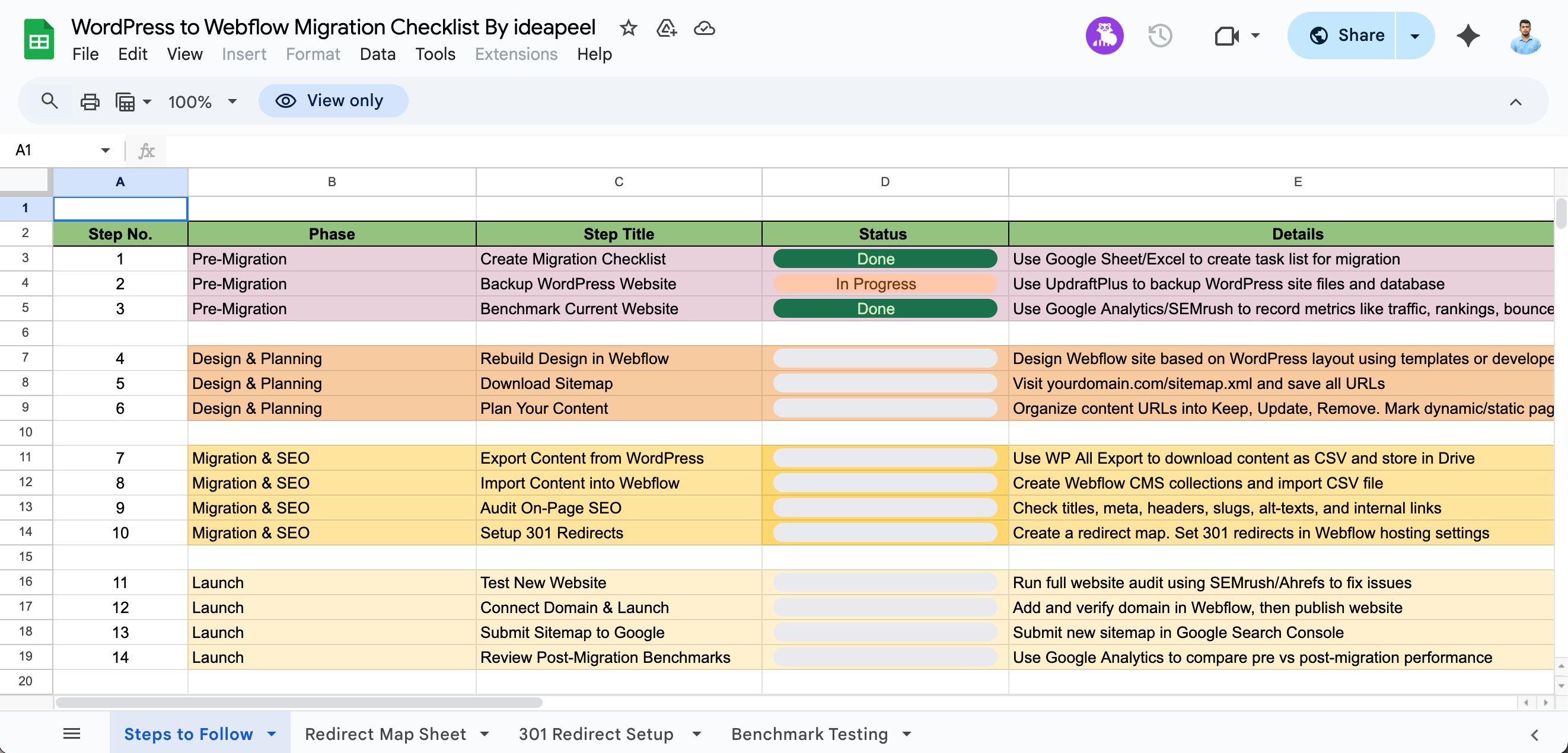
You don't have to work hard. We've already created a a step-by-step checklist to migrate from
WordPress to Webflow, including how to handle redirects and SEO.
Download WordPress to Webflow migration checklist and make a smooth transition.
Step 2: Backup your current WordPress website.
Go to the WordPress website’s Dashboard>Plugin. Download the UpdraftPlus backup plugin tools.
Next, select the “Backup Now” option. Ensure all data is backed up in the database and file.
Click on the “Download to your computer” button. When all is done, jump to the next step.
Step 3: Benchmark your current website.
Before moving from WordPress to Webflow, it's important to keep track of current site performance and metrics. So, you can decide whether the process impacts positively or negatively on your website.
Important metrics of your WordPress site need to be tracked:
- Traffic
- Current Ranking
- Bounce rate
- Time on page
- Conversion
Using Google Analytics is the best option to get all data visuals at a time. You can also use SEMrush/Ahrefs for further details and analysis.
Step 4: Rebuild Design
In this stage, you need to get through WordPress to Webflow redesign. Well, Webflow offers flexible design, customized templates, and dynamic visual elements to keep your website SEO friendly and fresh.
Pro tips: Keep in mind to lay the design as similar to WordPress. So your user will feel the same vibe. Also, upgrade the theme in Webflow which aligns with SEO best practices and your business goals.
Need an expert to keep your web redesign fresh and branded? Get in touch with our Webflow development team.
Step 5: Download the sitemap
It’s another crucial part of the migration process before transferring content to Webflow. Using a sitemap allows you to identify which web pages are currently active on Google!
Go to your existing WordPress website and click on the link address. Here, add /Sitemap.xml after the address.
Example: Webflow.com/Sitemap.xml
You'll see a different web page's sitemap appear on the screen. Click on the URLs and save all of the maps.
Step 6: Planning your content
To do this, copy the URLs from the sitemap, including the web pages, contact, and policy pages. Create a “Google Spreadsheet” and copy all URLs in one column.
Next, categorize the pages with dynamic or static pages.
Dynamic pages are all text pages that are automatically generated by CMS.
Okay, now! Identify the pages you want to keep on a new Webflow site. Now, simply go on to the Google search bar and type “site:Your Domain name.”.
Example: Site: https://Webflow.com
Here, you'll see how many pages of your website are live. Compare it with the total URL you've pasted on the Google spreadsheet. It'll indicate which CMS content is more important to keep to get traffic to migrate from the WordPress website to Webflow.
Step 7: Export content with a WordPress plugin
Create a Google Drive folder to gather all of your existing content on the WordPress site. Including copy images, multimedia, videos, PDFs, and others.
Well, you’ll need to manually convert WordPress to Webflow.Migrate WordPress blog to Webflow CMS using WordPress export plugins.
Install WP All Export.
Now, the content will be exported from WordPress by clicking “Confirm and Run Export.”
Download it as a CSV file.
Step 8: Import content to Webflow
Go to Webflow and create a new collection of items. Import the CSV file here. Ensure all pages in Webflow are organized. Next, map the file inside Webflow.
Step 9: Audit On-Page SEO

Rebuilding a website ensures that on-page search engine optimization doesn't get errors.
Here's a checklist for quick testing:
- Title tags
- Meta description
- URLs
- Heading tags (h1-h3)
- Internal and external links in the content body
- Image file name and alt text
Step 10: Set up 301 redirects
This step is something you have to do properly to complete the migration. Otherwise, your site will go out of search engines!
Whenever visitors go to your old website, this setup is redirected to the new website, ensuring the site is growing without losing traffic.
It's crucial to manage this aspect effectively. Once you purchase a hosting plan, set up 301 redirects first.
Step 11: Conduct testing and finalize.
All of your setup is done. Now, conduct testing to identify any errors in your new website. Use SEMrush or Ahrefs and run a site audit on the subdomain to check for any errors.
Step 12: Connect the domain and launch the website
Purchase a domain and connect the domain to your new Webflow site. Are you ready to publish your website? Click on the “Publish” button. Ensure your website is live on Google and responsive across all screens.
Step 13: Submit a sitemap to Google Search Console
Sitemap allows Google to index your web pages and crawl your website. So, resubmit a sitemap to the Google Search Console and keep counting for organic traffic!
Step 14: Review benchmarks
Last but not least! Review the benchmark comparing the complete scenario before and after migrating to Webflow. Use Google Analytics to get new metrics of traffic, SEO ranking, and bounce rate.
See what progress is actually made with this superb transformation! Also, consider the negative impact and try to recover with patience.
[[last-cta]]
Jump to Webflow from WordPress effortlessly with ideapeel
Find it hard to plan and rebuild the desired website without the hassle of such technical errors?
You need an expert WordPress to Webflow website migration service.
Where to search? Look no further.
ideapeel takes care of the entire migration process—no SEO loss, no missing content, no downtime stress.
Book a free consultation and discuss your migration project with us.
Final Words
It's true! Moving from WordPress to Webflow is a transformative choice for 2026. Whatever you have experienced in the WordPress platform, apply it and scale your business to grow within a new website destination.
So, are you ready to convert your Webflow website into a skyrocket tool that drives revenue? Contact ideapeel and make a switch to Webflow without losing SEO ranking!

Introduction
As we step into 2025, the SaaS (Software as a Service) industry continues to be a driving force behind digital transformation across sectors.
In the ever-evolving technological landscape, Software as a Service (SaaS) remains a cornerstone of innovation and transformation for businesses worldwide.
As we progress into 2025, SaaS products continue to redefine industries by offering flexible, scalable, and cost-effective solutions. From streamlining operations to driving customer satisfaction, SaaS platforms empower organizations to stay competitive and adapt to market demands.
However, as technology advances and customer expectations grow, keeping pace with the latest trends is imperative for SaaS businesses aiming to thrive in this dynamic environment.
Why Monitoring SaaS Trends is Crucial
Understanding and embracing SaaS trends is essential for businesses to unlock their full potential for product development. By staying informed, organizations can:
- Gain a Competitive Advantage: Early adoption of emerging trends enables companies to differentiate themselves in a crowded marketplace.
- Meet and Exceed Customer Expectations: Customers demand innovative, intuitive, and efficient solutions. Keeping up with trends ensures businesses can deliver on these expectations.
- Drive Innovation and Scalability: Staying updated on SaaS advancements fosters growth and innovation while enabling seamless scalability.
- Adapt to Market Changes: The SaaS companies evolve rapidly. Monitoring trends allows businesses to anticipate and respond to market shifts effectively.
Top SaaS Software Development Trends in 2025
AI and Machine Learning Integration
Artificial Intelligence (AI) and Machine Learning (ML) have become indispensable components of SaaS platforms. These technologies allow businesses to enhance user experiences, streamline operations, and make data-driven decisions.
AI-powered personalization is a key trend, with SaaS tool applications leveraging user data to deliver tailored recommendations and services. Predictive analytics, another crucial application of AI, enables businesses to forecast top SaaS trends, anticipate customer needs, and optimize processes. For instance, SaaS platforms in e-commerce use AI to suggest products based on browsing history, while those in healthcare employ predictive analytics to improve patient outcomes.
Moreover, AI and ML drive automation, reducing the need for manual intervention in repetitive tasks. This not only saves time but also minimizes errors, boosting efficiency and productivity across industries.
The Rise of Vertical SaaS
While traditional SaaS platforms cater to broad audiences, vertical SaaS solutions focus on industry-specific needs. This trend is gaining traction as businesses seek specialized solutions that address their unique challenges.
Vertical SaaS platforms offer tailored features and functionalities, making them more relevant and effective for niche markets. For example, a healthcare-focused SaaS application might include telemedicine capabilities, electronic health record (EHR) management, and compliance with healthcare regulations. Similarly, a SaaS solution for the retail sector may provide inventory management, point-of-sale systems, and customer loyalty programs.
By addressing specific pain points, vertical SaaS enhances efficiency and fosters stronger customer relationships, making it a valuable investment for businesses in specialized industries.
Increased Focus on Data Privacy and Security
In 2025, data privacy and security remain top priorities for SaaS providers. As cyber threats grow more sophisticated, businesses must adopt robust measures to protect sensitive information.
Regulations like GDPR (General Data Protection Regulation), CCPA (California Consumer Privacy Act), and HIPAA (Health Insurance Portability and Accountability Act) require strict compliance, prompting SaaS security providers to implement advanced features. Zero-trust architectures, multi-factor authentication, and end-to-end encryption are becoming standard practices.
Additionally, data privacy is no longer just a compliance issue—it’s a competitive advantage. Companies that prioritize user data protection build trust and loyalty, gaining a significant edge in the marketplace.
Enhanced Collaboration Features
The shift toward hybrid work environments has driven demand for SaaS platforms with robust collaboration features. These tools enable teams to work seamlessly, regardless of their location, fostering productivity and connectivity.
Key collaboration features include real-time document editing, video conferencing, task management, B2B, and workflow integration. For instance, platforms like Microsoft Teams, Slack, and Asana have integrated various tools to create unified digital workspaces.
As businesses continue to adapt to hybrid work models, SaaS platforms that prioritize collaboration and communication will play a critical role in ensuring operational success in the global SaaS market.
Edge Computing and SaaS
Edge computing is revolutionizing SaaS by reducing latency and improving performance for real-time applications. Unlike traditional cloud computing, which processes data on centralized servers, edge computing processes it closer to its source.
This trend is particularly impactful for applications requiring immediate data processing, such as Internet of Things (IoT) devices, real-time analytics, and augmented reality (AR) platforms. By leveraging edge computing, SaaS providers can deliver faster, more reliable services, enhancing user experiences and operational efficiency.
Microservices Architecture
Microservices architecture is a modular approach to SaaS development that promotes flexibility, scalability, software solutions, and efficiency. Developers can build, test, and deploy individual components independently with microservices, in contrast to monolithic architectures that tightly integrate all components.
This architecture supports iterative development, enabling businesses to introduce new features quickly and adapt to changing user needs. Additionally, microservices facilitate seamless scaling, making them ideal for SaaS platforms with growing user bases.
Sustainability and Green SaaS
Sustainability has become a priority across industries, and the SaaS sector is no exception. Green SaaS initiatives focus on reducing environmental impact through eco-friendly practices and energy-efficient operations.
For example, SaaS providers are adopting carbon-neutral cloud hosting, optimizing data center energy consumption, and incorporating sustainable development processes. These efforts not only contribute to environmental conservation but also attract environmentally conscious customers, enhancing brand reputation and loyalty.
Emerging Technologies Influence SaaS Development
Several emerging technologies are shaping the future of SaaS, offering new possibilities for innovation and growth.
- Blockchain: Blockchain technology enhances transparency, security, and trust in SaaS applications. For instance, blockchain can secure financial transactions, protect sensitive data, and improve supply chain traceability.
- Quantum Computing: Although still in its early stages, quantum computing holds immense potential for SaaS. It promises to revolutionize data processing by solving complex problems at unprecedented speeds, paving the way for groundbreaking applications.
- IoT Integrations: The Internet of Things (IoT) is driving demand for SaaS platforms that support connected devices. These integrations enable real-time monitoring, automation, prediction, and data-driven decision-making across industries like manufacturing, healthcare, and logistics.
ideapeel Activities in SaaS Software Development
At ideapeel, we specialize in creating innovative SaaS solutions that empower businesses to achieve their goals. Our comprehensive range of services includes:
- Custom SaaS Software Development: We design tailored solutions to address specific business needs and challenges.
- AI-Powered SaaS Solutions: Our team integrates advanced AI and ML capabilities to enhance functionality and user experience.
- Cloud Migration Services: Transition your legacy systems to the cloud seamlessly with our expert guidance.
- Data Privacy and Security Implementation: We implement robust security measures to ensure compliance and protect sensitive data.
- Low-Code/No-Code Apps: Accelerate development with intuitive platforms that enable non-technical users to create applications.
- API and Integration Services: Streamline workflows by integrating third-party tools and APIs.
- SaaS UI/UX Design: Our user-centric designs prioritize functionality and aesthetics, ensuring a seamless experience for users.
- Ongoing Maintenance and Support: We provide continuous monitoring, updates, and technical support to ensure uninterrupted operations.
Regional Trends in SaaS Development
The adoption and evolution of SaaS vary across regions, influenced by local demands, infrastructure, and technological advancements.
- Emerging Markets: Countries in Southeast Asia, Africa, and Latin America are experiencing rapid SaaS adoption. Factors such as increased internet penetration and growing digital economies are driving this growth.
- Established Tech Hubs: Regions like Silicon Valley, Europe, and India continue to lead innovation in SaaS development, setting benchmarks for global adoption in the coming year.
- Localization Strategies: SaaS providers are increasingly focusing on several key trends for regional customizations, such as language support and compliance with local regulations, to cater to diverse user bases.
Challenges in adopting new SaaS trends
While embracing SaaS trends in 2025 and beyond offers numerous benefits, businesses often face challenges during implementation:
- Balancing Innovation with Usability: Introducing advanced features without compromising user-friendliness is crucial.
- Managing Costs: Implementing cutting-edge technologies can be resource-intensive, requiring careful budget planning.
- Overcoming Resistance to Change: Employees and stakeholders may resist adopting new tools and workflows, necessitating change management strategies.
How Businesses Can Stay Ahead
To remain competitive in the dynamic SaaS landscape, businesses must adopt proactive strategies:
- Invest in Research and Development (R&D): Staying informed about emerging trends and technologies is essential for innovation.
- Foster Strategic Partnerships: Collaborating with tech innovators and SaaS experts enables businesses to leverage external expertise.
- Embrace Agile Methodologies: Agile approaches facilitate rapid adaptation to market changes and user needs.
- Upskill Teams: Investing in employee training ensures teams are equipped to handle new technologies and workflows.
Must Watch: The Future of the SaaS Market
The SaaS industry is on a trajectory of exponential growth, driven by advancements in AI, blockchain, green technologies, and more. We expect SaaS platforms to dominate enterprise software markets by 2030, offering unparalleled flexibility, scalability, and innovation. Businesses that align with current trends and invest in future-ready solutions will be well-positioned to lead in this evolving landscape.
Conclusion
The SaaS industry in 2025 is brimming with opportunities and challenges. Trends like AI integration, vertical SaaS, trend shaping, edge computing, and sustainability are shaping the future of software development by enabling businesses to innovate, scale, and thrive. By staying informed and proactive, organizations can harness the power of SaaS to achieve their goals.
At ideapeel , we’re committed to helping businesses navigate this dynamic landscape with tailored SaaS solutions. From custom development to ongoing support, we provide the expertise you need to stay ahead in the SaaS industry.

I. Introduction
Which website platform will best drive your success in 2025? The choice is critical; let’s explore the options and find the perfect fit together!
As the demands of businesses and individuals continue to evolve. Websites today must go beyond aesthetics, focusing on performance, functionality, and user experience. Two of the most popular platforms, Webflow and WordPress, cater to diverse user needs, each with its strengths and limitations.
WordPress has long been a favorite for its open-source nature and extensive plugin library. It powers over 40% of the web, making it a trusted choice for businesses and personal projects alike. On the other hand, Webflow, a newer entrant, has gained significant traction due to its design-focused interface and all-in-one platform. This guide provides an in-depth comparison to help you decide which is better suited for your requirements when building a website.
II. Webflow Overview

1. Ease of Use
Webflow is designed with simplicity and accessibility in mind. The platform features an intuitive drag-and-drop builder that enables users to visually design and build websites. This eliminates the need for coding knowledge, making it especially appealing to beginners and small businesses. Users can create a website with complex layouts, animations, and interactions directly in the editor, which automatically generates clean, production-ready code in the background.
Webflow also offers a wealth of learning resources, including video tutorials, documentation, and an active community forum. These tools help users get acquainted with the platform and troubleshoot issues as they arise. Pre-designed templates are available for various industries, allowing users to quickly launch a website while maintaining a professional appearance.
2. Design Flexibility
Webflow is unparalleled when it comes to design freedom. Unlike WordPress, which often requires plugins or coding to achieve complex layouts, Webflow allows users to design websites exactly as envisioned. The platform’s interface is akin to design tools like Figma or Adobe XD, providing a seamless transition for designers accustomed to these programs.
The platform’s design capabilities include custom animations, responsive breakpoints for mobile optimization, and the ability to use CSS-like styling directly in the visual editor. These features empower users to craft unique, visually stunning websites that are not constrained by the limitations of pre-designed themes.
3. Limitations
Despite its many strengths, Webflow has its drawbacks. The platform’s reliance on a proprietary system means users are locked into its ecosystem, with fewer opportunities for customization compared to WordPress. Additionally, Webflow’s pricing structure may be prohibitive for some users, especially those managing multiple websites or requiring advanced features such as CMS hosting or e-commerce.
For developers seeking to integrate third-party tools or APIs, Webflow can be restrictive. While it supports custom code embedding, it lacks the robust integration options available in WordPress. These factors make Webflow better suited for smaller, design-focused projects rather than large-scale, feature-heavy websites.
III. WordPress Overview

1. Ease of Use
WordPress, being one of the oldest and most widely used website platforms, offers a relatively simple setup process. Users can quickly install the software via hosting providers that often include one-click installation options. However, its ease of use depends heavily on the user's technical background. Beginners might find the default WordPress dashboard overwhelming at first due to the array of settings, menus, and options available.
For users who are new to web development, WordPress provides extensive documentation and a vibrant community of developers and enthusiasts who offer support. Beginners can also benefit from free and premium WordPress themes that simplify the process of creating visually appealing websites. These themes often come with pre-built layouts that can be customized to fit individual needs.
While WordPress has a steeper learning curve compared to Webflow, it becomes increasingly manageable with experience. For technically inclined users or those willing to invest time in learning, WordPress remains an excellent platform for building a variety of website builders.
2. Design Flexibility
WordPress is renowned for its design flexibility, enabling users to create anything from simple blogs to complex e-commerce sites or membership platforms. With thousands of free and premium themes available, users can find a starting point that closely aligns with their vision. These themes often come with customization options such as color palettes, font settings, and layout adjustments, allowing users to tweak the design to their liking.
For users seeking more control over their website’s appearance, WordPress supports page builders like Elementor, Divi, and WPBakery. These tools introduce a drag-and-drop editing experience, making it easier to create custom layouts without coding knowledge.
3. Limitations
However, the reliance on themes and plugins can sometimes result in performance issues, especially when multiple third-party tools are used simultaneously. Achieving a highly customized design may also require coding skills or hiring a professional developer, which can increase costs and complexity.
Despite these challenges, WordPress remains a go-to platform for users who prioritize flexibility and scalability. Its ability to adapt to a wide range of design requirements makes it a powerful tool for creating professional and visually appealing websites.
IV. SEO Comparison: WordPress vs. Webflow
1. WordPress SEO
WordPress has long been the go-to platform for SEO, thanks to its extensive plugin library. Tools like Yoast SEO and All in One SEO provide granular control over meta tags, keyword optimization, XML sitemaps, and more. These plugins simplify the process of optimizing a website for search engines, even for users with little technical expertise.
However, WordPress’s SEO strengths are also its weaknesses. The heavy reliance on plugins can lead to a cluttered backend, which can slow down website performance. Additionally, poorly coded or incompatible plugins can create conflicts, negatively impacting SEO.
2. Webflow SEO
Webflow takes a different approach by integrating SEO features directly into its platform. Clean code, fast hosting, and optimized image handling ensure that websites load quickly—a crucial factor for search engine rankings. Webflow also allows users to edit meta titles, descriptions, content management system and URLs without the need for additional tools.
Furthermore, Webflow’s built-in CDN (Content Delivery Network) enhances website performance, ensuring rapid load times regardless of user location. The platform’s attention to performance and scalability makes it a strong contender for businesses aiming to rank higher in search results.
V. Localization Features
1. WordPress
WordPress relies heavily on plugins for localization. Tools like WPML and Translate Press allow users to create multilingual websites, enabling businesses to reach a global audience. These plugins offer features such as language-specific content, automatic translation, and localized SEO settings.
However, advanced features like content synchronization and multi-domain setups often require premium versions of these plugins, increasing costs. Additionally, managing multiple plugins can complicate the workflow.
2. Webflow
Webflow includes built-in localization features, enabling users to create multilingual websites without additional tools. The platform supports language-specific styles, media, website design, and SEO settings, allowing for a seamless user experience. However, Webflow’s localization capabilities are limited to higher-tier plans, which may not be cost-effective for smaller projects.
VI. Third-Party Integrations
1. WordPress
WordPress excels in third-party integrations, thanks to its massive plugin ecosystem. Whether it’s email marketing, analytics, or payment gateways, WordPress supports virtually any tool or service. Users can also leverage advanced automation platforms like Zapier to streamline workflows.
2. Webflow
Webflow provides support for fewer native integrations compared to WordPress. While essential tools like Google Analytics or Mailchimp are simple to connect, advanced functionalities often require custom code embedding. This makes Webflow less flexible for users who rely on extensive third-party integrations.
VII. E-commerce capabilities
1. Webflow e-commerce

Webflow’s ecommerce tools provide an all-in-one solution for small to medium-sized businesses. The platform offers pre-designed templates, seamless Stripe integration, and customizable checkout experiences. It is ideal for users seeking a quick and visually appealing store setup for website creation.
2. WordPress E-commerce (WooCommerce)
.png)
WooCommerce, WordPress’s e-commerce solution, is highly customizable and scalable. It supports a wide range of payment gateways, shipping options, and plugins to enhance functionality. However, setting up and maintaining a WooCommerce store requires technical expertise, particularly for larger businesses.
VIII. Webflow vs. WordPress—(E-commerce Comparison)
IX. Collaboration Features
1. WordPress
WordPress does not have native collaboration tools, requiring users to rely on external platforms like Google Workspace or project management tools for teamwork.
2. Webflow
Webflow supports real-time collaboration, enabling multiple team members to work on a project simultaneously. Features like page branching and version history make it an excellent choice for large teams or agencies.
X. Webflow vs. WordPress—Choose the Right One
XI. Business Considerations for 2025
Businesses in 2025 require platforms that offer speed, security, and scalability. While WordPress remains a strong choice for those prioritizing affordability and flexibility, its maintenance demands can be a deterrent. Webflow, with its modern approach and reduced long-term costs, is well-suited for growth-focused enterprises.
X. Final Thoughts
WordPress and Webflow both have their merits, making them suitable for different needs. WordPress excels in flexibility and affordability, especially for content-heavy projects. Webflow shines in design freedom, collaboration tools, and performance optimization. For businesses aiming to stay ahead in 2025, Webflow emerges as the superior platform.
XII. Webflow vs. WordPress - Cost Comparison
XIII. Performance Comparison: Webflow and WordPress
Webflow:
Speed Optimized Hosting:
Average load time: < 1 second (with optimized Webflow hosting and CDN).
Webflow’s hosting speed is consistently quick due to its integration with CDNs, providing a global reach with minimal latency.
Clean Code:
Code Efficiency: Webflow delivers cleaner code with 50% fewer HTTP requests compared to WordPress sites using multiple plugins. This translates to faster page rendering times.
SEO: Webflow is built with SEO-friendly code, resulting in up to 20% faster page loading and potentially 15% higher rankings in search engines.
Built-in Image Optimization:
Average Image Load Time Reduction: Webflow automatically compresses and optimizes images, leading to an average reduction of image load time by 40% compared to WordPress sites that do not utilize optimization plugins.
Scalability:
Webflow can handle up to 10x more traffic with the same performance levels, especially when compared to WordPress sites on shared hosting plans, which can experience slowdowns during heavy traffic.
WordPress:
Hosting Variability:
On shared hosting, average load time can range from 3-5 seconds depending on the server’s performance.
On premium managed WordPress hosting (e.g., Kinsta, WP Engine), load time averages 1.5-2.5 seconds, which is still slower than Webflow.
Plugin Bloat:
WordPress sites with 10-20 plugins can experience an average 10-20% slower load time, with an increase in HTTP requests of 30-50% compared to plugin-free websites.
Old or poorly maintained plugins can slow down sites by up to 40%.
Code Optimization:
WordPress can add 20–30% more bloat to the code than Webflow, especially for themes or plugins that use excessive or unnecessary HTML, CSS, and JavaScript.
Image Management:
Non-optimized WordPress images can increase loading times by 50–70%. Optimization plugins or manual image compression may reduce this to 20%–30% faster load times.
Scalability Challenges:
Sites on WordPress, especially those using multiple plugins, can see a 40% performance drop when scaling from 10,000 to 50,000 visitors per month unless optimized for performance (e.g., using VPS or dedicated hosting).
XIV. Business Considerations for 2025
Businesses in 2025 require platforms that offer speed, security, and scalability. While WordPress remains a strong choice for those prioritizing affordability and flexibility, its maintenance demands can be a deterrent. Webflow, with its modern approach and reduced long-term costs, is well-suited for growth-focused enterprises.
Webflow or WordPress: Which platform to choose?
Webflow and WordPress ultimately depend on your specific needs, goals, and technical expertise. If you prioritize ease of use, performance, and design flexibility with minimal setup, making differences between Webflow and WordPress is complicated.
Webflow is the ideal choice. Its drag-and-drop interface, built-in SEO, and fast, optimized hosting make it perfect for businesses that need quick deployment, modern designs, and low maintenance. It’s especially suitable for small to medium-sized businesses, portfolios, and e-commerce stores that don't require advanced functionality but focus on aesthetics and performance.
On the other hand, WordPress is a fantastic choice for those who need extensive customization, flexibility and control over their website’s features. With its open-source nature, large plugin ecosystem, and vast community support, WordPress is highly versatile, making it the go-to platform for complex websites, blogs, or businesses that require a highly customizable solution. However, it comes with a steeper learning curve and the need for more maintenance, particularly when dealing with security concerns and plugin compatibility.


Introduction
Did you know that every second, three new websites are launched? That equates to a staggering 252,000 new websites every single day. With such intense competition, staying relevant and eye-catching is more important than ever. The website design landscape is constantly evolving, and 2025 promises a wave of exciting trends that combine cutting-edge technology with user-focused innovation.
To stand out in this crowded digital arena, you need to embrace these trends. From enhancing user experience (UX) to integrating stunning aesthetics, these innovations can help your website not only attract but retain visitors. Let’s dive into the top web design trends in 2025 and explore how they can transform your online presence.
Top Emerging Web Design Trends 2025
1. Dynamic Cursors

Dynamic cursors are transforming navigation into a more interactive and personalized experience. These cursors adapt and change their appearance based on user actions, providing intuitive guidance. For example:
- Purpose: They can highlight clickable areas or signal important interactions, making navigation smoother.
- Design: Dynamic cursors can reflect a website's brand identity, using custom animations and effects to align with the overall aesthetic.
- Caution: While engaging, overuse of effects can distract users. The key is to strike a balance between creativity and functionality.
2. Nature-Inspired Design

Websites in 2025 are embracing the organic, drawing inspiration from nature. This trend emphasizes:
- Organic Shapes: Asymmetrical and irregular shapes replace rigid grids, adding a sense of warmth and approachability to sustainable design elements.
- Applications: Organic elements can enhance layouts, buttons, and visual storytelling, offering a more inviting feel.
- User Impact: These design processes resonate emotionally, making brands appear more human and relatable.
3. Full-Page Headers

Full-page headers, also known as hero sections, are becoming a minimalist design feature. Their benefits include:
- Visual Impact: Bold imagery paired with compelling text grabs attention immediately.
- Clear Messaging: Strategically placed CTAs (calls to action) guide users toward desired actions.
- Storytelling: These headers allow brands to connect emotionally by presenting their narrative visually and textually.
4. Parallax Scrolling
Parallax scrolling enhances user engagement by creating an immersive experience for web development. Key features include:
- Interactive Storytelling: Backgrounds that move slower than foreground elements create depth and intrigue.
- Engagement: This technique captivates users and encourages them to explore more.
- Optimization: Ensure smooth animations across all devices to prevent lag and enhance usability.
5. Custom Illustrations

Custom illustrations are a versatile tool to elevate web design trends for 2025. Their benefits include:
- Enhanced Branding: Tailored visuals communicate a brand’s unique personality.
- Simplifying Complex Ideas: Illustrated visuals can break down intricate concepts into digestible content.
- SEO Boost: Engaging digital design keeps users on your site longer, improving search engine rankings.
Webflow Design Color Trends to Watch in 2025

Colors in 2025 reflect a dynamic spectrum of possibilities, with a diverse range of color palettes catering to various design aesthetics and objectives. Here are some key trends and their applications:
1. Bold Hues
Vibrant colors take center stage in 2025. These energetic tones command attention and inspire action to sustainable web design.
- Characteristics: Bright, energetic colors like electric blue, fiery red, and lime green.
- Applications: Perfect for call-to-action buttons, headlines, and promotional elements.
- Examples: Neon pink (#FF0090), solar yellow (#FFD700), cobalt blue (#0047AB).
2. Soft Pastels
Subtle and calming, pastels bring a touch of sophistication. These hues create an elegant, minimalistic aesthetic.
- Characteristics: Muted tones like lavender, baby blue, and mint green offer a serene aesthetic.
- Applications: Ideal for backgrounds, subtle accents, and minimalist themes.
- Examples: Powder blue (#B0E0E6), soft peach (#FFDAB9), mint green (#98FB98).
3. Gradients and Duotones
Depth and movement define the gradient trend. Use these tones to create modern, inclusive design and tech-savvy visuals.
- Characteristics: Blending colors creates depth and a tech-savvy feel.
- Applications: Best for hero sections, overlays, and dynamic visuals.
- Examples: Purple to pink (#6A0DAD → #FF77FF), blue to turquoise (#1E90FF → #40E0D0).
4. Monochromatic Schemes
Simple yet striking, monochromatic designs focus attention. Use these palettes to emphasize content over design.
- Characteristics: Single-color variations ensure harmony and focus.
- Applications: Suited for minimalist and content-focused eco-friendly design.
- Examples: Grayscale (#D3D3D3 → #4F4F4F), shades of blue (#ADD8E6 → #00008B).
5. Earthy and Neutral Tones
Inspired by nature, these palettes ground designs with warmth. Perfect for brands embracing sustainability.
- Characteristics: Nature-inspired colors like terracotta and sage green create warmth.
- Applications: Perfect for eco-friendly brands and lifestyle sites.
- Examples: Burnt sienna (#E97451), sage green (#B2AC88), sand beige (#F5DEB3).
6. Metallic Finishes
Luxurious and eye-catching, metallic tones exude elegance. Highlight premium features with these reflective hues.
- Characteristics: Luxurious gold, silver, and bronze add elegance.
- Applications: Premium brands and upscale product highlights.
- Examples: Gold (#FFD700), silver (#C0C0C0), rose gold (#B76E79).
7. High-Contrast Pairings
Bold and striking, high-contrast combinations draw attention. These dynamic palettes make a lasting impression.
- Characteristics: Bold combinations like black and yellow make designs pop.
- Applications: Tech sites, sports brands, and modern layouts.
- Examples: Black and yellow (#000000 → #FFFF00), navy and white (#001F54 → #FFFFFF).
8. Translucent and Glass Effects
Futuristic and sleek, glass effects blend transparency and color. Add depth and sophistication to any design.
- Characteristics: Transparent layers with gradients add a futuristic look.
- Applications: Overlays, popups, and modern UI elements.
- Examples: Frosted blue (#E6F7FF with 60% opacity) and smoky gray (#A8A8A8 with 40% opacity).
By incorporating these trends into your digital landscape, you can stay ahead of the curve and create visually compelling websites that resonate with audiences in 2025.
Trends Carried Over from 2024
Some design trends stand the test of time, evolving with new applications and innovations. These are still essential in 2025 for creating impactful, user-friendly websites.
1. Dark Mode
Dark mode continues to dominate as a favorite among users. It offers aesthetic appeal, functional advantages, and a sleek, modern design approach.
- User Comfort: Reduces eye strain, especially in low-light settings.
- Battery Efficiency: Prolongs battery life on mobile devices.
- Customization: Brands can integrate unique palettes within dark themes.
2. Mobile-First Design
With mobile usage at an all-time high, prioritizing mobile-first design is essential. Responsive designs ensure accessibility and engagement across all devices.
- Responsive Layouts: Websites must adapt seamlessly to various screen sizes.
- SEO Benefits: Mobile-friendly designs rank higher in search results.
- Enhanced UX: Simplifies navigation for on-the-go users.
3. Micro-Interactions
Subtle yet effective, micro-interactions enrich user experiences. They add personality to websites while providing valuable feedback.
- Boost Engagement: Keep users entertained and informed.
- Provide Feedback: Confirm actions, such as form submissions.
- Guide Users: Highlight important features or next steps.
4. White Space
Less is more when it comes to white space. This timeless trend ensures clarity and focus, enhancing both aesthetics and usability.
- Improved Readability: Makes text and images stand out.
- Better Navigation: Creates a sense of structure and clarity.
- Mobile Optimization: Ensures uncluttered interfaces for smaller screens.
5. AI Chatbots
AI chatbots are redefining customer service, offering 24/7 support and personalized experiences. They’re an invaluable tool for modern websites.
- 24/7 Support: Instant responses to user queries.
- Enhanced Experience: Guides visitors through the site and assists with purchases.
- Efficiency: Reduces the need for extensive customer service teams.
Advanced Web Design Innovations
Pushing creative boundaries, these advanced techniques are shaping the future of web design. Stand out with futuristic, interactive, and dynamic visuals.
1. Futuristic Gaming Aesthetics
Inspired by gaming UIs, this trend combines immersive elements with modern UI design. Perfect for engaging tech-savvy audiences.
- Immersive Interfaces: Sci-fi-inspired designs with holographic elements.
- Dynamic Interactions: Engaging micro-interactions and 3D visuals.
- Appeal: Perfect for tech-savvy audiences and innovative brands.
2. Window and Shadow Overlays
Add realism and depth to your designs with layered overlays. This trend creates tactile visuals that captivate users.
- Visual Depth: Mimics natural light and shadows for a tactile feel.
- Hierarchy: Creates a structured and layered appearance.
- Elegance: Blends modern aesthetics with organic textures.
3. Glow Effects
Glow effects are dynamic and captivating. They highlight interactive elements, giving websites a futuristic and vibrant look.
- Application: Highlight interactive elements or emphasize brand identity.
- Visual Feedback: Adds responsiveness and energy to interactions.
- Modern Appeal: Reflects advancements in display technology.
4. Flash-Era Nostalgia
This trend revives playful and creative web elements from the early internet, blending retro vibes with modern tools.
- Playful Animations: Dynamic, 3D design, unpredictable interactions.
- Retro Vibes: Blends nostalgia with cutting-edge tools like GSAP.
- Human Connection: Creates engaging, digital interfaces and memorable experiences.
5. Sophisticated Scroll Animations
Scrolling becomes an interactive journey with dynamic animations. Use this trend to tell compelling stories through design.
- Dynamic Content: Elements animate and transform as users scroll.
- Engagement: Encourages exploration and interaction.
- Applications: Ideal for data visualizations and product showcases.
6. AI-Generated Imagery
AI tools are revolutionizing visual creation, offering both efficiency and customization. Perfect for unique, high-quality visuals.
- Cost-Effective Creativity: Generates high-quality images quickly.
- Customization: Tailored visuals for unique brand needs.
- Controversy: Balancing AI tools with traditional design methods.
Preparing Your Website for 2025
Integrating these trends effectively requires strategic planning. Adapt your design to stay relevant and create lasting impressions.
- Align with Branding: Choose trends that enhance your identity.
- Work with Experts: Collaborate with professionals for seamless implementation.
- Stay Adaptive: Continuously monitor performance and update as needed.
Conclusion
The web design trends of 2025 highlight an exciting fusion of creativity, technological advancements, and user-focused innovations. From dynamic cursors and parallax scrolling to bold color palettes and nature-inspired designs, these trends push the boundaries of what’s possible in digital design practices. As competition grows in the digital space, staying ahead requires embracing these changes to captivate users and ensure a seamless experience for making web design.
Whether through immersive storytelling, visually striking animations, or responsive layouts, these trends offer tools to make your website stand out. The adoption of advanced techniques like AI-generated imagery and sophisticated scroll animations further underscores the importance of leveraging cutting-edge tools to maintain relevance.