How Much Does a Website Redesign Cost in 2026? Real Pricing for B2B SaaS Teams



Summarize with Ai





Key Takeaways
Quick answer: In 2026, a full B2B SaaS marketing site redesign from a specialist agency usually costs $10,000 to $40,000. Larger, multi-product sites run $40,000 to $105,000, and enterprise projects can pass $150,000. A landing page or a five-page site can come in at $2,000 to $15,000. The platform is the cheap part: Webflow hosting is only $23 to $39 a month on annual billing. What you really pay for is thinking, design, build and migration work.
Those figures come from published 2026 agency pricing guides, not from one audited survey, so treat them as planning ranges. The rest of this guide explains why two quotes for the same redesign can sit far apart, what each budget buys, and how to check a proposal before you sign it.
In short
- Scope, not page count, sets the price. Templates, integrations, research depth and migration risk matter most.
- Webflow platform fees are small. A Business plan on annual billing is $468 a year.
- The costs people forget are content, redirects, tracking, accessibility and post-launch fixes.
- A redesign should be judged by pipeline, not by looks. Capture your baseline before you start.
Website Redesign Cost in 2026: The Pricing Table
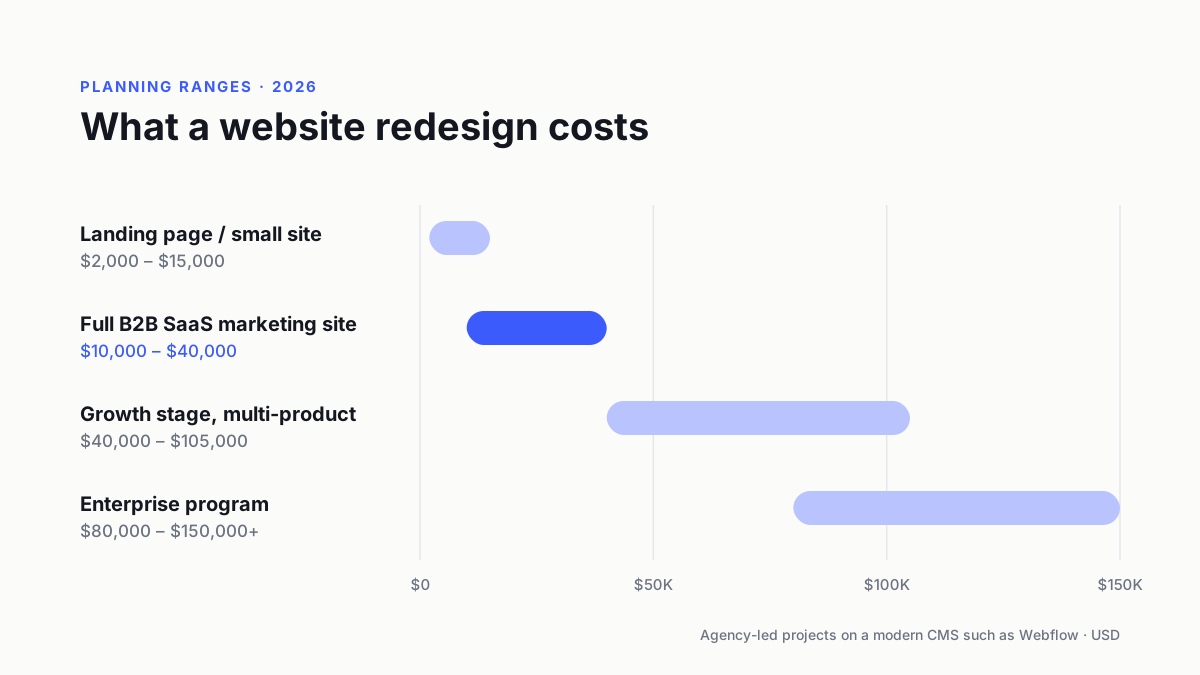
Here are planning ranges for agency-led projects built on a modern CMS such as Webflow. All figures are in US dollars.
How these ranges were built: one agency guide prices a SaaS landing page at $2,000 to $8,000, a small SaaS website at $5,000 to $15,000 and a full SaaS marketing website at $10,000 to $30,000 or more. Another puts a credible, conversion-ready SaaS startup site at $12,000 to $40,000 and a production-grade site for a mid-stage B2B SaaS company at $42,000 to $105,000. The same publisher lists enterprise redesigns at $80,000 to $150,000 or more. A European agency estimate is 25,000 to 70,000 EUR excluding VAT for a serious B2B SaaS marketing site, delivered in 10 to 14 weeks. Timelines in the table are typical, not guaranteed. A separate guide notes that most redesigns take two months or more.
If you see a lower number somewhere, check what it excludes. Template-based small business sites can cost far less, but that is a different product from a B2B SaaS site built around positioning, demos and pipeline.
Why Two Quotes for the Same Redesign Can Be 3x Apart
Take the "full SaaS marketing website" row above. The published range runs from $10,000 to $30,000 and beyond, and both ends are honest numbers. The gap usually comes from four multipliers that a one-line brief never mentions.
1. How many people can say no. A founder who approves design alone moves fast. A marketing lead, a product lead, a sales lead and a CEO each reviewing every round adds revision cycles. Price follows decisions, not pages. If your approval chain is long, ask for a fixed number of review rounds in the proposal.
2. How much thinking comes before pixels. Some agencies start at design. Others run a positioning workshop, competitor review and message mapping first. The second path costs more and tends to produce a site that explains your product faster, which is the real job of a SaaS homepage.
3. How many unique templates you need. A homepage, a product page, a feature page, a use case page, a pricing page, a blog index, a blog post and a resource page are eight templates. Ten more pages built from those same templates cost far less than one more template. Ask for the template count, not just the page count.
4. How risky the migration is. A site with 40 pages and clean URLs is simple. A site with 600 blog posts, old landing pages and years of backlinks needs a redirect map and a content audit. That work is invisible when it goes well and expensive when skipped.
Refresh, Redesign or Rebuild: Which One Are You Really Buying?
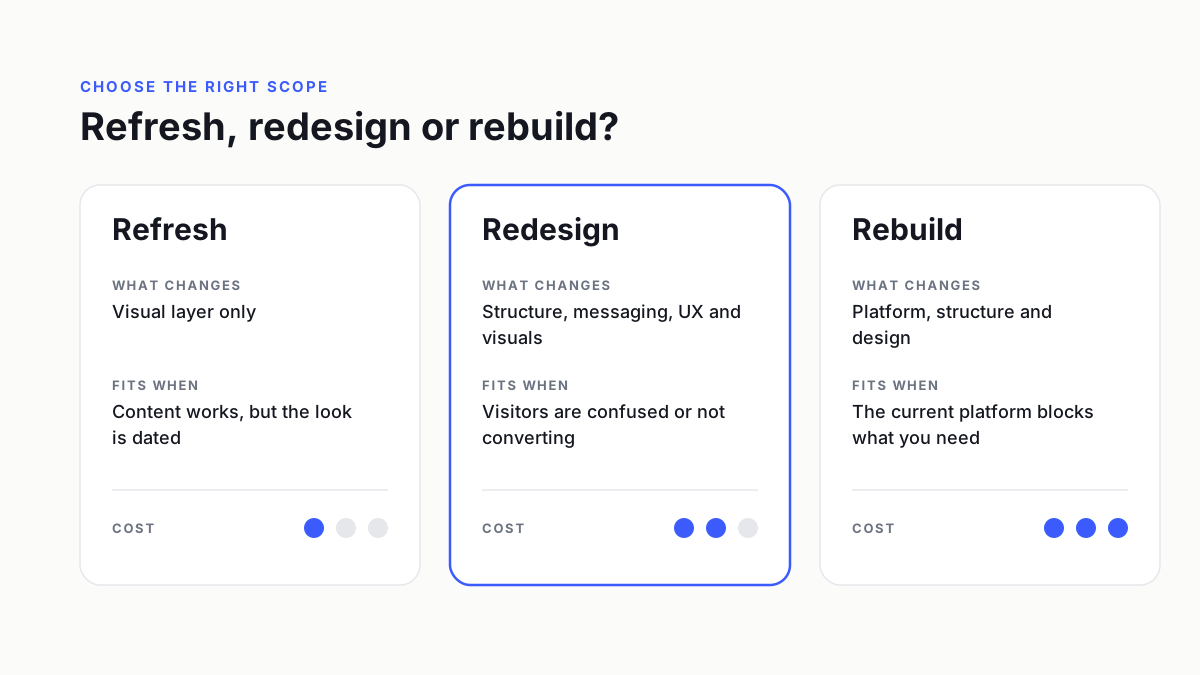
These three words get used as if they mean the same thing. They do not, and mixing them up is the fastest way to compare quotes that cannot be compared.
Here is a quick test. Open your analytics and look at your five highest-traffic pages. If people reach them, stay, and click through to a demo or pricing page, your content is working and a refresh may be enough. If they land and leave, a new skin on the same sitemap gives you a better-looking version of the same conversion rate. That is a redesign problem.
A rebuild only makes sense when the platform itself is the obstacle: you cannot edit pages without a developer, the site is slow because of the stack, or you need CMS structures the current tool cannot support.
B2B SaaS Redesign Budget: What Your Money Actually Pays For
A B2B SaaS site is not a brochure. It has to explain a product, handle skeptical buyers and feed a sales team. Here are the workstreams that usually sit inside a proper quote, and what pushes each one up.
Positioning and messaging. Workshops, competitor review, value proposition and page-level messaging. Costs rise when your product serves several buyer types or you are repositioning.
UX and UI design. Wireframes, visual design, a component system and mobile layouts. Costs rise with the number of unique templates and with custom illustration or product mockups. Our SaaS UI and UX design work follows this same sequence: structure first, then visuals.
Core pages. Homepage, product and feature pages, solution or use case pages, customer stories, about and contact. A pricing page deserves its own line in your plan. It is often the most visited page after the homepage and has the highest buying intent.
Demo and conversion paths. Demo request flows, free trial sign-ups, gated content, calendar booking and form logic. Costs rise with CRM routing, lead scoring and multi-step forms.
Blog and resource center. CMS structure, categories, author pages, related-content logic and reusable article templates. Costs rise when you migrate hundreds of existing posts.
Integrations. CRM, marketing automation, analytics, chat and consent tools. Every integration needs setup, testing and an owner after launch.
SEO migration and QA. URL mapping, redirects, metadata transfer, structured data, performance tuning, accessibility checks and cross-browser testing.
If a quote groups all of this into one line called "design and development," ask for it to be split. You cannot compare two proposals you cannot see inside. [[inner-cta]]
Webflow Redesign Cost: The Platform Is the Small Part
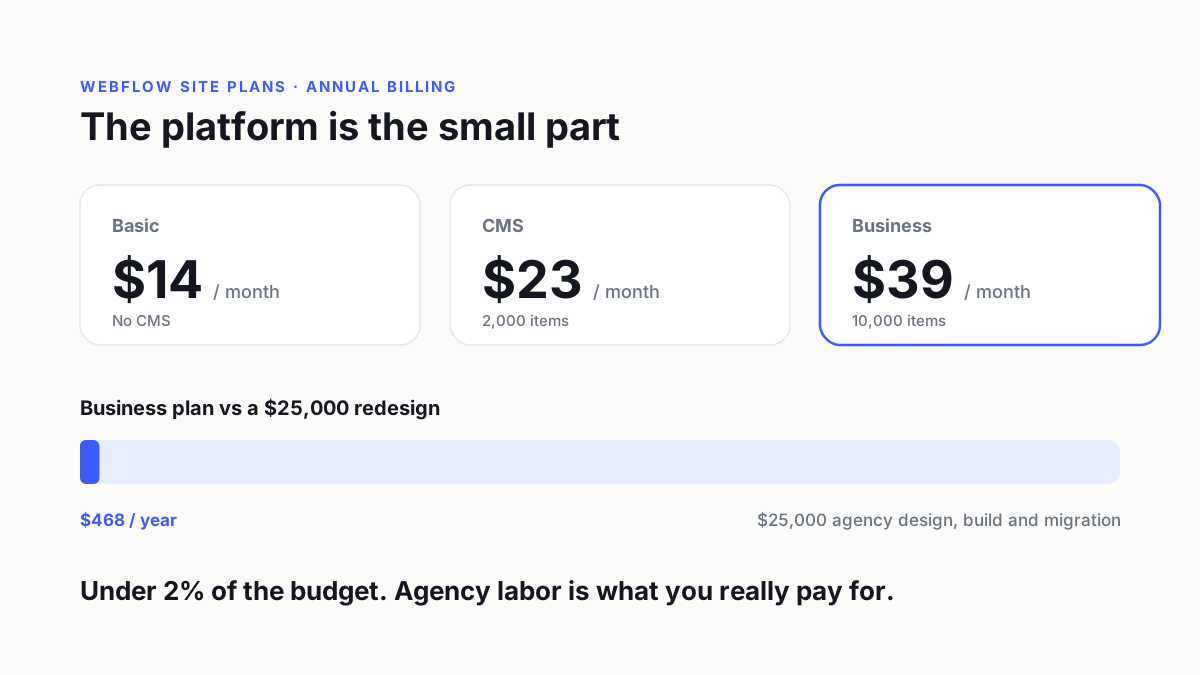
Webflow splits costs into site plans (hosting a live site) and workspace plans (seats for the people building it). For a marketing site you mostly care about site plans. Prices below are for general site plans as listed by Tech.co and confirmed by another 2026 pricing tracker. Webflow changes pricing from time to time, so confirm on the official pricing page before you budget.
The number worth remembering: even the Business plan on annual billing costs $468 a year, which is under 2% of a $25,000 redesign. Platform fees should never drive your decision. Agency labor does.
What you pay the agency for on a Webflow project:
- Design and component planning so your team can edit pages without breaking layouts
- CMS collection setup for blog posts, customer stories and any other repeating content
- Interactions and animation, kept light enough that pages still load fast
- Redirects, metadata, sitemap and analytics setup
- Handover training so your marketers can ship pages without a developer
A Webflow redesign is a strong fit when marketing needs to move without engineering tickets and your site is mostly content. It is a weaker fit when the site is really a web app, needs heavy custom back-end logic, or must live inside an existing engineering stack. If you want help weighing that, our Webflow development service page explains how we scope it.
The Costs That Never Show Up in the First Quote
Most budget overruns are not caused by bad agencies. They come from work nobody priced on day one.
- Copywriting and content. If the proposal assumes you will supply final copy, plan for the time and cost of writing it. Late content is a common reason launches slip.
- Redirects and technical SEO. Google says 301 and other permanent redirects do not cause a loss in PageRank, but someone has to build and test the map. For domain changes, Google recommends keeping redirects for at least 180 days, and longer if you still see traffic through them.
- Accessibility. WCAG 2.2 is the current W3C standard. The European Accessibility Act has applied since June 28, 2025 and focuses on consumer-facing services such as e-commerce, so a B2B-only SaaS site may fall outside it. Check with a lawyer, but building to WCAG 2.2 AA is still the safest target and costs less when planned from the start.
- Tracking. Forms, demo events, UTM handling and CRM attribution need to work on launch day, or you lose your first weeks of data.
- Integrations that grow. A CRM sync that looks simple often turns into field mapping, duplicate handling and routing rules. Ask what happens when the scope grows.
- Maintenance. A common agency rule of thumb is 15% to 20% of the build cost per year for upkeep. That figure fits custom code stacks better than a managed Webflow site, where hosting and security patches are handled by the platform. Budget for content updates, new pages and conversion tests instead.
- Contingency. Set aside 10% to 15% of the project budget for scope changes. It is a common planning habit, not a law, but it keeps one surprise from stalling the whole project.
Will a Redesign Hurt Your Google Rankings and AI Search Visibility?
It can, and Google says so. In its site move guidance, Google notes that combining a move with a redesign of content and URL structure will probably cause some traffic loss while pages are reassessed. The fix is not to avoid redesigning. It is to change URLs only when you have a reason, map every important old URL to its new home, and watch Search Console after launch.
What about AI search? Google's own guidance on AI features and your website says no special optimization is required to appear in AI Overviews and AI Mode, that normal SEO fundamentals still apply, and that no special schema.org markup is needed. It also explains that these features may use a query fan-out technique, issuing several related searches across subtopics to build one answer.
For your budget, that has three practical meanings:
- Be wary of an "AI SEO" or "GEO" add-on priced as a separate miracle. The work that helps is the same work that always helped: clear page structure, crawlable text, accurate facts and strong internal links.
- Write pages that answer related questions, not just one keyword. Fan-out means a page about pricing may also be matched against questions about timelines, hidden costs and alternatives. Make each section understandable on its own.
- Keep important facts in real text. Pricing, specs and definitions inside images or scripts cannot be quoted by search or answer engines.
Performance matters too. Google's Core Web Vitals guidance sets good thresholds at a Largest Contentful Paint of 2.5 seconds or less, Interaction to Next Paint of 200 milliseconds or less and Cumulative Layout Shift of 0.1 or less. Ask your agency to test against these before launch, not after. [[question-block]]
The Payback Math: How to Know if a Redesign Is Worth It
Do not judge a redesign by whether the team likes the new look. Judge it by pipeline. Start by capturing a baseline for at least 90 days before the project begins: visitor-to-lead rate, demo requests, qualified opportunities, organic clicks from Search Console and traffic from AI platforms where your analytics can identify it.
Benchmarks vary a lot because every source defines "conversion" differently. One 2026 roundup notes that credible B2B SaaS benchmarks range from 1.1% to 7.6%, with whole-site visitor-to-lead rates around 1% to 2% being normal. Another puts the median B2B SaaS visitor-to-lead rate at 1.5% to 2.5%. Use these as context, not as targets. Your own baseline matters more.
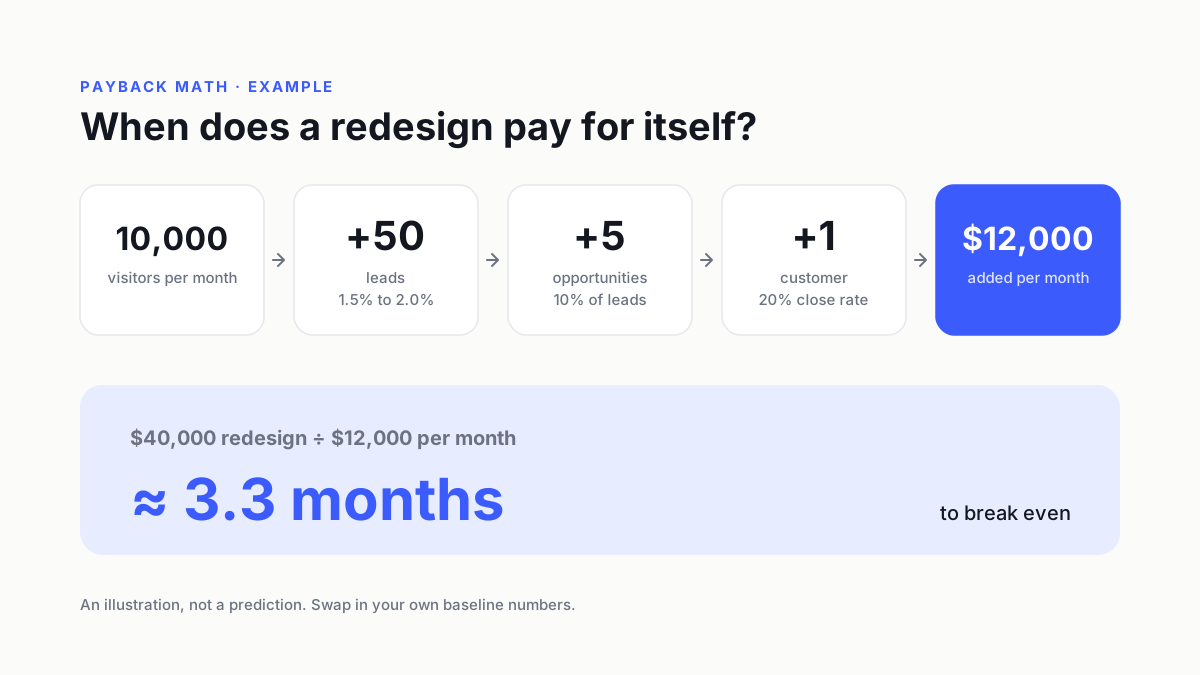
Here is a simple break-even model. The inputs are placeholders. Swap in your own numbers.
In this example, one extra customer per month adds $12,000 of contract value, so the project breaks even in about 3.3 months of uplift. This is an illustration, not a prediction. Real uplift depends on traffic quality, offer, sales follow-up and how weak the old site was. If the model only works with a miracle conversion jump, your budget or your scope is wrong.
Eight Questions That Expose a Weak Proposal
Before you sign, ask every agency the same questions so you can compare like with like.
- How many unique templates are included, and what does an extra template cost?
- How many design concepts and revision rounds are included?
- Who writes the copy, and what happens if content arrives late?
- Is there a redirect map and a post-launch redirect check?
- Which integrations are in scope, and who owns them after launch?
- How will accessibility and Core Web Vitals be tested?
- What training and handover do we get, and for how long is support included?
- What is excluded from this price?
An agency that answers these clearly, in writing, is usually one that has run the project before. If you want to see how we answer them, browse our recent project work or start a project inquiry.
Final Thoughts: Plan Your Redesign Around Business Goals
The right budget is not the lowest quote or the highest. It is the one that matches your goal, your approval process and the real size of your site. Count your templates, list your integrations, set a baseline, and ask every agency to show what is inside the price.
If you want a second opinion on scope or a transparent estimate for your B2B SaaS site, talk to ideapeel. We design and build on Webflow for SaaS and technology teams, and we will tell you plainly if a refresh is all you need.
Will a redesign lower my Google rankings?
It can, especially if URLs change. Google says combining a redesign with URL changes can cause some traffic loss. Careful redirect mapping, preserved content intent and monitoring in Search Console reduce the risk.
References
- Orbix Studio, SaaS Design Agency Pricing in 2026
- ParallelHQ, Website Design Prices
- ParallelHQ, How Much Do Web Design Services Cost in 2026
- ParallelHQ, Website Design Pricing
- Kolonell, B2B SaaS marketing site and pricing page redesign cost (2026)
- Lean Labs, How much does a website redesign typically cost
- Launch Codex, How much does a website redesign cost
- Tech.co, Webflow pricing
- TemperStack, Webflow pricing (April 2026)
- Webflow, Official pricing page
- Google Search Central, Site moves with URL changes
- Google Search Console Help, Change of Address tool
- Google Search Central, AI features and your website
- web.dev, Web Vitals
- W3C, Web Content Accessibility Guidelines 2.2
- EUR-Lex, Directive (EU) 2019/882, European Accessibility Act
- Docket, B2B SaaS website conversion rate benchmarks (2026)
- SaaS Hero, 2026 B2B SaaS conversion metrics
[[last-cta]]
Enter your website URL to receive a detailed website analysis report in just 5 minutes!

How much does a B2B SaaS website redesign cost?
Most B2B SaaS marketing sites land between $10,000 and $40,000. The price rises with the number of unique templates, CRM and marketing integrations, research depth, and how many existing pages must be migrated.